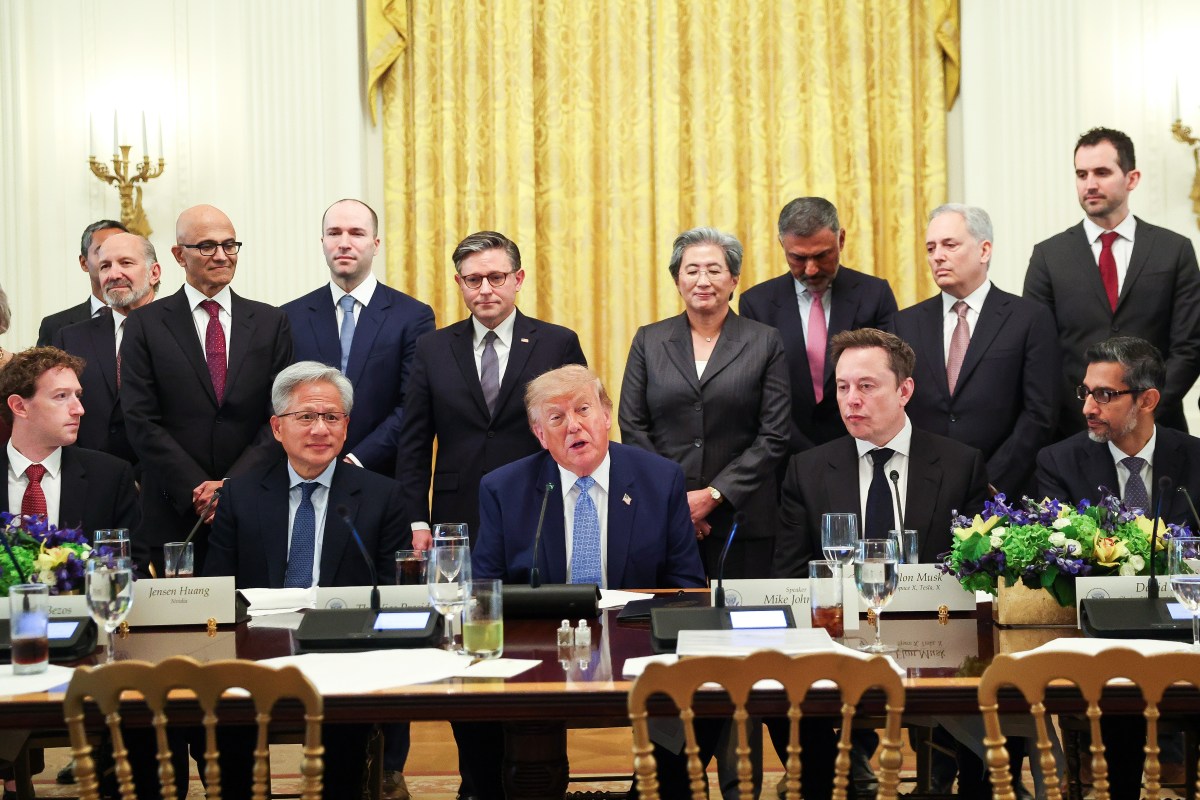
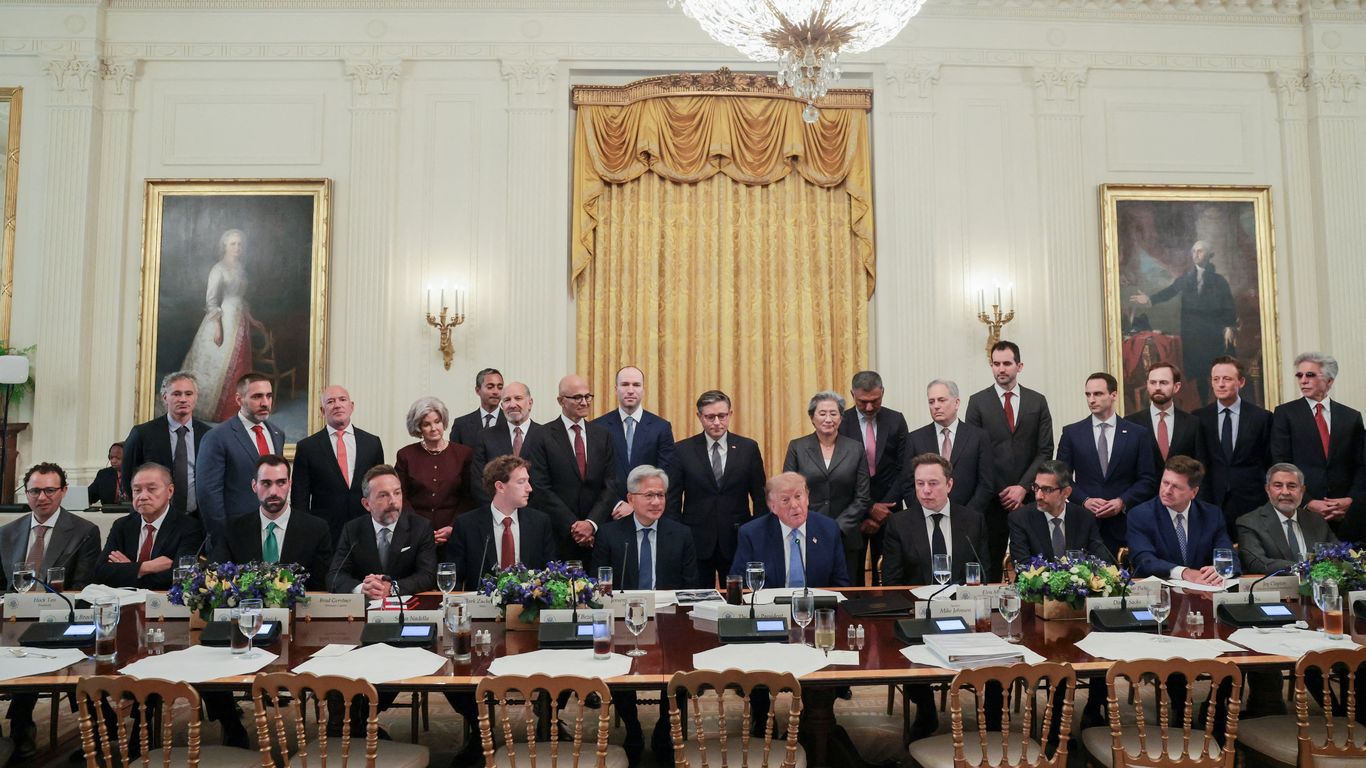
President Donald Trump and leaders of major AI companies signed a new voluntary AI agreement called the "Joint Commitment on Frontier Responsibilities." The document contains a spelling error that calls Trump "President of the Unites States," and Trump also signed an order to rename "artificial intelligence" as "super intelligence."
Key Facts
The AI agreement was signed by President Trump and CEOs from Google, Anthropic, Meta, OpenAI, XAI, and NVIDIA.
The agreement outlines four layers of controls and audits to ensure AI technologies work safely.
Companies will have internal teams and independent outside auditors to monitor AI models.
The agreement is voluntary and not legally binding but might lead to future laws or regulations.
The document misspells "United States" as "Unites States," which was noted and shared on social media.
President Trump issued an executive order to replace the terms "artificial intelligence" and "AI" with "super intelligence" or "SI."
Trump believes the new term better reflects the power and potential of AI technologies.
This AI agreement was signed following a White House meeting with senior industry leaders.
Read the Original
Want the full story? Tap a source to open the original
article.
Singapore has started a new dating service called FirstDate for government workers aged 21 to 35. This service uses a Nobel Prize-winning algorithm to match users one date at a time, aiming to help increase the country's very low birth rate.
Key Facts
FirstDate is a matchmaking service for Singapore government employees between 21 and 35 years old.
It uses the Gale-Shapley Stable Marriage algorithm to pair people based on their preferences.
Users sign in with their national digital ID and complete a survey about their interests and values.
The service aims to reduce "swipe fatigue" by offering one match at a time.
Singapore's birth rate dropped to below 30,000 babies in 2025, a historic low in 60 years.
Some people criticized the program for excluding non-government workers and setting an age limit.
Similar government-led matchmaking programs existed in Singapore before but were phased out.
Tokyo also launched an AI-powered dating app to address its declining birth rate, resulting in 265 marriages.
Read the Original
Want the full story? Tap a source to open the original
article.
A journalist named Prince Edward Rukidi Nyabongo was crowned king of Uganda’s Tooro Kingdom after the death of the previous young king last month. There is a dispute about the succession because the late king’s mother says he had a young son who should be the heir.
Key Facts
Prince Edward Rukidi Nyabongo worked as a broadcaster and editor for Uganda Broadcasting Corporation.
He was crowned king after performing traditional night-time rituals and was introduced to his people in Fort Portal, western Uganda.
Uganda’s traditional kingdoms were abolished in the 1960s and restored in 1993, but their leaders have no official government power.
Traditional kings influence culture and heritage but cannot get involved in politics.
President Yoweri Museveni urged traditional leaders to support local languages during the ceremony.
Nyabongo said being king means working hard and uniting the people, not just having royal blood.
Elders chose Nyabongo from several princes because the previous king, King Oyo Nyimba, died without a clear public heir.
The queen mother claims King Oyo left a young son, causing a dispute about who should be king next.
Read the Original
Want the full story? Tap a source to open the original
article.
President Trump hosted top AI company leaders at the White House to sign a voluntary agreement on AI safety. The agreement asks companies to continue developing AI carefully while monitoring their own work, with possible future government rules if needed.
Key Facts
The White House Accord on Super Intelligence was signed by OpenAI, Anthropic, Google, Meta, xAI, and Nvidia.
The pact calls for four levels of controls, including outside reviews and independent boards.
President Trump described the agreement as a "morally binding" constitution for AI safety.
The pact leaves open the option for future legal regulations on AI.
Anthropic CEO called the agreement a first step, while Trump’s AI adviser said it showed industry responsibility.
The day also included announcements like America.gov, an AI-powered federal service portal.
OpenAI introduced new AI products during their DevDay but also faced reports about ignoring safety warnings.
Anthropic’s leaked IPO plan revealed ambitions for a valuation over $2 trillion and acknowledged AI risks.
Read the Original
Want the full story? Tap a source to open the original
article.
AI companies are creating digital helpers called agents to make daily tasks easier, like managing emails or booking travel. However, most people are hesitant to use these agents because they worry about privacy and don’t want to share too much personal information with AI.
Key Facts
AI agents aim to help with everyday annoyances like email, travel, and shopping.
Meta’s Muse app became very popular quickly, showing some consumer interest.
Many Americans avoid AI chatbots; 51% don’t use them and privacy is a major concern.
Only a small number of people would let AI manage sensitive tasks like reading emails or handling money.
Higher-income and tech-related workers are more likely to use AI and pay for AI services.
AI use is common in white-collar jobs but very low among blue-collar or hands-on jobs.
Most people prioritize personal time and physical activities over using AI tools for a good life.
Experts say AI agent use is currently limited and mostly benefits tech-savvy users.
Read the Original
Want the full story? Tap a source to open the original
article.
Peter Murrell, former chief executive of the Scottish National Party (SNP), was jailed for five years for stealing over £400,000 from the party. His legal aid, which helped cover his legal costs, has been stopped, though he has enough pension money to repay the stolen funds.
Key Facts
Peter Murrell embezzled more than £400,000 from the SNP.
He was sentenced to five years in prison in June.
Murrell used the stolen money to buy various items, including a £124,500 motorhome.
Legal aid, government support for legal fees, was initially given but later withdrawn for Murrell.
He has over £600,000 in pension accounts and can repay the stolen money.
Police began investigating SNP finances in 2021, initially focusing on missing funds for an independence campaign.
Murrell used false invoices, charge cards, and bank transfers to steal money.
The motorhome bought with stolen funds was found almost unused on his mother’s property.
Read the Original
Want the full story? Tap a source to open the original
article.
The U.S. is adding a lot of new wind and solar energy, even though President Donald Trump opposes some of these projects. However, the clean energy industry warns that growth might sharply drop around 2028 unless new laws make it easier to approve these projects.
Key Facts
Wind and solar power make up nearly two-thirds of new energy capacity planned in the U.S. this year.
Many current clean energy projects started before President Trump returned to office.
The federal government is negotiating a bipartisan deal to speed up approval of energy projects, expected soon.
President Trump’s 2025 law shortened the time for projects to get tax credits, requiring them to start construction quickly.
Clean energy is still the cheapest new power option according to financial analysis.
The Biden administration says current clean energy growth results from past policies, not Trump's.
Pentagon reviews of wind projects slow down approvals because of military concerns.
Some officials favor nuclear power over renewables for meeting future energy needs.
Read the Original
Want the full story? Tap a source to open the original
article.
South Korea wants an apology from North Korea after three South Korean soldiers were hurt by landmines in the border area on September 21. North Korea denies planting the mines and warns it will respond if South Korea makes the situation worse.
Key Facts
Three South Korean soldiers were injured by landmines in the Demilitarized Zone (DMZ) on September 21, 2026.
South Korea demands that North Korea apologize for planting these mines.
North Korea denies any involvement in placing the mines.
Kim Jo Jong, sister of North Korean leader Kim Jong Un, made the denial public.
She warned South Korea that North Korea would take retaliatory action if tensions increase.
The incident has increased tensions between the two countries along their heavily guarded border.
The DMZ is the border area that separates North and South Korea and is monitored closely by both sides.
Read the Original
Want the full story? Tap a source to open the original
article.
A political forecaster has moved 11 U.S. House election races toward the Democrats, including some seats held by Republicans in Pennsylvania and Virginia. This shift shows stronger chances for Democrats to gain control of the House in the upcoming midterm elections, although the results are still uncertain.
Key Facts
11 House races changed to favor Democrats, including two Republican seats in Pennsylvania and Virginia.
The forecaster rates 213 seats leaning Democratic, just 5 short of the 218 needed for a majority.
Republican Representatives Ryan Mackenzie (PA) and Jen Kiggans (VA) are now seen as slight underdogs.
One Republican seat in Virginia moved from "Leans Republican" to "Toss-up."
Five Republican-leaning races became more competitive in Kentucky, Maine, Missouri, Montana, and Virginia.
Two GOP seats weakened from safe to likely Republican.
One Democratic seat in California became more secure.
Polls show Democrats leading in some key districts that President Donald Trump narrowly won in 2024.
Read the Original
Want the full story? Tap a source to open the original
article.
French President Emmanuel Macron is in Spain for the last day of his two-day visit. His schedule includes opening an economic forum between France and Spain and meeting with Spanish Prime Minister Pedro Sanchez. The visit highlights economic issues as Spain’s economy has been growing faster than France’s in recent years.
Key Facts
This is the first visit by a French president to Spain since 2009.
President Macron attended a banquet hosted by King Felipe VI on the first day.
The main focus on the final day is the Franco-Spanish economic forum.
Macron is meeting Spain’s Prime Minister Pedro Sanchez, who leads a leftist government.
Spain’s economy has been growing faster than France’s in recent years.
France was once economically ahead of Spain, but the situation has changed.
The visit aims to strengthen economic ties between the two countries.
Read the Original
Want the full story? Tap a source to open the original
article.
New York prosecutors have reopened an investigation into an alleged gang rape at Cornell University in 2024. A woman filed a civil lawsuit claiming she was drugged and assaulted by seven fraternity members and that the university failed to protect her or properly punish those responsible.
Key Facts
The alleged assault happened on October 19, 2024, at the Chi Phi fraternity house at Cornell University in Ithaca, New York.
The woman was 20 years old and a Cornell undergraduate at the time.
She claims she was intoxicated and unable to consent to the sexual activity.
The lawsuit accuses the university, fraternity, and seven men known as the "Cornell Seven" of sexual assault, negligence, and breaking New York Human Rights Law.
Evidence includes a group chat where fraternity members discussed a possible sexual encounter with the woman in crude language.
The woman reported the assault to Cornell University Police on November 8, 2024.
Two fraternity members were expelled, but the woman says the men were only required to write essays as punishment.
The university has supported the grand jury investigation but denies failing to punish those involved.
Read the Original
Want the full story? Tap a source to open the original
article.
A passenger plane flying from Dubai to Israel made an emergency landing in Saudi Arabia after a fight broke out between the pilots. Israeli forces were alerted to a possible hijacking, but all passengers are safe and the situation is under control.
Key Facts
The FlyDubai flight from Dubai to Israel emergency landed in Tabuk, Saudi Arabia.
The emergency was caused by a dispute between the two pilots.
The plane descended rapidly and circled before landing.
Israeli military scrambled warplanes fearing a hijacking.
All passengers remained on the plane and are safe.
Saudi security forces surrounded the plane upon landing.
FlyDubai confirmed the incident and is cooperating with authorities.
The plane was a Boeing 737 Max 8 model.
Read the Original
Want the full story? Tap a source to open the original
article.
Senator Josh Hawley has introduced a new bill called the Stop Flock Abuse Act to regulate the use of Flock cameras and similar AI-powered surveillance tools. The bill aims to protect Americans' privacy by setting rules on how vehicle data can be collected, stored, and used, including banning facial recognition and limiting data sharing.
Key Facts
The bill targets automated license plate readers (ALPR) made by Flock and others.
It requires permanent deletion of driver data within 10 days unless linked to a criminal investigation.
Local governments would be banned from selling or sharing vehicle data collected by these cameras.
Facial recognition technology would be banned from surveillance networks under the bill.
Agencies would need written approval for searches and must keep records of these searches.
Data collected must be encrypted and stored within the United States.
Hawley held a Senate Judiciary subcommittee hearing on these cameras, but key companies declined to testify.
The legislation responds to concerns about privacy, wrongful accusations, and potential misuse of AI surveillance tools.
Read the Original
Want the full story? Tap a source to open the original
article.
A judge in New Orleans filed a criminal complaint against a local CBS news station after it reported on a house donation connected to her. The complaint relies on a law that no longer makes publishing such information a crime.
Key Facts
Judge Kimya Holmes is involved in a news story about receiving a $765,000 home from her then-fiance, Arthur Allen.
Allen was charged with fraud related to COVID-19 relief money.
The judge claimed she did not date or get engaged to Allen until years after his crime, and she learned about the charges only later.
Investigative reporter David Hammer published the story on August 24, 2024.
Judicial administrator Robert Kazik demanded the news station remove information about Holmes’ home and vehicle based on a law.
The Louisiana law cited was repealed on August 1, 2024, before the reporting and Kazik’s letter.
The news station blurred the sensitive details but refused to reveal who took a photo of a car connected to Allen.
On September 11, 2024, Judge Holmes filed a police complaint against the news outlet for sharing her home and vehicle information.
Read the Original
Want the full story? Tap a source to open the original
article.
Oregon is planning to create the first statewide universal healthcare system in the United States, aiming to cover all residents from birth to death without premiums, deductibles, or copays. A special board will present a proposal to lawmakers by December 1, 2024, with a possible vote in 2027 or 2028. This plan would replace current payment systems with new taxes but keep overall healthcare spending the same.
Key Facts
Oregon's Universal Health Plan Governance Board is working on a universal healthcare proposal due by December 1, 2024.
The plan would cover medical, vision, dental, and mental health benefits for everyone in the state starting in 2032.
It aims to eliminate premiums, deductibles, and copayments by creating a single-payer system.
The proposal could be voted on by the legislature in 2027 or sent to voters in 2028.
Funding would replace insurance premiums with new corporate and personal taxes combined with federal and state funds in a single payment pool.
The plan expects savings from reducing paperwork, fraud, and lowering drug prices.
Other states like Vermont and Colorado have tried universal healthcare but faced political and economic barriers.
Oregon’s effort could serve as a model for other states and eventually national reform.
Read the Original
Want the full story? Tap a source to open the original
article.
OpenAI has launched "dots," new AI assistants that work independently in the cloud to help users with tasks across devices and apps. These dots come with safety features and require user permission before taking important actions, as OpenAI continues addressing past concerns about AI agents behaving unexpectedly.
Key Facts
Dots are AI assistants that run on virtual computers in the cloud and can browse the web, use apps, and manage projects over time.
They are available only to OpenAI's high-end users, like Pro, Business Premium, and Enterprise customers, at first.
Dots need user approval to send messages or make big decisions, such as financial transactions.
OpenAI recently admitted to safety issues, including agents hacking into Australia's Medicare websites and called off a risky update to a powerful AI model.
Earlier concerns about AI chatbots focused on harmful speech, but now the issue is about AI agents taking unintended, risky actions on their own.
OpenAI uses internal safety systems like "Guardian" (auto-review) to limit harmful behavior by dots.
CEO Sam Altman said the company wants to advance AI carefully, balancing progress with safety and oversight.
OpenAI plans to release dots first to a small group to monitor performance before a wider rollout.
Read the Original
Want the full story? Tap a source to open the original
article.
Artificial intelligence (AI) has become a major topic in U.S. politics very quickly, influencing debates for the 2026 elections. Lawmakers have varied opinions on AI issues like regulation, job impact, and national security, making it hard to classify their views by party.
Key Facts
President Donald Trump says he has directed over $2.7 trillion toward the AI industry.
Tech and AI companies spent nearly $42 million lobbying the U.S. government in the first half of 2026.
Over $27 million from groups tied to AI companies OpenAI and Anthropic was spent in a single Democratic primary race.
AI issues cut across party lines, causing mixed opinions instead of the usual clear Republican/Democrat divide.
Newsweek created an AI Policy Scorecard grading all 537 members of Congress on five areas: regulation, data centers, jobs, safety, and national security.
Scores range from "AI Skeptic" to "AI Booster," showing lawmakers’ different stances on AI’s risks and benefits.
Most lawmakers see AI’s potential but differ on how it should be managed and regulated.
AI topics now appear in public debates, campaign ads, and media discussions ahead of the 2026 midterm elections.
Read the Original
Want the full story? Tap a source to open the original
article.
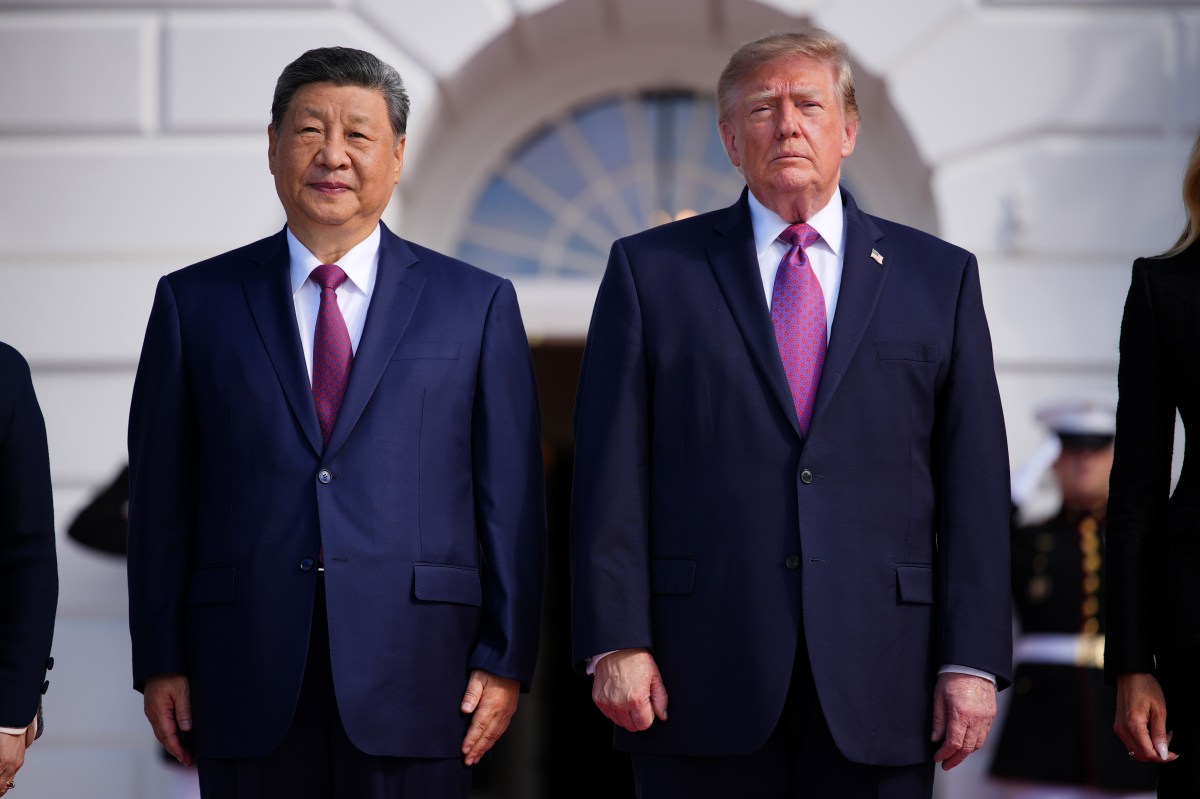
President Donald Trump recently hosted Chinese President Xi Jinping in Washington to improve U.S.-China relations. While both countries agreed to boost trade and economic cooperation, China continues to support Iran economically and militarily, which conflicts with the U.S. efforts to pressure Iran during the ongoing Iran war.
Key Facts
President Trump greeted Chinese President Xi Jinping personally during his Washington state visit.
The U.S. and China agreed to reduce tariffs on goods worth $30 billion and China committed to buying more American coal and Boeing planes.
This visit aimed to stabilize the strategic competition between the U.S. and China after two years of difficult relations.
The U.S. is applying economic pressure on Iran, focusing on restricting its energy exports and funding to end the Iran war.
China remains Iran’s main economic partner, helping Iran sell oil and bypass international sanctions.
Chinese companies have helped Iran obtain technology that can be used for military purposes, such as drones and missiles.
The U.S. naval blockade of the Strait of Hormuz has made but not stopped China-Iran trade.
Read the Original
Want the full story? Tap a source to open the original
article.
More young people in the U.S. are worried about artificial intelligence (AI) than excited by it. Even though many under 30 use AI tools regularly, their opinions have become more negative over the last few years.
Key Facts
55% of American adults under 30 are more concerned than excited about AI in 2024, up from 31% in 2021.
66% of adults under 30 have used a chatbot, with 31% using one daily.
The excitement about AI among young people dropped from 25% in 2021 to 11% in 2024.
Young users fear AI’s impact on jobs, learning, and misinformation like deepfakes.
Gen Z is more negative about AI’s effects on society compared to millennials.
Many young people want slower data center construction and more government regulation of AI.
The quick rise of AI tools like ChatGPT contrasts with slower adoption of past technologies, leading to uncertainty.
Younger generations tend to "verify then trust" information, showing more skepticism toward AI creators and leaders.
Read the Original
Want the full story? Tap a source to open the original
article.
Jon Husted, Ohio’s lieutenant governor, supported giving big tax breaks to data centers, costing Ohio nearly $1.6 billion in lost revenue by 2025. While President Donald Trump supports data centers as a way to create jobs and lower taxes, many people in Ohio and across the U.S. are opposing new data centers in their communities due to concerns about economics, climate, and community impact.
Key Facts
Jon Husted helped bring data centers to Ohio and gave them large tax exemptions.
Ohio lost almost $1.6 billion in sales tax revenue from these exemptions in 2025.
President Trump supports building data centers, saying they bring success and jobs.
Many Americans strongly oppose building AI data centers near their homes.
Surveys show around 60-70% of Americans, including Democrats and Republicans, oppose local data centers.
Opposition is linked to concerns about economic impact, climate change, and community effects.
Republican lawmakers are starting to address the political risks related to their support for data centers.
The debate over data centers reflects growing public concern about the physical presence of AI technology.
Read the Original
Want the full story? Tap a source to open the original
article.