Six months after the United States and Israel launched a military campaign against Iran, the conflict has shifted back to economic pressure. Iran’s leadership has weakened due to targeted attacks, and severe sanctions have deeply hurt Iran’s economy, making survival more difficult.
Key Facts
The US and Israel began a coordinated military campaign against Iran on February 28, following growing tensions after Israel’s war on Gaza in October 2023.
Iran’s Supreme Leader Ali Khamenei was killed early in the campaign, and his son Mojtaba was appointed but has not appeared publicly.
Several top Iranian military leaders were also killed, leading to new appointments focused on loyalty and continuity.
The US has intensified economic sanctions under “Operation Economic Outcast” to cut off Iran’s financial connections worldwide.
Iran’s oil exports dropped from about 1.8 million barrels per day to less than half a million.
Inflation in Iran is nearing 90%, and food prices have doubled compared to last year.
The current economic crisis is worsened by long-standing international sanctions and internal economic weaknesses.
The campaign’s outcome has so far been Iran’s survival but with increasing economic hardship.
Read the Original
Want the full story? Tap a source to open the original
article.
Six months have passed since the United States and Israel started a war with Iran. President Donald Trump expected the conflict to last only a few weeks, but it is still ongoing with no plans for peace talks.
Key Facts
The war between the US, Israel, and Iran began six months ago.
President Donald Trump initially predicted the war would last four to five weeks.
The conflict has continued far beyond that estimate.
President Trump has said the war will go on as long as needed.
There is currently no timetable for restarting peace negotiations with Iran.
The US and Israel are the main countries leading the conflict against Iran.
Discussions about Trump’s accomplishments during the war are ongoing.
The situation remains unresolved with no clear end in sight.
Read the Original
Want the full story? Tap a source to open the original
article.
Six months into the conflict between the United States and Iran, President Trump’s administration has focused on slowly tightening economic pressure on Iran rather than quick military victory. This strategy has reduced Iran’s control over the Strait of Hormuz and damaged its nuclear program, but challenges remain.
Key Facts
The U.S. aims to limit Iran’s economic resources rather than defeat it through rapid military action.
Iran’s ability to control tanker traffic in the Strait of Hormuz has weakened due to U.S. naval pressure and alternative shipping routes.
Iran’s oil exports through the Strait have dropped significantly because of a U.S. blockade.
Iran has used the Strait of Hormuz to disrupt global shipping but is losing its leverage.
The U.S. military strikes in June 2025 damaged Iran’s nuclear capacity, especially its ability to produce weapon-grade materials.
Iran continues to build and protect underground nuclear facilities, raising concerns about its nuclear commitments.
The Trump administration views the conflict as a slow process to gradually limit Iran’s power rather than an immediate win.
Read the Original
Want the full story? Tap a source to open the original
article.
Singapore plans to clear large parts of Maju Forest and Gillman Forest to build new homes. This decision has led to rare public protests and petitions, with many residents and environmental groups concerned about the loss of important natural habitats.
Key Facts
Singapore’s government will clear about 15 hectares (37 acres) of Maju Forest and 10 hectares (25 acres) of Gillman Forest for housing.
Maju Forest is home to endangered species and diverse wildlife, such as long-tailed macaques and critically endangered birds.
Over 60,000 people have signed petitions against the forest clearance.
Public protests and rallies have taken place at Speakers’ Corner, a designated free speech area in Singapore.
This opposition is unusual in Singapore, where development decisions are often made without public debate.
Past public pushback helped preserve part of Dover Forest from being fully developed.
Prime Minister Lawrence Wong recently announced plans for island land reclamation to support industry and defense, which also raised environmental concerns.
Residents and groups are calling for stronger environmental protections and more transparency in planning decisions.
Read the Original
Want the full story? Tap a source to open the original
article.
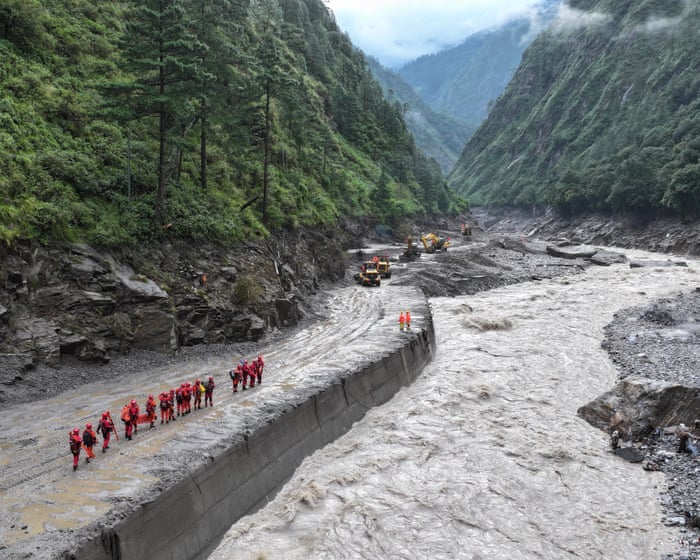
A flash flood caused by a glacier collapse in the Himalayas has killed over 470 people in Nepal and Tibet, with many still missing. Rescue teams face difficult conditions, including destroyed roads and the threat of a nearby unstable lake that could cause more flooding.
Key Facts
At least 469 people have died in Nepal and 3 in Tibet due to the flood.
Around 1,535 people are still missing in both regions.
The flood occurred after a glacier collapsed, sending ice, rocks, and mud down river valleys.
Entire villages, roads, bridges, and hydropower plants were destroyed.
Helicopters are being used to rescue people and deliver aid because roads are washed out.
A barrier lake formed by the disaster holds millions of cubic meters of water and may burst, creating a new flood risk.
Nepal deployed 30,000 security personnel; China sent 500 military and paramilitary staff and its Premier to supervise rescue work.
Nepal has declined international rescue help but asked for financial aid to support ongoing relief efforts.
Read the Original
Want the full story? Tap a source to open the original
article.
The Independent Commission Against Corruption (Icac) is investigating claims that Charles Perrottet planned to damage a political opponent’s career after his brother, Dominic Perrottet, became New South Wales premier in 2021. The inquiry is looking at whether Charles and others took illegal political donations from a property developer to influence political outcomes within the NSW Liberal Party.
Key Facts
Charles Perrottet wrote about plans to harm a Liberal minister’s career shortly after his brother Dominic Perrottet became NSW premier in October 2021.
The phrase “we execute the prick once party room is over” appeared in messages between Charles and his wife Anita Perrottet.
Icac is investigating whether Charles Perrottet and others received illegal donations from fugitive property developer Jean Nassif.
David Elliott, a former Liberal police minister, was allegedly targeted for political damage connected to these donations.
Dominic Perrottet is not named as a person of interest and is not accused of wrongdoing in the investigation.
Anita Perrottet told Icac she could not recall the details or meaning of the controversial messages.
Evidence shows Charles Perrottet and others expected to share $2 million from Jean Nassif.
Elliott was moved from police minister to transport minister and later retired after losing party support and his seat was abolished.
Read the Original
Want the full story? Tap a source to open the original
article.
A police officer in Scotland, Alan Greer, who was later found to be a violent serial rapist, joined the police force despite having criminal warnings on his record. Police Scotland has confirmed they knew about some offenses before hiring him but said current checks would catch such issues.
Key Facts
Alan Greer was investigated in 2002 and 2005 for making inappropriate phone calls to women.
He received a formal police caution from the Metropolitan Police in 2005.
Despite knowing this caution, Strathclyde Police accepted Greer into the force in 2009.
Greer worked as a police officer for 17 years before taking his own life in 2024.
During his career, he committed multiple serious sexual offenses, including rape and assault.
Police Scotland has identified 15 victims but believes the actual number may be higher.
Police Scotland now conducts annual integrity tests and regular re-vetting of officers.
Assistant Chief Constable Lynn Ratcliff said Greer would not pass today’s vetting checks.
Read the Original
Want the full story? Tap a source to open the original
article.
China has warned that a newly formed lake near the Nepal-Tibet border may burst and cause another flood. The lake was created by debris blocking rivers after a glacier collapse caused a deadly flash flood earlier this week.
Key Facts
A recent glacier collapse triggered a flash flood near the Nepal-Tibet border on Wednesday.
A barrier lake holding about 2.5 million cubic meters of water has formed upstream from the flood site.
Officials expect an additional 3 million cubic meters of water to flow into the lake by Saturday.
The lake has started to overflow, raising concerns about a possible breach and a second flood.
Heavy rain has complicated the situation and increased risk levels.
Rescue teams near the Nepal-Tibet border have suspended operations due to safety risks from the overflowing lake.
Nepali authorities warn of potential floods caused by river blockages and advise people to avoid rivers.
Hundreds have died or gone missing in Nepal and Tibet from the initial flood, with many missing on the Tibet side, including foreigners.
Read the Original
Want the full story? Tap a source to open the original
article.
Flood rescue efforts in Tibet have been paused because a lake formed by debris is at risk of bursting. In Nepal, the death toll from the floods has reached 469, with over 1,300 people missing.
Key Facts
Rescue work in Tibet stopped due to danger from a debris-formed lake that might burst.
The floods hit the border area near Gyirong in Tibet, destroying villages and causing flash floods.
Nepal’s death toll from the floods is 469, with more than 1,300 people still missing.
Over 500 foreign citizens are among the missing in Nepal, including individuals from India, the US, Australia, Britain, and Canada.
Chinese media report at least 558 people missing in Tibet, with at least 260 being foreign nationals.
Nepalese army helicopters are trying to rescue about 100 people trapped in a tunnel at a hydropower project.
Rescue efforts are slowed down by destroyed roads and bridges in the mountainous region.
Continued rain is expected to raise water levels in the lake, increasing the risk of further flooding downstream.
Read the Original
Want the full story? Tap a source to open the original
article.
Europe is experiencing a severe drought and high temperatures that are causing rivers and farmland to dry up. This situation is affecting farming, river transportation, and the cooling systems of some nuclear power plants.
Key Facts
Europe is facing record-low water levels in its rivers due to drought and heat.
Farmland is drying out, which can harm crop growth.
Shipping on rivers is being disrupted because of low water levels.
Some nuclear power plants use river water to cool their systems, and this is now a challenge.
The drought and heatwaves are widespread, impacting multiple industries and regions across Europe.
Read the Original
Want the full story? Tap a source to open the original
article.
A dolphin in South Australia died from the H5N1 bird flu virus, the second known native mammal in the area to be infected. Due to concerns about possible mass deaths of elephant seals from the virus, the Australian government is removing researchers from the remote Macquarie Island station to protect their mental health.
Key Facts
A common dolphin near Goolwa, South Australia, tested positive for H5N1 bird flu.
This is the second native mammal in Australia known to catch H5 bird flu, after seals and a red fox.
Researchers will be withdrawn from Macquarie Island, 1,500 km from Tasmania, due to expected seal deaths during breeding season.
The government is concerned about the mental health impact on researchers from seeing many dead seals.
Macquarie Island has large elephant seal populations living close to the research base.
Bird flu has not yet been found on Macquarie Island but is expected to cause a significant seal death event.
South Australia will now confirm bird flu cases through local labs instead of relying on a central government lab.
The government plans to monitor the situation to allow researchers to return in future seasons.
Read the Original
Want the full story? Tap a source to open the original
article.
Six months after the start of the conflict between the United States, Israel, and Iran, the war shows no clear signs of ending soon or causing a collapse of Iran's government. The fighting has led to disruptions in oil shipping routes and increased tensions in the Middle East, with regional countries adjusting their defense and economic strategies.
Key Facts
The war began on February 28, 2026, after surprise attacks by the US and Israel on Iran.
The US hoped economic and military pressure would change Iran’s government, but this has not happened.
Oil shipping through the Strait of Hormuz has slowed significantly due to attacks and a US blockade.
The Gulf states are facing challenges in using oil income to grow their economies because of the conflict.
The US military remains heavily present in the Middle East.
Tensions, such as between Houthi rebels and Saudi Arabia, are expected to continue or worsen.
New military agreements, like one between Turkiye, Pakistan, and Saudi Arabia, show rising regional defense cooperation.
Rival global powers like China and India continue their influence in the region, but their involvement is steady rather than increasing dramatically.
Read the Original
Want the full story? Tap a source to open the original
article.
On the biggest stories we show what the outlets agree on and where they differ. Readers keep that going, and get the daily digest by email every morning. Most choose $3.99/month.
A French-Colombian soldier serving in the French Foreign Legion was kidnapped in early August while traveling in southwestern Colombia. Colombian authorities believe the kidnappers are part of a breakaway faction of the former FARC guerrilla group involved in criminal activities like drug trafficking and illegal mining.
Key Facts
The soldier, Jose Olger Melo Charry, was taken hostage on August 6 in the department of Narino, Colombia.
Melo Charry holds the rank of corporal and joined the French Foreign Legion four years ago.
The kidnappers are believed to belong to Estado Mayor Central, a dissident group from the old FARC rebel army.
FARC officially disarmed in 2016 after a peace agreement, but some factions continue illegal activities.
The boss of the group blamed for the kidnapping is Ivan Mordisco, Colombia’s most-wanted guerrilla leader.
Armed groups in Colombia often kidnap people to get money or pressure the government.
Colombia’s current president, Abelardo de la Espriella, is taking a tougher approach against armed groups with U.S. support.
Peace talks under the previous president, Gustavo Petro, failed to reduce violence from these groups.
Read the Original
Want the full story? Tap a source to open the original
article.
Paramedics in Kanazawa, Japan, ask people not to rearrange their shoes when they enter a home during emergencies. They explain that changing the shoe placement can slow down their work, especially when carrying a patient on a stretcher.
Key Facts
In Japan, it is common to take off shoes when entering a house.
Homeowners usually arrange guests’ shoes neatly facing the door for easy exit.
Paramedics arrange their shoes in a special way so three people can quickly put them on and leave with a patient.
Moving the shoes can cause delays of about 30 seconds, which may affect patient care.
Firefighter Daisuke Yamashita explained the reason for strict shoe placement in a video posted on Instagram.
Many people thanked the emergency services for sharing this advice online.
Paramedics suggest people prepare important documents ahead of time, like the national ID card, to help speed up emergency care.
Some comments suggested that usual manners could be set aside during emergencies if needed.
Read the Original
Want the full story? Tap a source to open the original
article.
The article discusses personal spending habits and focuses on a story about Ella overcoming a shopping addiction. It highlights issues related to managing money and controlling spending.
Key Facts
The article centers on how people can spend too much money on shopping.
Ella is featured as someone who had a shopping addiction.
The story shows how Ella managed to overcome her habit.
The content is connected to personal finance topics.
The article aims to help readers think about their own spending.
It was published recently and is part of money and shopping sections.
The article encourages better money management skills.
Read the Original
Want the full story? Tap a source to open the original
article.
In northern Nigeria’s conservative state of Sokoto, a lively nightlife scene thrives despite strict religious rules, a local morality police, and ongoing security problems. People gather in nightclubs to enjoy music, dancing, and drinks, showing a contrast between the region’s Islamic traditions and modern social life.
Key Facts
Sokoto state in northern Nigeria is known as the “seat of the caliphate” due to its important Islamic history.
The Hisbah force is the local Islamic police that enforces Shariah laws, including dress codes and alcohol bans.
Despite these laws, nightclubs in Sokoto remain busy and popular among locals, especially on weekends.
Partygoers use nightlife as a way to enjoy life and escape the difficulties caused by insecurity and economic problems.
Non-Muslim residents like Vincent Tabat and Benjamin Danjuma openly attend clubs and sometimes face conflicts with the Hisbah force.
Northern Nigeria sits where the population is nearly half Christian and half Muslim, creating complex religious dynamics.
Nightlife in the north contrasts with stricter religious expectations but continues growing.
Experts say nightlife has long existed in Nigeria and now helps people cope with regional challenges.
Read the Original
Want the full story? Tap a source to open the original
article.
Some spiritual teachers are using artificial intelligence (AI) chatbots to offer guidance and answers to people seeking spiritual help. These AI chatbots provide 24/7 access to teachings and advice without judgment, making them more available than traditional human gurus.
Key Facts
People are turning to AI chatbots for spiritual guidance because they can ask questions anytime without feeling judged.
In Hinduism, gurus are important for spiritual growth and liberation, and AI is now used to share their teachings.
AI chatbots use large language models that analyze many texts, including sacred books like the Bhagavad Gita.
Indian guru Jaggi Vasudev (Sadhguru) created an AI feature in his app that answers questions based on his teachings.
American self-help guru Deepak Chopra has an AI platform called “Digital Deepak” that responds using his talks and writings.
Some critics say AI cannot replace the personal experience and ethical guidance of human gurus.
AI tends to agree with users rather than challenge them, which might limit deep spiritual growth.
GitaGPT is another AI platform offering spiritual help using the teachings of the Hindu god Krishna.
Read the Original
Want the full story? Tap a source to open the original
article.
Wildfires in Algeria caused the death of 12 people across several provinces. More than 150 fires started in one day, and most of them have been put out.
Key Facts
Wildfires occurred in multiple provinces in Algeria.
Twelve people died because of the fires.
Over 150 fires started in just one day.
Less than one-third of the fires are still burning.
Residents in Jijel province are examining the damage caused by the fires.
Read the Original
Want the full story? Tap a source to open the original
article.
Each summary links back to the original reporting, so you can check the work. Support that, and get the daily digest every morning. Most choose $3.99/month.
A street artist in Sheffield, Chris Ashmore, has defended his unfinished mural of snooker player Ronnie O'Sullivan after it received mixed reviews from locals and went viral online. Ashmore explained he has only completed part of the work and plans to make adjustments once he has better access.
Key Facts
Chris Ashmore was hired to paint a mural of seven-time world snooker champion Ronnie O'Sullivan.
The mural is on the back wall of the Spot On Snooker Club on Langsett Road in Sheffield.
Some people liked the mural, saying it brightened their day, while others criticized O'Sullivan’s face as looking "skeletal" and "zombie-like."
Ashmore said the mural is unfinished and he has only worked on it for two weeks out of the five weeks allocated.
He painted from scaffolding, which blocked his full view of the mural and affected his perspective.
The mural went viral on social media, leading to both praise and harsh criticism.
Spot On manager Dan Kirkland supported Ashmore and said small changes could improve the mural.
Ashmore plans to finish the mural properly and will not rush despite the social media reactions.
Read the Original
Want the full story? Tap a source to open the original
article.
A large data centre is being built near Amanda Young's home in Newport, Wales, changing the quiet area into an industrial site. The UK is seeing more data centres because they help run many online services and artificial intelligence but can cause noise, traffic, and environmental concerns in local communities.
Key Facts
Data centres are buildings with many powerful computers supporting online services like banking and streaming.
The UK government sees data centres as important national infrastructure.
The new Vantage Data Center Campus in Newport will cover 46 acres with three centres.
Local residents worry about noise, traffic, the look of the data centre, and house prices.
The data centre company says it works with authorities to reduce noise, traffic, and environmental impact.
Campaigners in Cardiff protest plans for another data centre on a key park-and-ride site.
Concerns include effects on local wildlife, water, and the noise from generators and cooling fans.
The company planning the Cardiff site says it has worked with water authorities to avoid problems with water supply.
Read the Original
Want the full story? Tap a source to open the original
article.