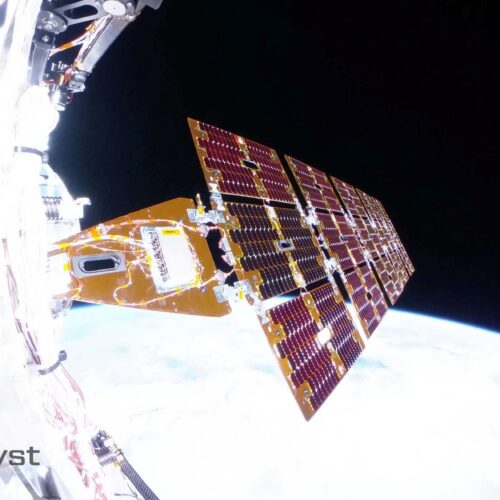
Reaction wheel failures leave Swift rescue mission spinning in orbit
Summary
NASA's Link satellite, launched to help save the Swift gamma-ray telescope by boosting its orbit, is facing problems with its attitude control system. Two of its three reaction wheels have stopped working, causing the spacecraft to spin and disrupting communication, but engineers are working on solutions.Key Facts
- The Link satellite was launched on July 3 to rescue NASA’s Swift observatory, which is at risk of burning up on reentry.
- Link experienced issues with attitude control because two of its three reaction wheels are inoperable.
- Reaction wheels help control the orientation or pointing of a spacecraft.
- Link’s cold gas thruster system, used for fine control, is also partially malfunctioning.
- Electric thrusters on Link, originally meant for orbit raising, are now being used to stabilize its position.
- NASA is paying $30 million to Katalyst Space Technologies to develop and operate the Link mission.
- Swift cannot move itself since it has no propulsion and is about 22 years old, operating well past its planned lifetime.
- NASA views the mission as both a rescue operation and a test of commercial satellite servicing capabilities.
Read the Full Article
This is a fact-based summary from The Actual News. Click below to read the complete story directly from the original source.