Have physicists finally discovered glueballs? New evidence points to yes.
Summary
Physicists using the Beijing Spectrometer III (BES III) experiment have found new evidence supporting the existence of glueballs, which are particles made only of gluons. These findings match theoretical predictions and help explain how mass arises in particles like protons and neutrons.Key Facts
- Glueballs are predicted particles made entirely of gluons, the force carriers that hold quarks together.
- The existence of glueballs is part of the theory called quantum chromodynamics, which explains the strong nuclear force.
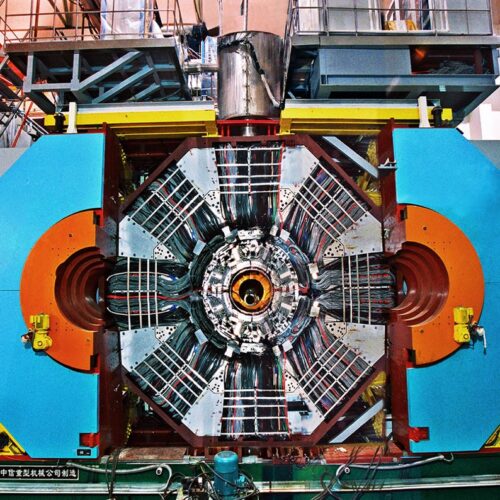
- BES III is an experiment in China that studies particles produced in electron-positron collisions, especially J/ψ particles.
- The X(2370) particle, discovered by BES III in 2011, is a strong glueball candidate.
- New BES III data with over 10 billion J/ψ events allowed physicists to measure X(2370)’s mass more precisely at 2.395 GeV/c², matching theoretical predictions.
- Glueballs must have specific properties like zero spin, no electric charge, and odd parity to fit quantum chromodynamics.
- Discovering glueballs helps scientists better understand the mass of matter beyond the Higgs boson’s role.
Read the Full Article
This is a fact-based summary from The Actual News. Click below to read the complete story directly from the original source.