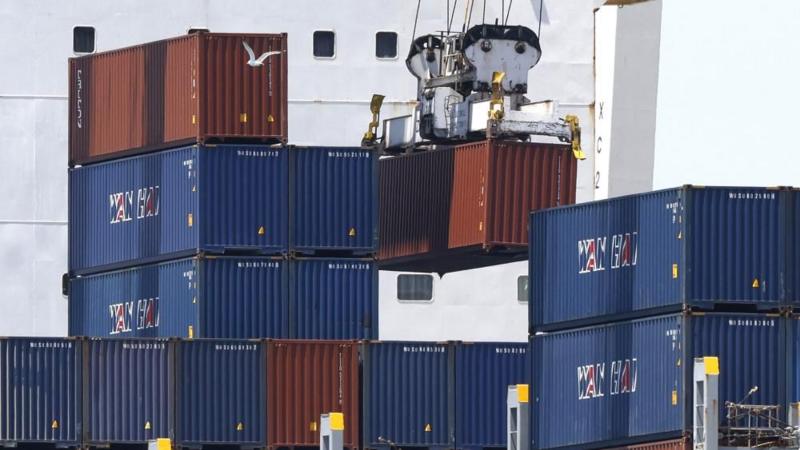
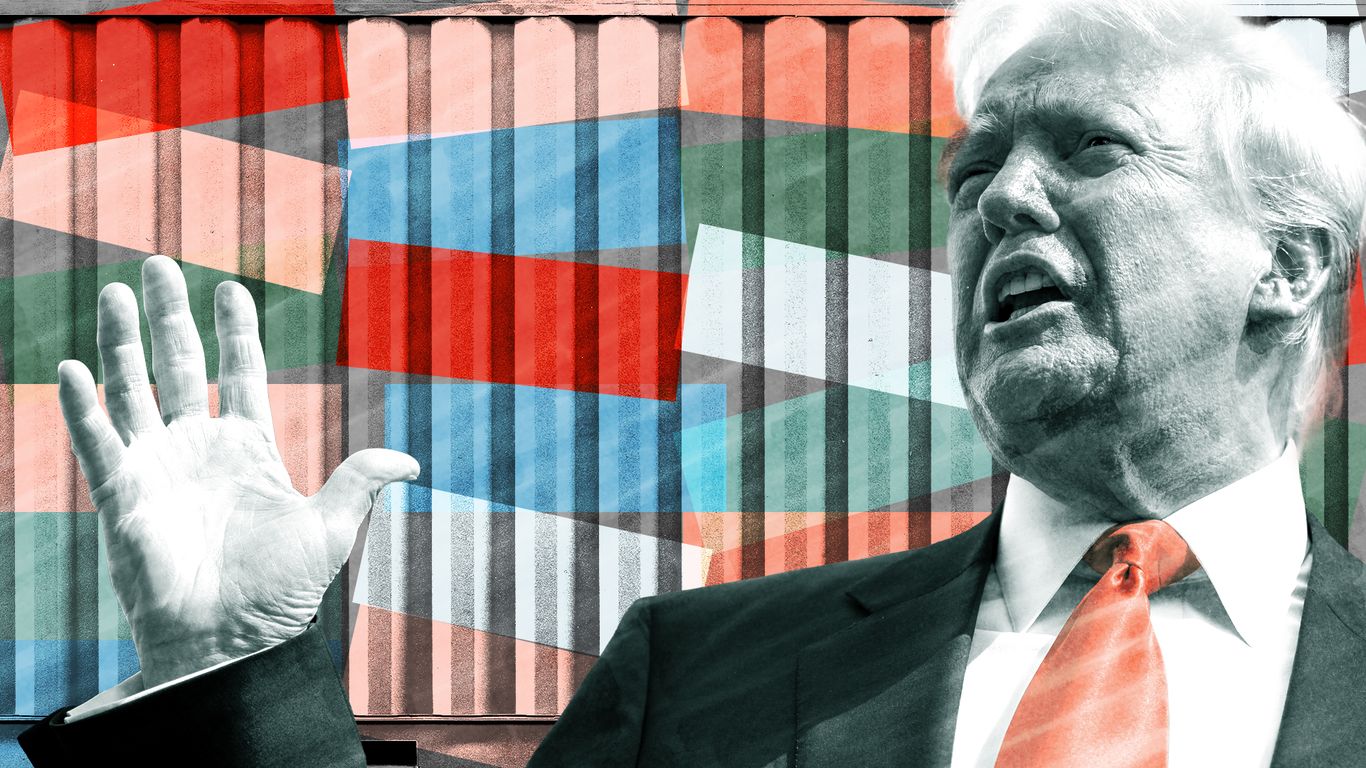
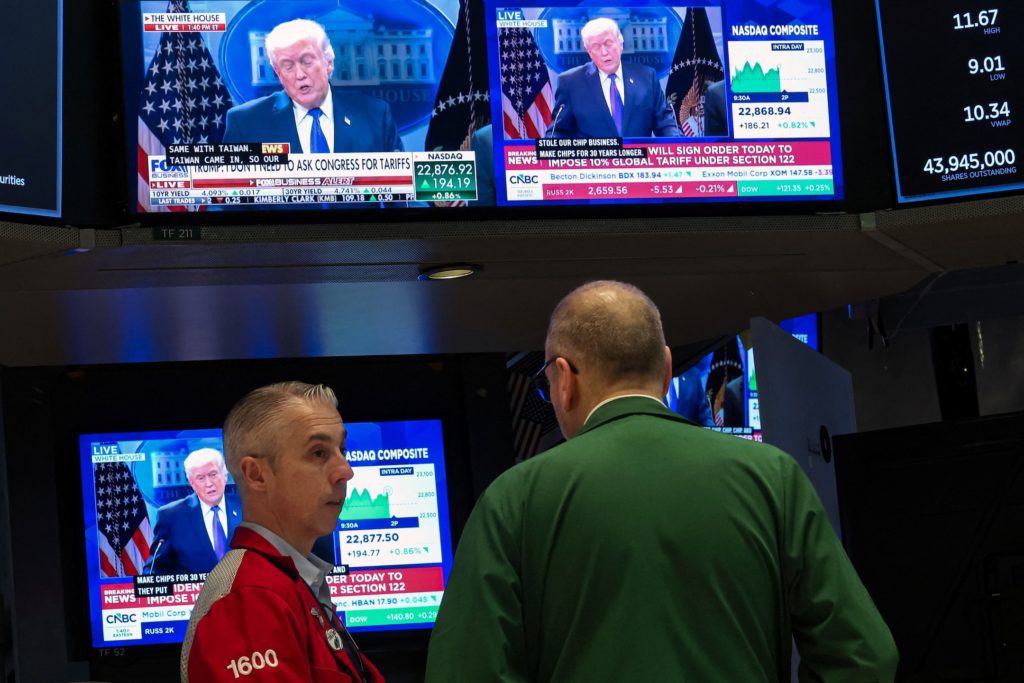
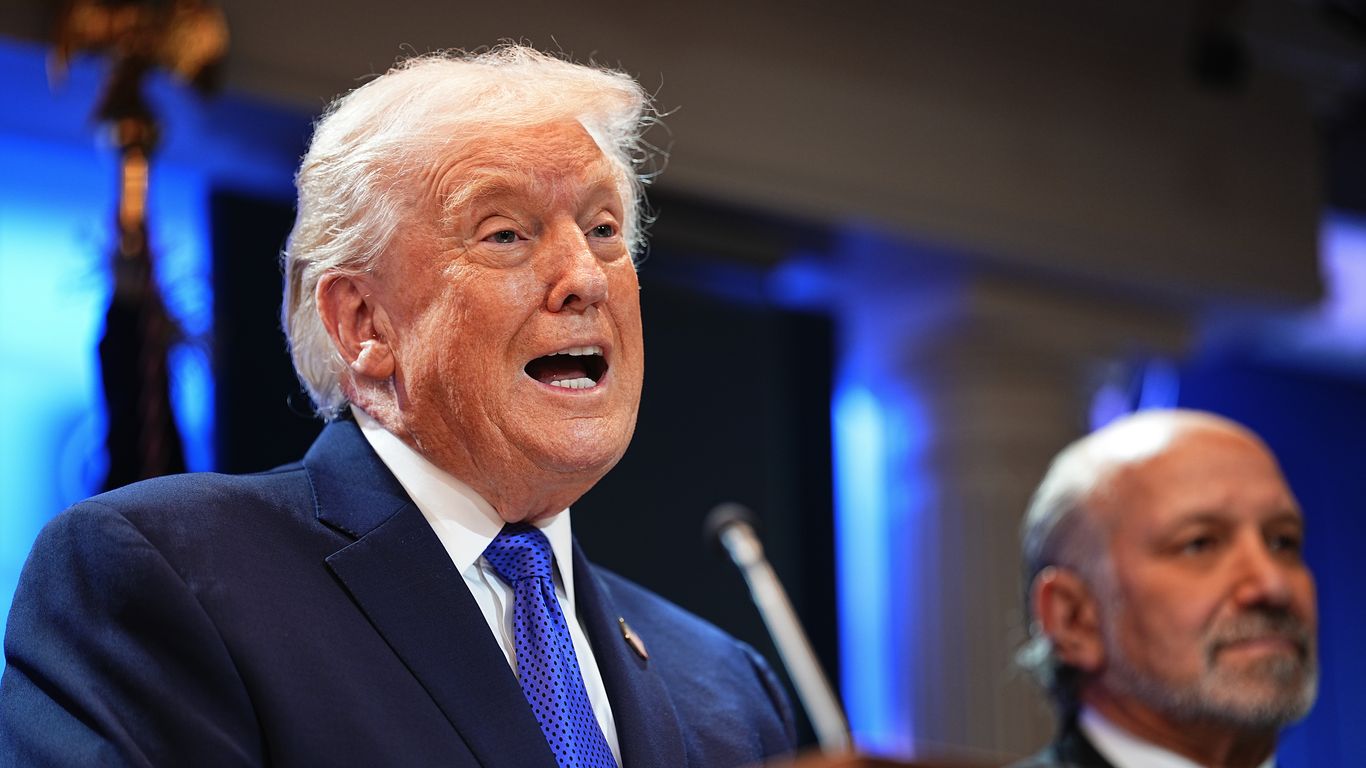
President Donald Trump announced a 15 percent tariff on countries worldwide after a Supreme Court ruling went against his tariff policy. The court decided that only Congress, not the president, can impose tariffs, affecting Trump's economic plans.
Key Facts
President Trump announced a 15 percent tariff following a Supreme Court ruling.
The Supreme Court ruled 6-3 against Trump's use of emergency powers for tariffs.
Chief Justice John Roberts wrote that only Congress can impose tariffs.
The ruling impacted Trump's tariffs on several countries, including China, Canada, and Mexico.
Trump expressed disappointment with the court's decision and plans to use other methods to impose tariffs.
Some officials and commentators support Trump’s tariff strategies despite the ruling.
The decision affects billions of dollars in tariffs collected under Trump's plan.
Read the Original
Want the full story? Tap a source to open the original
article.
The IRS issued new guidance on a tax break for production facilities, allowing for up to a 100% depreciation deduction. This benefit is part of a new tax law aiming to boost manufacturing and production investments, with clear details outlined for its application.
Key Facts
The IRS released guidance for a tax deduction on certain production properties.
The guideline is part of the One Big Beautiful Bill (OBBB) aimed at encouraging investment.
The deduction allows for up to 100% depreciation of eligible property in the year it is used.
Qualified production property includes nonresidential real estate like factory buildings.
Activities covered include manufacturing, chemical production, and refining.
The benefit applies to property in service between July 4, 2025, and January 1, 2031.
Taxpayers must choose to treat their property as qualified production property.
This guidance can be used immediately, with further detailed regulations planned.
Read the Original
Want the full story? Tap a source to open the original
article.
The Suffolk Punch Trust, which focuses on breeding rare Suffolk Punch horses, is closing its visitor center, cafe, and shop due to high costs. The trust will continue to operate its Colony Stud for horse breeding.
Key Facts
The Suffolk Punch Trust breeds rare Suffolk Punch horses in Hollesley, Suffolk.
The trust started its operations in 1759, making it a long-standing institution.
Suffolk Punch horses are Britain's oldest breed of heavy horse.
These horses are classified as critically endangered by the Rare Breeds Survival Trust.
Due to economic challenges, the trust is closing its public facilities, including a visitor center, cafe, and shop.
The trust plans to focus on developing its Colony Stud for future sustainability despite the cutbacks.
Read the Original
Want the full story? Tap a source to open the original
article.
A traveler tried to change his return flight with Delta Airlines and found the new cost would be $14,000, much more than he originally paid. His attempt to cancel part of the trip resulted in being told he would owe more money, which he found confusing. The issue seems related to airline fare rules and pricing structures for international travel.
Key Facts
A man paid $5,923 for a Delta One round-trip ticket from Austin to Amsterdam.
He wanted to change the return trip to depart from Dublin instead.
Delta quoted him $14,000 for the flight change.
If he canceled part of his trip, he would owe Delta $7,111.
Reddit users suggested that fare rules and the difference between one-way and round-trip pricing might be involved.
Airline pricing can make one-way international fares more expensive than round-trip ones.
The U.S. Department of Transportation notes refunds are not given for non-refundable tickets if the flight operates as scheduled.
Delta directs customers to use its support channels to submit refund or adjustment requests.
Read the Original
Want the full story? Tap a source to open the original
article.
Sophie Downing went to a coffee shop in Nottingham and received a receipt saying her gift card had a balance of £63 quadrillion. This happened because the coffee shop entered a gift card number instead of its actual value. The mistake was corrected, and she was charged correctly for her purchase.
Key Facts
Sophie Downing visited a coffee shop called 200 Degrees in Nottingham.
She planned to buy a matcha latte using a £10 gift card.
She received a receipt showing a balance of over £63 quadrillion.
The error happened because the gift card number was put into the wrong place in the till.
The shop fixed the mistake, and she paid the correct amount for her drink.
She found the incident funny and shared it with her partner.
The barista gave her the wrong receipt as a souvenir.
A correct receipt showing the true balance of the gift card was also provided to her.
Read the Original
Want the full story? Tap a source to open the original
article.
A passenger on a United Airlines flight from Lisbon to Newark reported feeling shocked by a flight attendant's comments during the journey. This experience, shared on Reddit, sparked discussions about how passengers should handle negative service encounters. It highlighted the importance of lodging formal complaints through the airline’s customer care service.
Key Facts
A passenger felt surprised by a flight attendant's comments during a United Airlines flight.
The flight was from Lisbon, Portugal to Newark, New Jersey.
The passenger shared the experience on Reddit, leading to about 300 comments discussing the issue.
Some Reddit users suggested formally complaining to United Airlines.
United Airlines provides an online portal for compliments or complaints.
The issue highlights ongoing tensions between airline staff and passengers concerning service interactions.
Newsweek could not verify the complete details of the incident.
Read the Original
Want the full story? Tap a source to open the original
article.
Millennials prefer smaller, more affordable homes compared to the larger "McMansion" style homes favored by Gen X. Zillow data shows millennials value energy efficiency, bold colors, and practical features like reading nooks over showy and expansive designs.
Key Facts
Millennials are buying smaller, more affordable homes instead of large "McMansions."
"McMansions" were popular among Gen X and often featured large foyers, many bathrooms, and extensive open floor plans.
New home trends include bold colors like olive green and navy blue instead of the neutral colors popular in 2006.
Energy efficiency is important, with a rise in listings for zero-energy ready homes and homes with EV charging stations.
There is an increased focus on flood protection and fire resistance in homes.
Zillow noted a cultural shift towards homes being personal sanctuaries rather than just status symbols.
Mentions of reading nooks in home listings have increased by 48 percent.
Millennials value homes that are adaptable to changing lifestyles, families, and climates.
Read the Original
Want the full story? Tap a source to open the original
article.
The Supreme Court decided that President Trump did not have the authority to use emergency powers to impose broad global tariffs. However, many specific tariffs based on national security reasons remain in place. These tariffs impact a range of goods, including steel, aluminum, and some manufactured items.
Key Facts
The Supreme Court ruled against President Trump using emergency powers to set global tariffs.
Tariffs related to national security, called Section 232 tariffs, still remain.
Section 232 tariffs cover products like steel, aluminum, vehicles, and electronic parts.
Tariffs on everyday goods are still being collected despite the ruling.
Some tariffs negotiated with countries like the UK and Japan are lower.
The court did not decide on refunding billions that importers have already paid in tariffs.
President Trump plans to find other ways to apply tariffs.
Tariffs continue to influence U.S. prices and trade relationships.
Read the Original
Want the full story? Tap a source to open the original
article.
The U.S. Supreme Court ruled that President Donald Trump acted beyond his powers when he used a specific law to impose global tariffs. After the court decision, President Trump announced new temporary tariffs under a different law. The situation may lead to more legal battles and discussions about trade policies.
Key Facts
The Supreme Court decided 6-3 against President Trump’s use of a 1977 law to impose global tariffs.
The court ruled Trump couldn't use the International Emergency Economic Powers Act (IEEPA) to place taxes on imports from almost every country.
Trump's previous tariffs generated an estimated $130 billion, which could potentially be refunded.
After the ruling, Trump used Section 122 of the 1974 Trade Act to impose a new 10% temporary tariff.
Section 122 lets the president impose tariffs up to 15% for up to 150 days.
President Trump previously used different laws, such as the Trade Expansion Act of 1962, for specific tariffs.
The administration is exploring using Section 301 of the Trade Act of 1974 for further tariffs.
Read the Original
Want the full story? Tap a source to open the original
article.
The U.S. Supreme Court struck down President Donald Trump's global tariffs, which included tariffs on Canada. Canada is looking to trade talks with the U.S. to address remaining trade challenges, especially concerning the U.S.-Canada-Mexico trade deal (USMCA).
Key Facts
The U.S. Supreme Court struck down tariffs imposed by President Trump on several countries, including Canada.
These tariffs, sometimes called "fentanyl tariffs," had a significant impact on trade but exempted 85% of it under USMCA.
Canada considers the tariffs "unjustified" and seeks to address their effects on industries like steel, aluminum, and automobiles.
The U.S.-Canada-Mexico trade deal (USMCA) is up for review, and renewal discussions must be concluded by July 1.
The Trump administration has shown interest in separate deals with Canada and Mexico instead of renewing the trilateral USMCA.
Canada's Trade Minister, Dominic LeBlanc, mentioned ongoing efforts to negotiate with U.S. counterparts.
The U.S. has expressed concerns about Canadian trade barriers, including restrictions on American wine and spirits sales and rules for online streaming services.
Canada aims to double its non-U.S. exports by 2035 as part of reducing reliance on the U.S. market.
Read the Original
Want the full story? Tap a source to open the original
article.
The Supreme Court decided President Trump cannot use the International Emergency Economic Powers Act (IEEPA) to impose tariffs, limiting his ability to pressure other countries using energy-related tariffs. The ruling affects various sectors differently, with some industries benefitting and others still facing existing tariffs under different laws. President Trump announced new tariff plans using other legal powers.
Key Facts
Supreme Court struck down the use of IEEPA for President Trump to impose tariffs.
President Trump previously used tariffs as a tool for economic and geopolitical influence.
The decision particularly benefits companies from South Korea and Japan regarding batteries, while solar industries still face other tariffs.
Oil and gas companies remain affected by steel tariffs under a different act, which increase domestic costs.
President Trump plans to impose new 10% tariffs on most countries, excluding certain critical goods.
A new bipartisan bill is being considered that could penalize countries buying Russian oil and gas.
The ruling aims to ensure market predictability for businesses and consumers in the U.S.
Read the Original
Want the full story? Tap a source to open the original
article.
President Trump plans to use Section 122 of the Trade Act of 1974 to reimpose tariffs after a Supreme Court decision affected his previous tariffs. This section allows for temporary tariffs for emergencies, with specific limits on time and amount. Trump intends to apply a 10% tariff on all foreign goods using an executive order.
Key Facts
President Trump will use Section 122 to reimpose tariffs after the Supreme Court's decision.
Section 122 allows for temporary tariffs during short-term emergencies.
Trump plans a 10% tariff on all foreign goods.
The tariffs under Section 122 can last up to 150 days unless Congress extends them.
Section 122 limits the maximum temporary surcharge to 15%.
Other trade options include Section 301 for investigating unfair trade practices and Section 232 for national security threats.
Section 122 does not require investigations, allowing quick action by the president.
Read the Original
Want the full story? Tap a source to open the original
article.
The US Supreme Court has removed many tariffs President Donald Trump put in place, creating uncertainty for UK businesses. President Trump plans to bring back some tariffs through different legal methods. Key sectors like UK steel and aluminium are not immediately affected, but future trade concerns remain.
Key Facts
The US Supreme Court struck down many tariffs imposed by President Trump under a specific law.
President Trump plans to introduce a new 10% global tariff and reintroduce struck-down tariffs using different legal methods.
The tariff changes do not affect certain sectors in the UK, such as steel and aluminium.
The British Chamber of Commerce stated that the ruling does not fully clarify the situation for UK businesses.
The UK government's focus is to reduce tariffs wherever possible, particularly on steel and aluminium.
There's uncertainty about refunding the over $130 billion collected in tariffs, with potential legal disputes.
UK industry leaders seek clear guidance on the implementation of the ruling and progress on resolving remaining tariffs.
President Trump expressed dissatisfaction with the Supreme Court decision but indicated plans to address it.
Read the Original
Want the full story? Tap a source to open the original
article.
The U.S. Supreme Court ruled against President Donald Trump's global tariffs, stating he exceeded his authority. The ruling does not clarify how the government will refund the estimated $175 billion collected. The case goes back to the Court of International Trade to manage the refund process.
Key Facts
The Supreme Court decided that President Trump overstepped his power with global tariffs.
The decision doesn't explain how or when the government will refund the $175 billion collected.
The refund process will be managed by the Court of International Trade.
More than 1,000 importers have already filed lawsuits seeking refunds, and more are expected.
Small businesses might face challenges in getting refunds due to costs and complex procedures.
Trump plans to impose a new 10% global tariff for 150 days using a different law.
The tariffs could affect steel, aluminum, cars, copper, lumber, and kitchen cabinets.
President Trump is expected to visit China for trade discussions next month.
Read the Original
Want the full story? Tap a source to open the original
article.
The U.S. Supreme Court stopped President Trump's ability to impose certain global tariffs, which could help businesses like Jenelle Peterson's toy company. Business owners are cautiously hopeful but worried about getting refunds on tariffs they already paid. President Trump may use other laws to continue imposing tariffs.
Key Facts
The U.S. Supreme Court blocked President Trump's power to impose certain global tariffs.
Business owner Jenelle Peterson might expand her toy imports due to the decision.
Businesses are worried about the process to get refunds for tariffs they've already paid.
President Trump plans to impose a 10% global tariff using a different law.
The decision affects tariffs imposed under a 1977 law called the International Emergency Economic Powers Act (IEEPA).
Despite the ruling, the average effective tariff rate remains high at 9.1%.
Businesses and trade groups welcomed the decision but still have concerns about other potential tariffs.
The stock market's reaction to the news was small, with only moderate gains.
Read the Original
Want the full story? Tap a source to open the original
article.
Victor Schwartz, a wine importer in New York, was a lead plaintiff in a Supreme Court case that ruled against President Donald Trump's global tariffs. The court decided 6-3 that Trump did not have the authority to impose these broad import taxes, which affected many small businesses. This decision marked a significant legal defeat for one of Trump's key economic policies.
Key Facts
Victor Schwartz owns VOS Selections, a company that imports wines and spirits to the U.S.
He challenged President Trump's broad tariffs, arguing they were illegal and harmful to small businesses like his.
The Supreme Court ruled 6-3 that Trump overstepped his authority with these tariffs.
The decision was a setback for Trump's economic policy and affected the way import businesses are taxed.
The case was helped by arguments that the Constitution gives Congress, not the President, the power to impose taxes.
Chief Justice John Roberts and two other conservative justices appointed by Trump sided with the majority.
Learning Resources, an educational toy company, was also a lead plaintiff, arguing similar points about the tariffs.
The ruling left some tariffs in place but overturned others, based on different laws.
Read the Original
Want the full story? Tap a source to open the original
article.
This article lists the eight best forex brokers for traders in the USA as of 2026. It highlights each broker’s strengths, including trading costs, currency options, platforms, and customer support, and notes that all are regulated by U.S. authorities.
Key Facts
The top eight forex brokers for U.S. traders in 2026 are OANDA, FOREX.com, tastyfx, Interactive Brokers, Schwab, eToro, Trading.com, and Plus500.
All brokers except eToro are regulated by the Commodity Futures Trading Commission (CFTC) and National Futures Association (NFA); eToro is regulated by the Securities Exchange Commission (SEC) and FINRA.
OANDA is ranked the best overall broker, offering 68 currency pairs, low costs, and support for major trading platforms like MetaTrader 4 and TradingView.
OANDA provides access to cryptocurrency trading through Paxos and futures trading via Wedbush, covering various products like commodities and financial indices.
High-volume traders on OANDA can join the Elite Trader program for cash-back rebates that lower trading costs significantly.
FOREX.com is noted for its low spreads, tastyfx is beginner-friendly, Interactive Brokers offers low commissions, Schwab provides strong customer support, eToro specializes in social and copy trading, Trading.com has a wide selection of currency pairs, and Plus500 is good for futures trading.
OANDA’s spreads on major pairs like EUR/USD start at 0.4 pips, with commissions lower than some competitors due to direct bank pricing.
Traders can choose from multiple platforms on OANDA, including MetaTrader 4, its own OANDA Trade, and TradingView.
Read the Original
Want the full story? Tap a source to open the original
article.
The Supreme Court decided to remove several international tariffs set by President Trump. Despite this, President Trump plans to maintain most of the tariffs using different approaches.
Key Facts
The Supreme Court removed many tariffs put in place by President Trump.
President Trump plans to keep most tariff policies despite the ruling.
The discussion about this situation included Natasha Sarin from Yale University.
Natasha Sarin is a professor of law and finance.
She is also the president of The Budget Lab at Yale.
The discussion focused on how these changes affect the economy and consumers.
Read the Original
Want the full story? Tap a source to open the original
article.
President Trump announced that he will sign an executive order to impose a 10% tariff on goods from all countries. This move follows a Supreme Court decision that blocked some existing tariffs. The new tariffs are allowed under the Trade Act of 1974, which lets the President set tariffs for a limited time.
Key Facts
President Trump plans to impose a 10% tariff on imports from all countries.
This action follows a Supreme Court decision that overturned previous tariffs.
The tariffs are being imposed under Section 122 of the Trade Act of 1974.
The Trade Act of 1974 permits tariffs for up to 150 days.
The tariffs under this act can go up to 15%.
President Trump cited addressing trade deficits as a reason for the tariffs.
Read the Original
Want the full story? Tap a source to open the original
article.
The Supreme Court recently overturned several of President Trump's tariffs. Rick Woldenberg, who owns a toy company in Chicago, was a plaintiff in the case. He shared his thoughts on the decision and its impact on his business.
Key Facts
The Supreme Court overturned many tariffs that were put in place by President Trump.
Rick Woldenberg is one of the business owners who challenged these tariffs.
Woldenberg owns a small toy manufacturing company called Learning Resources in Chicago.
The case was brought to the Supreme Court, where they decided to remove many of the tariffs.
Woldenberg discussed the court's decision and its effects on his business operations.
Read the Original
Want the full story? Tap a source to open the original
article.