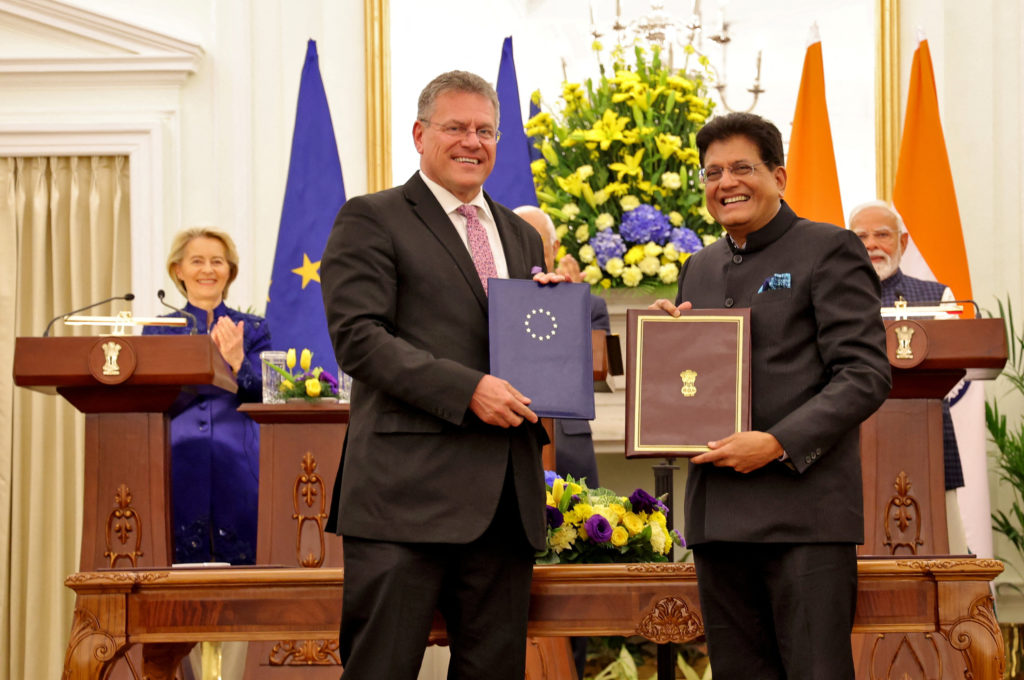
India and the European Union (EU) have signed a free trade agreement, creating a large market involving about 2 billion people. The deal aims to reduce tariffs and boost trade in goods, services, and investments between the two regions. It still needs legal approval and may become operational next year.
Key Facts
The trade agreement covers India and the 27-nation European Union.
The agreement impacts a combined market size of nearly $27 trillion.
It represents about 25% of the global gross domestic product (GDP).
Tariffs between India and the EU are expected to be significantly reduced.
The EU is providing access to 144 services sectors, while India offers 102 subsectors to the EU.
The deal includes goods, services, and investments in industries like textiles, pharmaceuticals, machinery, and electronics.
The agreement still requires legal checks in both Brussels and New Delhi.
The deal could help India and the EU reduce reliance on the U.S. market.
Read the Original
Want the full story? Tap a source to open the original
article.
The UK government announced a 15% discount on business rates for pubs and music venues in England, starting in April, with no increases for two years. This decision follows backlash from an earlier budget that would have raised costs significantly for these businesses. The government stated this package aims to provide short-term relief, while a review of how pubs are valued will occur before 2029.
Key Facts
Pubs and music venues in England receive a 15% discount on business rates from April.
There will be no increase in these rates for two years.
The package is valued at £1,650 for the average pub.
The government says the plan will cost £80 million in its first year.
Treasury Minister Dan Tomlinson emphasized pubs are vital to communities.
Shadow Chancellor Mel Stride called the measures insufficient.
The government will review how pubs are valued before the 2029 revaluation.
UK Hospitality and the British Beer and Pub Association support the initiatives but call for further long-term reforms.
Read the Original
Want the full story? Tap a source to open the original
article.
India and the European Union (EU) have finalized a free trade agreement after nearly 20 years of talks. The deal aims to increase economic ties by lowering import taxes and allowing free trade on most goods. It is expected to boost job creation and economic growth for both regions.
Key Facts
India and the EU reached a free trade agreement after two decades of negotiations.
The agreement affects around 2 billion people and covers almost all goods.
It will lower import taxes significantly, particularly for European wine and cars.
The deal was partly encouraged by U.S. trade pressures on India and the EU.
This partnership involves not just trade but also defense and security cooperation.
The agreement could result in up to 4 billion euros ($4.7 billion) in tariff cuts annually.
India will reduce tariffs for 96.6% of EU exports and Brussels will do the same for nearly 99% of India's exports.
The deal excludes some Indian products like dairy and cereals due to domestic concerns.
Read the Original
Want the full story? Tap a source to open the original
article.
Japanese Prime Minister Sanae Takaichi has announced plans to pause the country's consumption tax if her party wins upcoming elections, which has caused global market concerns. Investors are worried about the impact on Japan's debt levels, which are already the highest among advanced economies. These concerns have led to increased volatility in Japanese government bonds and the yen.
Key Facts
Japan’s Prime Minister Sanae Takaichi plans to halt the consumption tax on food and non-alcoholic drinks for two years if her party wins.
The proposed tax pause is estimated to create a yearly revenue shortfall of 5 trillion yen ($31.71 billion).
Takaichi suggests this shortfall could be managed by reviewing current expenses and tax breaks but gave no detailed plan.
Japan’s largest stimulus since the COVID-19 pandemic, worth 21.3 trillion yen ($137 billion), was approved in November, including various subsidies and handouts.
Market turmoil is due to concerns about Japan's high debt levels, with the country’s debt-to-GDP ratio over 230%, the highest among developed countries.
Japanese government bond yields have risen significantly, with 40-year bond yields reaching record highs, reflecting investor unease.
Global markets are also worried due to high deficits in other major economies.
The Bank of Japan has reduced bond purchases, moving away from ultra-low interest rates and limiting its ability to intervene in the market.
Read the Original
Want the full story? Tap a source to open the original
article.
The UK government is proposing changes to the leasehold system in England and Wales. These changes include capping ground rents and ending the sale of new leasehold flats. Instead, new flats will use a commonhold system where flat owners collectively own the building and land.
Key Facts
The UK government plans to cap ground rents for leasehold homes at £250 a year, reducing to nearly zero after 40 years.
The sale of new leasehold flats will be banned, with new flats sold as commonhold, a system where owners collectively manage the property.
The reforms affect around 3.8 million properties that currently pay significant ground rents.
The changes follow the abolition of ground rents for most new residential leasehold properties in 2022.
Under the commonhold system, flat owners have more control over their property costs compared to the leasehold system.
Existing leasehold properties' transition to commonhold is still under discussion, with consultations ongoing until April 2024.
Service charges for maintenance will be made more transparent, and landlords will be held accountable.
The government will scrap the process of "forfeiture," which allows freeholders to seize leaseholder properties through court action.
Read the Original
Want the full story? Tap a source to open the original
article.
Apple has agreed to a $95 million settlement after a lawsuit claimed its Siri voice assistant recorded users without their consent. Users are now receiving their settlement payments.
Key Facts
Apple settled a lawsuit for $95 million.
The lawsuit claimed Apple's Siri was recording user conversations.
It was also alleged that these conversations were shared with third parties.
The settlement is part of a class-action lawsuit.
Users involved in the lawsuit are now getting payments from the settlement.
Read the Original
Want the full story? Tap a source to open the original
article.
Nearly 50 Labour MPs have written to Chancellor Rachel Reeves to ask for the planned rise in business rates for music venues to be stopped. The MPs argue that the proposed rate increase could significantly raise costs for these venues, putting them at risk. The concern comes as the government plans to reduce business rate discounts and potentially exclude music venues from a support package for the hospitality industry.
Key Facts
Labour MPs wrote to Chancellor Rachel Reeves about business rates for music venues.
The rate increase could raise music venue bills by 45% to 275%.
Music venues are considered at risk due to higher costs.
The government plans to reduce business rate discounts from April.
MPs are worried the hospitality sector might not get enough support.
The letter pressing for action was coordinated by MP Anneliese Midgeley.
MPs seek to stop the April increase until a better valuation method is found.
The Treasury has not yet commented on the matter.
Read the Original
Want the full story? Tap a source to open the original
article.
Cadillac has introduced a new Deep Ocean Package for its high-performance CT5-V Blackwing sedan, costing an extra $26,995 on top of the car's initial price of $158,000. This package focuses on style changes, adding features like carbon fiber interior, special blue details, and exclusive paint, rather than performance upgrades. Only 200 units will be produced, with production starting in March.
Key Facts
The Deep Ocean Package adds $26,995 to the CT5-V Blackwing's price.
The car's power remains the same with a 6.2-liter V8 engine.
The package includes aesthetic changes like carbon fiber and black/blue accent details.
Seats are upgraded to high-performance bucket seats in semi-aniline leather.
The car features Santorini Blue seat belts and blue brake calipers.
Only 200 cars will be produced, starting in March at the GM Lansing Grand River Assembly Plant.
The car gets a Deep Ocean blue paint and black detailing like mirror caps and lug nuts.
Read the Original
Want the full story? Tap a source to open the original
article.
Shake Shack has introduced a new limited-time shake called the "True Love Shake" for Valentine's Day. The company is offering deals on this shake with a 50% discount on February 10 and a buy-one-get-one-free offer from February 10 to 14 at participating locations in the U.S.
Key Facts
The "True Love Shake" is made with vanilla frozen custard, strawberry purée, and a dark chocolate shell.
It is topped with chocolate-flavored whipped cream and strawberry curls.
The shake is available at participating U.S. Shake Shack locations, excluding airports, stadiums, arenas, travel plazas, and museums.
On February 10, customers can use the code SELFLOVE to get 50% off the shake.
From February 10 to 14, using the code SHARELOVE allows customers to get a buy-one-get-one-free deal on the shake.
The offers are only valid for orders placed via in-Shack kiosks, the Shake Shack app, or the website.
The promotional codes are case-sensitive and can't be used with other offers.
This is Shake Shack’s second "crackable" shake, following the Peppermint Bark Chocolate Shake from last year's holiday lineup.
Read the Original
Want the full story? Tap a source to open the original
article.
Kaiser Foundation Health Plan Inc. has agreed to a $10.5 million settlement over claims it sent marketing text messages to people who had opted out. People who received these texts can claim money without needing to show proof, by filling out a claim form that matches Kaiser’s records.
Key Facts
Kaiser agreed to a $10.5 million settlement for sending texts after opt-out requests.
The settlement applies to texts sent from January 21, 2021, to August 20, 2025.
People can claim up to $75 per text they received without having to show proof.
Claims are based on records from Kaiser, and require only a completed claim form.
The settlement includes administrative costs, attorneys' fees, and possibly a service award.
There are two groups covered in the settlement: one for national consumers and another for Florida consumers.
Kaiser denies any wrongdoing but agreed to settle to resolve the claims.
Read the Original
Want the full story? Tap a source to open the original
article.
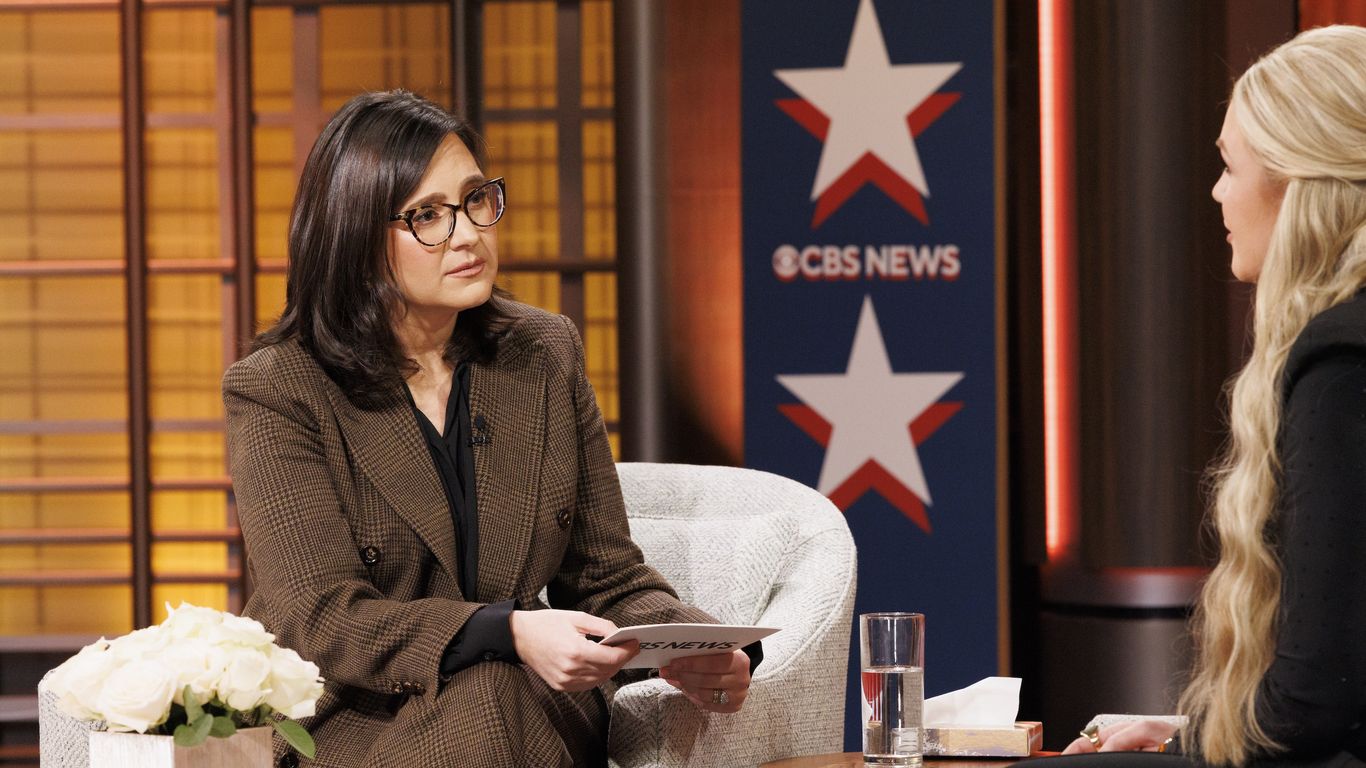
CBS News, led by editor-in-chief Bari Weiss, is adding new contributors, mainly podcasters and independent writers, to broaden its reach. These contributors are part of an effort to introduce new journalistic principles within the network. The changes aim to bring fresh and independent voices to CBS News while making it more culturally relevant.
Key Facts
Bari Weiss is the editor-in-chief of CBS News.
CBS appointed Weiss after buying her news startup, The Free Press.
New contributors include podcasters, writers, and some existing Free Press contributors.
Notable new contributors are Andrew Huberman, Peter Attia, and Niall Ferguson.
Weiss's goal is to align CBS News with new journalistic principles.
Some CBS staff members are concerned about changes affecting editorial independence.
Changes include delaying a "60 Minutes" episode.
Weiss will discuss her strategy with CBS staff in a town hall meeting.
Read the Original
Want the full story? Tap a source to open the original
article.
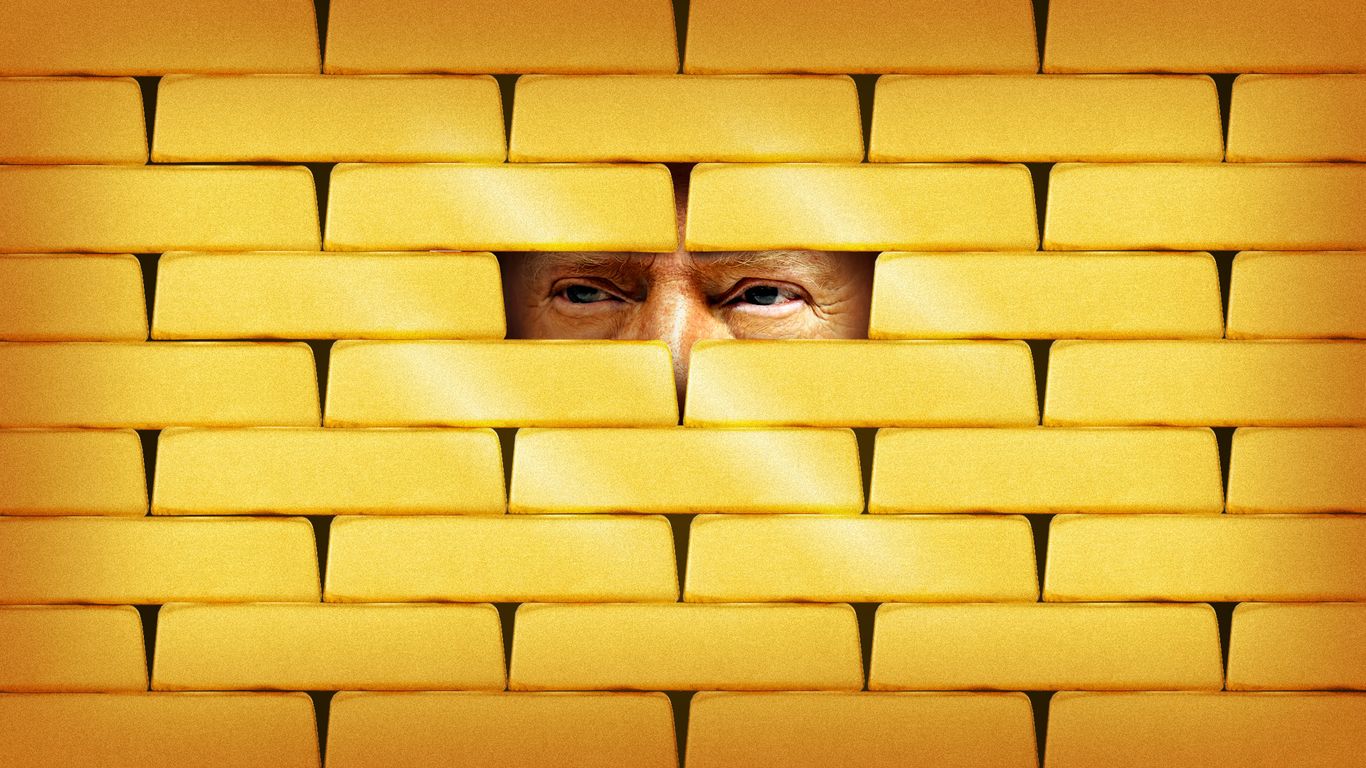
Investors are increasingly buying gold as they lose confidence in traditional safe investments like the U.S. dollar and Treasuries. This shift is driven by uncertainty related to policies from President Donald Trump's administration, leading to a rise in gold prices.
Key Facts
Gold prices have risen over 17% this year.
Investors view gold as insurance against unpredictable U.S. policy.
Central banks now hold more gold than U.S. Treasuries, the first time in 30 years.
Many countries seek alternatives to the U.S. dollar and Treasuries for their reserves.
The demand for metals like gold and silver is increasing due to factors beyond U.S. policy.
One risk to continued gold investment is a drop in general global risks.
Analysts believe gold isn't overpriced because its value depends on buyer willingness.
The future of gold’s rally depends on ongoing U.S. policy uncertainty.
Read the Original
Want the full story? Tap a source to open the original
article.
Krispy Kreme is bringing back its "Chocomania" collection, which includes four new doughnuts glazed in Hershey's chocolate. These new doughnuts will be available at participating U.S. stores from January 27 to February 1, 2026.
Key Facts
Krispy Kreme is introducing four new doughnuts under its "Chocomania" collection.
All four doughnuts feature Hershey's chocolate glaze for the first time.
The new doughnuts include variations like Chocolate Cheesecake and Chocolate Chip Cookie.
The "Chocomania" collection is available from January 27 to February 1, 2026.
Customers can purchase the doughnuts in-store or order online for pickup or delivery in the U.S.
Krispy Kreme partners with Hershey's to create these chocolate-inspired doughnuts.
Read the Original
Want the full story? Tap a source to open the original
article.
India and the European Union have agreed on a major trade deal to create a large free trade zone, encompassing about two billion people. This deal is expected to boost trade significantly between the two regions, particularly benefiting sectors like textiles, gems, and leather goods in India. The agreement will lead to reduced tariffs on many EU exports to India, and is set to be implemented within a year following legal procedures.
Key Facts
India and the European Union have reached a deal to form a huge free trade zone covering two billion people.
The agreement was announced by European Commission President Ursula von der Leyen and Indian Prime Minister Narendra Modi.
The deal covers around 25% of the global gross domestic product (GDP).
EU exports to India are expected to double by 2032 because of the agreement.
Tariffs on 96.6% of EU goods exported to India will be eliminated or reduced.
The agreement will reduce costs for EU products by up to 4 billion euros annually in duties.
The deal is expected to be formalized after legal procedures, taking five to six months, and implemented within a year.
Talks on the deal had started in 2007 but gained momentum after the geopolitical changes following Russia's actions in Ukraine.
Read the Original
Want the full story? Tap a source to open the original
article.
Domino's Pizza has announced a special deal for the Super Bowl, offering any large pizza with two toppings for $6.99 for carryout orders. This promotion runs from January 26 to February 1, 2026, as Domino's prepares for a busy day with increased pizza orders on Super Bowl Sunday.
Key Facts
The Domino's deal offers large, two-topping pizzas for $6.99 each.
The offer is available from January 26 to February 1, 2026.
The promotion is for carryout orders only.
Customers can choose from several crust options, including Hand Tossed, Crunchy Thin, and New York Style.
Last year, Domino's sold about 2.4 million pizzas on Super Bowl Sunday.
The company can sell up to 40 percent more pizzas on Super Bowl Sunday compared to a regular Sunday.
There is an option to upgrade to Parmesan Stuffed Crust for an additional $3 or to a specialty pizza for an extra $4.
Domino's describes the Super Bowl Sunday as one of its top five busiest sales days in the U.S.
Read the Original
Want the full story? Tap a source to open the original
article.
The Centers for Medicare & Medicaid Services (CMS) has proposed updates to Medicare Advantage and Part D policies for 2027. The changes include adjustments to how payments are calculated, updates to risk adjustment systems, and modifications to the star ratings system used to evaluate plans.
Key Facts
CMS proposed a 0.09% average increase in Medicare Advantage payments for 2027, totaling over $700 million, considering changes in how patients are coded.
The current risk-adjustment system will use newer health and cost data to better align payments with actual health risks.
Diagnoses from paperwork not tied to real doctor visits will no longer be counted for payment calculations starting in 2027.
Updates to the star ratings system include clarifying rules and specifying which performance measures count towards scores.
The proposal aims to ensure affordable and reliable benefits for beneficiaries while reducing reliance on non-clinical coding practices.
Stakeholders can submit comments on the proposed changes until February 25, 2026, with final announcements set for April 6, 2026.
Read the Original
Want the full story? Tap a source to open the original
article.
Countries in the Global South are exploring alternatives to the U.S. dollar (USD) for international trade. This includes using China's Cross-Border Interbank Payment System (CIPS) and local currencies for trade, particularly among BRICS nations. These moves aim to reduce dependency on the USD in global trade.
Key Facts
South African and Chinese central banks launched a new payment system aimed at reducing reliance on the USD.
Standard Bank in Africa now connects directly to China's payment system, allowing trade in Chinese renminbi.
BRICS nations are seeking to use local currencies for trade to avoid USD dependency.
Countries like India, UAE, Brazil, and China are actively trading with one another in their local currencies.
China and Russia are shifting their trade to local currencies, partly to avoid Western sanctions.
BRICS is working on a digital currency system called Bridge to bypass USD and SWIFT for international payments.
Over the last decade, China has become a leading trade partner in the Global South, reducing U.S. trade influence.
Analysts note hidden costs exist when trading in USD, benefitting the U.S., and countries are seeking alternatives.
Read the Original
Want the full story? Tap a source to open the original
article.
A new law in Jersey aims to make it easier for people to get credit cards. This change allows sharing specific information with UK credit agencies, which might help more credit card companies return to Jersey. The decision about returning to the Jersey market will still lie with the banks.
Key Facts
Jersey's government passed a law to simplify credit card approval.
The law changes how information is shared with UK credit agencies.
The amendment lets the government share names and addresses for credit checks.
There is an option for Jersey residents to opt out of having their information shared.
The Jersey Consumer Council has supported this change for several years.
The law aims to resolve issues with credit card availability in Jersey.
Banks will decide if they want to re-enter the credit card market in Jersey.
Privacy concerns related to data sharing have been addressed.
Read the Original
Want the full story? Tap a source to open the original
article.
Over 80,000 Keurig McCafé Premium Roast Decaf Coffee K‑Cup Pods have been recalled due to concerns they may contain caffeine. The U.S. Food and Drug Administration (FDA) categorized this as a Class II recall, indicating potential temporary health effects for certain individuals.
Key Facts
Keurig McCafé Premium Roast Decaf Coffee K‑Cup Pods are being recalled.
Over 80,000 pods are affected by the recall.
The recall is due to concerns that the decaf pods might contain caffeine.
The FDA classified this as a Class II recall, which means it may cause temporary health effects.
Consumers can identify the recalled products by checking the best-by date, batch number, material number, and ASIN.
The pods were sold in California, Indiana, and Nevada.
People who need to limit caffeine for health reasons are advised not to use these pods.
Consumers can return the pods to retailers for a refund or replacement.
Read the Original
Want the full story? Tap a source to open the original
article.
President Donald Trump announced he plans to increase tariffs on South Korean exports from 15% to 25%. He claims this is because South Korea has not ratified their trade deal quickly enough. The tariffs will affect various goods, including cars, lumber, and pharmaceuticals.
Key Facts
President Trump intends to increase tariffs on South Korean exports to 25%.
The current tariff is 15%, agreed upon as part of a trade deal last year.
Trump made the announcement on the social media platform Truth Social.
The tariff hike targets products such as automobiles, lumber, and pharmaceuticals.
The South Korean legislature has not yet approved the trade deal.
The White House has not yet made the tariff increase official with an executive order.
The U.S. and South Korea reached a trade agreement in July to lower tariffs to 15%.
Trump discussed trade with South Korean President Lee Jae-myung during an international forum in October.
Read the Original
Want the full story? Tap a source to open the original
article.