Warner Bros. Discovery is considering a sale or split of its assets, which could change the media industry by creating a larger market player. Potential buyers like Netflix could overtake YouTube as the largest media distributor by viewership. This decision comes as the company faces challenges such as a large debt and competition in streaming.
Key Facts
Warner Bros. Discovery is open to being bought, either in full or partly.
The company’s potential buyers include major firms such as Netflix and Comcast.
A sale could result in a large media distributor, potentially overtaking YouTube’s viewership.
Currently, YouTube is the leading TV distributor with 13.1% of monthly viewing.
If Netflix and Warner Bros. Discovery were combined, their monthly viewership share would be 14.5%.
Warner Bros. Discovery's announcement caused its stock price to rise by nearly 9%.
The company is also considering a plan to split into two units: one for streaming and studios and another for cable networks.
Warner Bros. Discovery has struggled with over $40 billion in debt following its 2022 merger.
Read the Original
Want the full story? Tap a source to open the original
article.
A study by Professor Alex Garlick from the University of Vermont found that lobbying by the health care industry contributes to rising health care costs. The research suggests that the more health care lobbyists there are in a state, the higher the health care costs for consumers. It also notes that strong lobbying can lead to fewer laws aimed at controlling these costs.
Key Facts
Professor Alex Garlick conducted the study and research.
Health care industry lobbying is linked to higher consumer costs.
Every new lobbying group in a state may increase costs by $7 for consumers.
Stronger lobby groups correlate with fewer efforts to pass cost-control laws.
Some states, like Maryland, actively regulate health care prices to control inflation.
Lobbyists often oppose transparency in the pharmaceutical supply chain.
The corporatization of health care is seen as increasing profit-seeking behavior.
Preventing monopolies in health care is crucial for controlling costs.
Read the Original
Want the full story? Tap a source to open the original
article.
The U.S. inflation report for September, initially delayed by a government shutdown, is set to be released. It will provide important updates about consumer prices, which influence Federal Reserve decisions on interest rates. Economists expect slight increases in inflation due to factors like tariffs and rising energy costs.
Key Facts
The Department of Labor's inflation report was delayed due to a government shutdown.
The report will be released on Friday at 8:30 a.m. ET.
August's report showed a 0.4% monthly increase and 2.9% annual increase in prices.
Economists expect September's inflation to rise slightly, with similar monthly and annual increases.
Core inflation excludes food and energy prices and reflects steadier economic trends.
Tariffs and restrictive immigration policies are contributing to higher costs.
The Federal Reserve uses CPI data to help decide on interest rate changes.
Higher inflation impacts various sectors, such as food, energy, and goods involving imported parts.
Read the Original
Want the full story? Tap a source to open the original
article.
A nurses' union in Illinois filed a legal complaint against a hospital and its past and current owners for not paying promised COVID-19 bonuses. The union claims the bonuses were promised to retain nurses during the pandemic but were not given to union members, although non-union staff received them. The union seeks to enforce a collective bargaining agreement that requires adequate staffing and proper compensation during health emergencies.
Key Facts
The Illinois Nursing Association filed the complaint in the Northern Illinois District Court.
The complaint involves St. Joseph Medical Center – Joliet, its former owner Ascension, and current owner Prime Healthcare.
The union claims a promised one-time bonus was not paid to its members during the COVID-19 pandemic.
The bonuses were meant to address nurse shortages and increased patient numbers.
Ascension's CEO promised a bonus in a 2021 email to nursing staff.
Non-union staff received the incentive, but union members did not.
The union's collective bargaining agreement includes provisions for maintaining staffing through emergency pay adjustments.
The union alleges the hospital's refusal to pay violates this agreement.
Read the Original
Want the full story? Tap a source to open the original
article.
Online rumors suggest that Glock might stop making most of its pistol models by the end of November, based on a social media post from a gun store. The post claims that only a few models will remain available, and no official confirmation from Glock has been provided. This change is reportedly for innovation and strategic focus, according to Glock's website.
Key Facts
Rumors say Glock may discontinue most pistol models by end of November.
Glockstore, a gun retail shop on Instagram, shared this information.
The store claimed only Glock models 43, 43X, and 48X will remain.
New Glock "V models" reportedly won't allow quick conversion to automatic.
There will be no change in pricing for the new models, according to the post.
Glock's website mentions focusing on new products for innovation and growth.
Newsweek has not confirmed these claims with Glock or Glockstore.
Read the Original
Want the full story? Tap a source to open the original
article.
Taco Bell has introduced a new drink called the Strawberry Vanilla Cream Soda Freeze, but it's only available to Taco Bell Rewards members. The drink is part of a trend where fast-food chains launch special drinks to attract customers and boost loyalty programs.
Key Facts
Taco Bell debuted the Strawberry Vanilla Cream Soda Freeze as a limited-edition menu item.
The drink is exclusively available to Taco Bell Rewards members.
It is a frozen slushy with vanilla and strawberry flavors.
Pricing is $3.79 for a small and $3.99 for a medium, with a $1 price during "Happier Hour" (2-5 p.m. daily).
Taco Bell aims to increase app engagement and build its beverage sales target to $5 billion by 2030.
Taco Bell operates 8,121 locations in the U.S., with California having the most branches.
Introducing novelty drinks is a strategy to compete with chains like Starbucks and Dunkin’.
Read the Original
Want the full story? Tap a source to open the original
article.
The U.S. housing market currently has 500,000 more sellers than buyers, the largest difference recorded since 2013. Economic uncertainty, high borrowing costs, and increasing home prices have made it difficult for buyers, causing a slowdown in the market. As a result, many homes are staying on the market longer and sellers are beginning to lower prices.
Key Facts
There are 500,000 more sellers than buyers in the U.S. housing market.
The gap between buyers and sellers is the largest since data collection began in 2013.
Economic uncertainty, high borrowing costs, and rising home prices contribute to this trend.
Home prices rose by more than 30% in many areas from March 2020 to March 2023.
The number of homes for sale reached over 2 million this summer.
Homes now spend an average of 50 days on the market before selling.
The median sale price of a U.S. home was $435,545 last month, a 1.7% increase from the previous year.
Housing experts predict that increasing seller numbers could lead to price drops by the end of 2025.
Read the Original
Want the full story? Tap a source to open the original
article.
The government is working to reduce the administrative workload for businesses by cutting unnecessary regulations. They announced plans to simplify reporting requirements and exempt some new technologies from certain rules. This effort aims to save businesses money and encourage growth.
Key Facts
The government aims to reduce business regulations to make operations easier for businesses.
The changes could save firms nearly £6 billion a year.
Over 100,000 businesses, like small family cafes, will benefit from simpler reporting rules.
New AI technology could receive temporary exemptions from regulations to foster quick development.
The goal is to cut the administrative costs of regulation by 25% by the end of the current Parliament.
Criticism exists over new employment rules possibly increasing business costs, but the government claims they will be fair.
Business groups have welcomed the plan to reduce bureaucracy, citing cost reductions and competitiveness.
The Liberal Democrats suggest that a tailored UK-EU customs union could further reduce red tape.
Read the Original
Want the full story? Tap a source to open the original
article.
The MAGA movement is actively boycotting major entertainment and tech companies like Disney and Netflix over content and statements that it finds offensive. Despite these boycotts, Disney and Hulu have experienced growth in new subscriber numbers. These actions illustrate how political groups can influence public opinion and corporate actions.
Key Facts
The MAGA movement is organizing boycotts against companies like Disney and Netflix for content deemed inappropriate.
Disney had 3 million cancellations in September, up from a 1.2 million average in the previous three months.
Hulu saw 4.1 million cancellations, up from a 1.9 million average over the past three months.
Despite the cancellations, Disney+ and Hulu gained more than 2 million new subscribers each in September.
MAGA claims Disney became a target after comments by Jimmy Kimmel regarding political leanings.
Netflix was criticized by MAGA for featuring LGBTQ+ content in some shows.
The NFL faced backlash from MAGA for choosing Bad Bunny, a Puerto Rican singer, for the Super Bowl halftime show.
MAGA has also boycotted other companies like Target and Bud Light for stances on diversity and inclusion.
Read the Original
Want the full story? Tap a source to open the original
article.
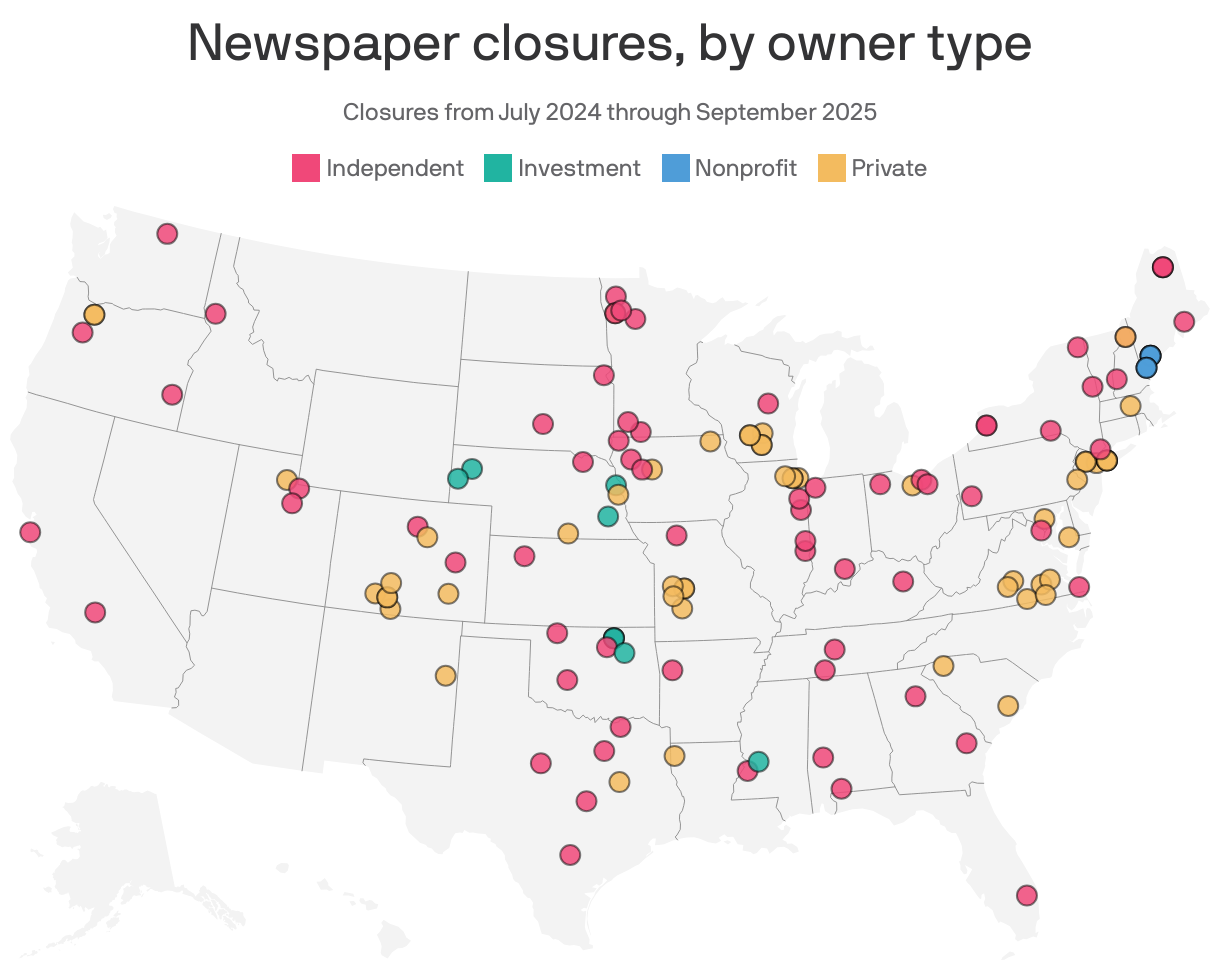
A report from Northwestern's Medill School of Journalism shows that small, independent newspapers in the U.S. are closing rapidly compared to those owned by large investment firms. These closures increase the risk of some areas becoming "news deserts," where local news is scarce or unavailable. Challenges like the pandemic and changes in advertising markets are partly to blame for these closures.
Key Facts
Many independent newspapers, often family or community-owned, are shutting down faster than newspapers owned by big investment firms.
"News deserts" are areas with little or no local news access, often found in rural places.
About half of the 136 newspaper closures in the last 14 months were from independent groups with five or fewer papers.
In the same period, only eight newspapers owned by investment firms closed.
Economic problems from the pandemic have increased the rate of newspaper closures.
Over the past 20 years, more than one-third of U.S. newspapers have shut down.
There are currently 213 U.S. counties without a local news source and 1,524 counties with only one.
Although digital-only news outlets are growing, most serve urban areas, not rural ones.
Read the Original
Want the full story? Tap a source to open the original
article.
Pizza Hut is closing 68 restaurants in the UK, affecting 1,210 jobs. The closures are due to tough business conditions and rising costs. DC London Pie, the company running these UK Pizza Hut locations, went into administration, and some restaurants were saved by Yum! Brands.
Key Facts
Pizza Hut will close 68 restaurants in the UK.
1,210 employees will lose their jobs due to these closures.
The restaurants affected are in cities like Brighton, Hull, Bristol, Leeds, and Edinburgh.
Eleven delivery outlets will also shut down.
DC London Pie Limited, the company operating these restaurants, went into administration.
Yum! Brands, the owner of the Pizza Hut brand, saved 64 other restaurants and 1,276 jobs.
Increasing costs and difficult trading conditions led to the closures.
DC London Pie had taken over these UK operations from insolvency earlier in the year.
Read the Original
Want the full story? Tap a source to open the original
article.
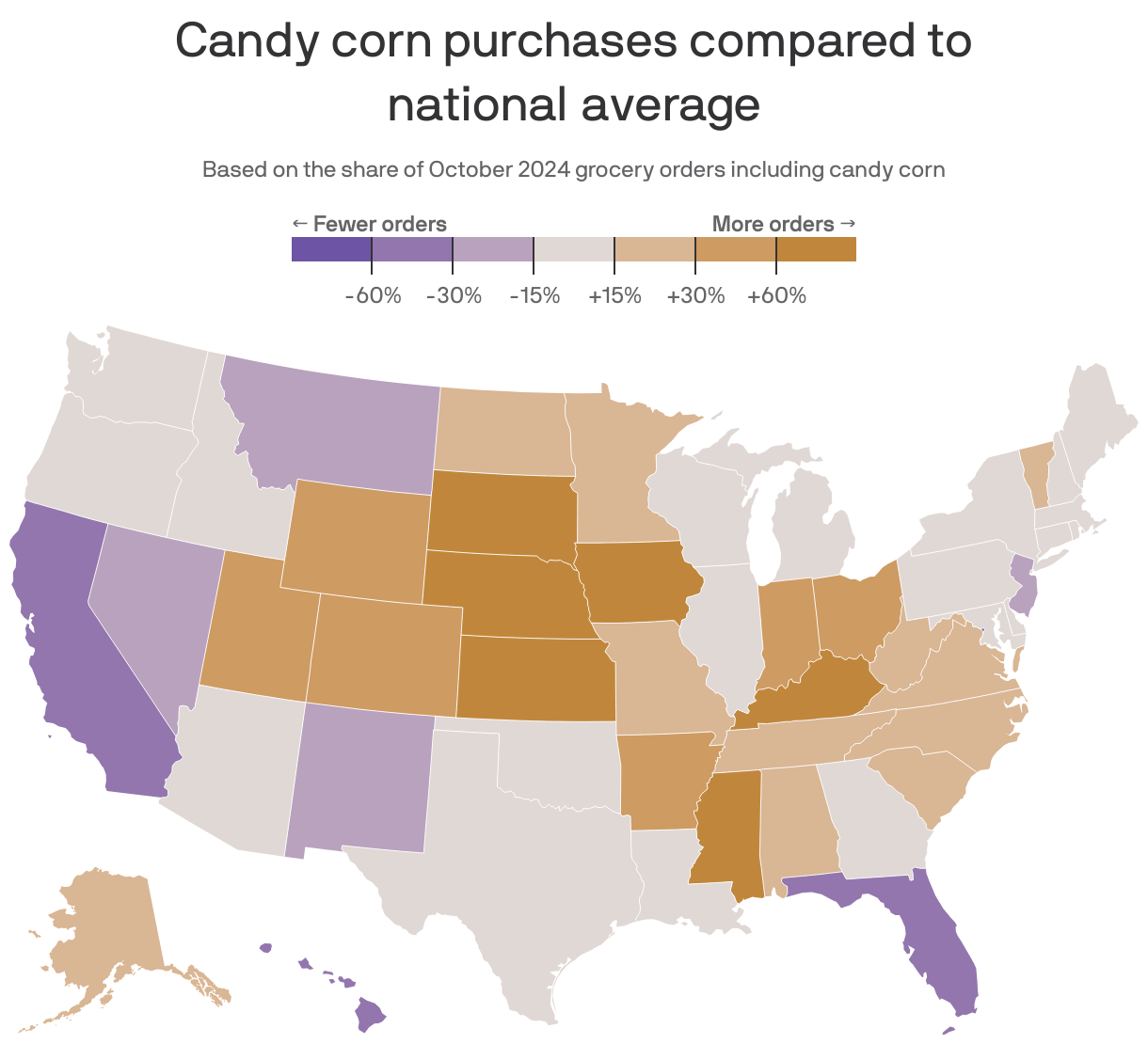
Some states in the U.S. buy more candy corn than others. Instacart data shows Mississippi, Nebraska, and Kentucky ordering a lot, while Hawai'i, Washington, D.C., and Florida order very little.
Key Facts
Instacart provided data about candy corn orders.
Mississippi, Nebraska, and Kentucky have the highest orders compared to the national average.
Hawai'i, Washington, D.C., and Florida have the least interest in candy corn.
The data compares the share of orders from last October with the national average.
Candy corn is a popular Halloween candy, often discussed in terms of preference and how people eat it.
Read the Original
Want the full story? Tap a source to open the original
article.
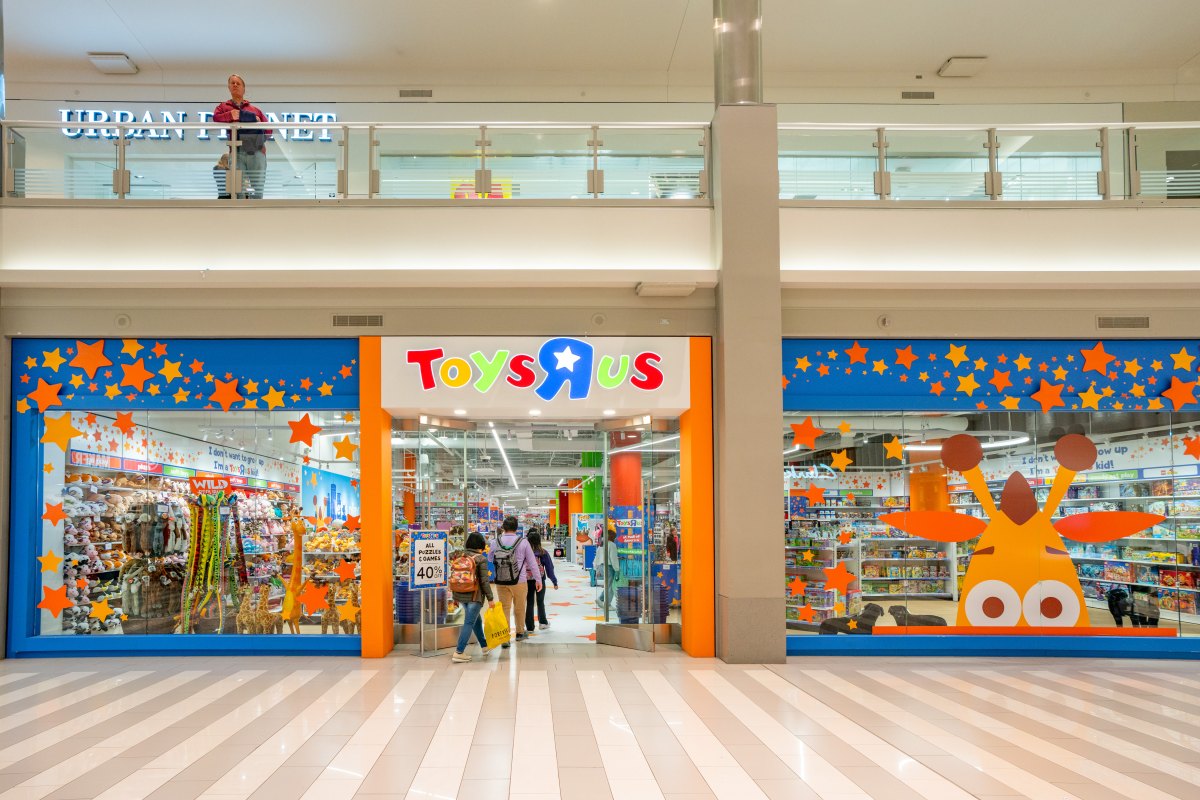
Toys R Us is expanding in the U.S. by opening more stores and seasonal shops ahead of the holiday season. The expansion is part of a partnership with Go! Retail Group and aims to reestablish the brand by increasing store presence across the country. The company had previously filed for bankruptcy in 2017 but has since been reopening various types of retail spaces.
Key Facts
Toys R Us is opening new flagship stores and seasonal holiday shops across the U.S.
The expansion is possible through a partnership with Go! Retail Group.
Toys R Us originally filed for bankruptcy in 2017 but has reemerged with new store formats.
The expansion includes both standalone locations and spaces within Macy's stores.
New stores are opening in locations like Chicago, California, Maryland, Iowa, and more.
Seasonal shops have already opened in several states for the holiday season.
Go! Retail Group CEO highlighted the importance of this expansion strategy for reaching customers during peak seasons.
The company is aiming to leverage its nostalgic value to attract customers in a competitive retail market.
Read the Original
Want the full story? Tap a source to open the original
article.
The United States and other countries are working to reduce their reliance on China for rare earth minerals, which are crucial for many high-tech products. Despite efforts to boost domestic production and secure alternative sources, experts believe it will take at least a decade to challenge China's current hold on the market. President Trump has signed several agreements to strengthen the U.S. supply chain of these minerals.
Key Facts
China is a major supplier of rare earth minerals, critical for tech products like smartphones and electric vehicles.
Experts say breaking China's grip on this market will take at least 10 years, even with significant investments.
The U.S. imports about 10,000 tonnes of rare earth magnets annually from China.
President Trump has been active in boosting U.S. access to rare earths through deals with countries like Pakistan and Ukraine.
The U.S. and Australia have agreed to invest $8.5 billion in rare earth projects to secure mineral supplies.
Australia’s mineral reserves are only about one-seventh the size of China's reserves.
Efforts to increase self-reliance in rare earths are also happening in Europe and Asia.
The European Union aims to process 40% of its mineral consumption within Europe by 2030.
Read the Original
Want the full story? Tap a source to open the original
article.
UK government borrowing in September was the highest for the month in five years, reaching £20.2 billion. Borrowing rose due to increased debt interest payments, despite higher tax income from changes like increased national insurance contributions.
Key Facts
UK borrowing in September was £20.2 billion, the highest in five years for that month.
Borrowing increased by £1.6 billion compared to September last year.
The rise in borrowing was due to increased debt interest payments.
From April to September, borrowing reached £99.8 billion, up £11.5 billion from the same period last year.
September's figures followed a similar trend in August, with borrowing at a five-year high for that month too.
The borrowing figure was slightly below analysts' predictions but aligned with earlier government forecasts.
Increased tax income was partly due to higher employers' national insurance contributions.
Pay raises and inflation also raised government running costs and state benefit costs.
Read the Original
Want the full story? Tap a source to open the original
article.
The automotive industry is adjusting to changes in buyer preferences, with companies like ZF altering their focus to include various types of vehicles, not just electric ones. This shift is influenced by market demands for more efficient and affordable powertrains, along with changes in U.S. trade policies under President Trump. The U.S. market for electric vehicles is currently stalled at 7.5% due to tariffs, price differences, and weak policies.
Key Facts
Automotive supplier ZF is expanding its focus to include multiple types of vehicles, including hybrids and internal combustion engines.
ZF initially stopped developing internal combustion engines but has reversed this decision due to changing market needs.
The company is also focusing on software-defined vehicles and automated driving technologies.
Regionalization involves making products in the same place where they are sold, which is a growing trend among manufacturers.
President Trump's tariff strategy encourages regionalization by offering cost benefits to companies that produce and sell within the U.S.
Electric vehicles currently account for 7.5% of new car sales in the U.S.
Market challenges for electric vehicles include tariffs, price differences, and weak supportive policies.
Read the Original
Want the full story? Tap a source to open the original
article.
Ferrari plans to release its new electric supercar, the Ferrari Elettrica, to customers in 2026. The company focuses on innovation and maintaining exclusivity by controlling production to ensure its cars remain special. Ferrari aims for a balanced mix of internal combustion, hybrid, and electric car sales by 2030.
Key Facts
Ferrari plans to introduce the battery-electric Elettrica supercar in 2026.
The company was founded in 1939 by Enzo Ferrari, originally focusing on V12 engines.
Ferrari has launched 41 new sports cars since its IPO in 2015.
Ferrari plans a sales mix of 40% hybrid, 40% internal combustion, and 20% electric by 2030.
The company aims to keep Ferrari cars scarce, targeting a wait list of 20 to 24 months for new models.
Ferrari's new E-Building at its Maranello headquarters produces battery modules for electric vehicles.
A new facility, the E-Vortex test track, is being built to develop new technologies on-site.
Ferrari promises to debut four new vehicles each year until 2030.
Read the Original
Want the full story? Tap a source to open the original
article.
Workers on the Isle of Man support a proposed 9.9% increase in the minimum wage from £12.25 to £13.46 due to rising living costs. However, the Minimum Wage Committee and business owners express concerns about potential negative impacts on businesses. The proposal uses a calculation based on median earnings, prompting debates about sustainability and effects on the local economy.
Key Facts
The proposed minimum wage increase is 9.9%, raising the wage from £12.25 to £13.46 per hour.
Tynwald, the island's parliament, is considering the proposal despite concerns from the Minimum Wage Committee.
The increase uses a basis of 66% of median earnings on the Isle of Man.
There is disagreement over the potential impact on businesses, with worries about closures and job losses.
Some workers support the raise, citing the rising cost of living and affordability issues.
Business owners argue that the increase is too high to absorb and might result in higher prices for goods and services.
The Isle of Man Chamber of Commerce warns about the risk of business and job impacts.
The debate includes discussions on controlling living costs in addition to wage increases.
Read the Original
Want the full story? Tap a source to open the original
article.
Anthony Cabrera finished building his house in New Jersey before new U.S. tariffs on imported home items took effect. These tariffs, including those on products like kitchen cabinets and furniture, have increased costs for building and renovating homes. Economists say the tariffs could worsen issues in the U.S. housing market by raising construction costs.
Key Facts
Anthony Cabrera completed his house in Hopatcong, New Jersey, just before new tariffs began.
His house's construction costs rose from about $300,000 to $450,000 due to higher prices for materials.
New tariffs affect items like kitchen cabinets, timber, and wooden furniture.
The U.S. government says the tariffs aim to boost domestic manufacturing and protect national security.
Economists warn that tariffs could worsen U.S. housing market conditions by raising costs further.
Other 2023 tariffs included a 50% tariff on steel and copper imports.
A Goldman Sachs report indicates U.S. consumers might bear up to 55% of the tariff costs this year.
Companies like IKEA may raise prices due to increased import costs.
Read the Original
Want the full story? Tap a source to open the original
article.
Argentina's central bank agreed to a $20 billion currency swap deal with the U.S. Treasury to help stabilize its exchange rate. The deal allows Argentina to increase its monetary policy tools and improve its foreign exchange reserves. The arrangement comes before an important midterm election in Argentina.
Key Facts
Argentina's central bank signed a $20 billion currency swap deal with the U.S. Treasury.
The deal aims to stabilize Argentina's exchange rate and increase monetary policy tools.
Argentina's peso dropped to a record low, weakening by 1.7% to 1,475 per dollar.
The swap deal is part of Argentina's strategy to handle foreign exchange market changes.
The U.S. Treasury hasn't released details about the swap arrangement.
U.S. support depends on Argentina continuing economic reforms for private sector growth.
Argentina's midterm election is important for President Milei's party, which aims to expand its legislative presence.
President Trump commented that U.S. support may depend on Argentina's election outcome, but officials later stressed good policies are more crucial.
Read the Original
Want the full story? Tap a source to open the original
article.