The Rolling Stones released a new music video for their song "In the Stars" that uses artificial intelligence (AI) to create younger-looking digital versions of band members Mick Jagger, Keith Richards, and Ronnie Wood. The video shows them as they appeared many years ago.
Key Facts
The Rolling Stones have a new music video for the song "In the Stars."
The video features digitally created younger versions of Mick Jagger, Keith Richards, and Ronnie Wood.
Artificial intelligence (AI) technology was used to make these de-aged digital versions.
The digital images resemble how the band members looked decades ago.
This is an example of a famous band using AI in music and visual media.
Read the Original
Want the full story? Tap a source to open the original
article.
Elon Musk and Sam Altman, co-founders of OpenAI, have been involved in a legal trial where Musk accused Altman of cheating him out of millions of dollars and breaking the original promise of making OpenAI a non-profit organization. Both Musk and Altman gave testimony in court, and the case may have significant effects on the future development of artificial intelligence.
Key Facts
The trial took place in a federal court in California over three weeks.
Musk claims that Altman swindled him out of millions of dollars.
Musk also says Altman abandoned OpenAI’s original non-profit mission.
Both Elon Musk and Sam Altman testified during the trial.
OpenAI is the company that created the AI program ChatGPT.
The case is seen as important for the future direction of artificial intelligence.
The trial has ended and the jury is now deciding the outcome.
The information comes from a BBC report summarizing the trial proceedings.
Read the Original
Want the full story? Tap a source to open the original
article.
A New Jersey man named Conor Shannon plans to sue Uber and the autonomous vehicle company Avride after a collision with Avride’s delivery robot caused him injuries. The robot unexpectedly entered a bike lane, leading to the crash in October 2025, and reportedly tried to leave the accident scene.
Key Facts
The crash happened on October 22, 2025, on Varick Street in Jersey City.
Conor Shannon was riding his bike home and hit an Avride delivery robot that suddenly moved into the bike lane.
Shannon suffered a concussion and a broken collarbone and is still recovering.
Avride’s robots are about 33 inches tall, move up to 5 mph, and use multiple sensors to avoid collisions.
Avride said their robots follow traffic laws and safety rules and value community safety.
Uber partnered with Avride in October 2024 to use these delivery robots and has expanded the service to several U.S. cities.
Shannon’s lawyer claims Avride is using cities like Jersey City to test its robots in real-world conditions.
The lawsuit had not been officially filed but was planned to be filed soon.
Read the Original
Want the full story? Tap a source to open the original
article.
Russia announced a successful test of its new long-range missile called the Sarmat, which can carry multiple nuclear warheads. Meanwhile, NASA and private companies like SpaceX and Blue Origin are preparing new rockets for space missions, and an Indian startup, Skyroot Aerospace, is close to launching its first commercial rocket.
Key Facts
Russia tested its Sarmat intercontinental ballistic missile (ICBM) successfully at a site in northern Russia.
The Sarmat missile is designed to carry several nuclear warheads and evade missile defenses.
Russia plans to deploy the Sarmat missile for active use later this year.
NASA is assembling its third Space Launch System rocket at Kennedy Space Center in Florida.
SpaceX is preparing to launch its upgraded Starship Version 3 rocket from Texas.
Blue Origin is working on its New Glenn rocket and Blue Moon lander for future missions.
Indian company Skyroot Aerospace is close to launching its first orbital rocket, Vikram-1.
Skyroot raised $60 million recently, valuing the company at $1.1 billion, and was started by a former Indian space agency engineer.
Read the Original
Want the full story? Tap a source to open the original
article.
A recent shooting involving streamer Dalton Eatherly, known as "Chud the Builder," highlights how social media rewards extreme and harmful behavior. Experts say online platforms use algorithms that encourage creators to push boundaries for views and money, blending online actions with real-world consequences.
Key Facts
Dalton Eatherly, aka "Chud the Builder," has gained attention for racially abusive videos and provoking viewers.
He was involved in a shooting outside a Tennessee courthouse and faces attempted murder charges, claiming self-defense.
Social media algorithms prioritize extreme and emotional content to maximize user engagement.
This encourages content creators to produce more extreme and controversial material for attention and profit.
The article references Aristotle’s idea that repeated exposure changes what people find acceptable or normal.
Yale research shows users express increasing outrage on platforms when it is rewarded with likes and shares.
A 2025 study found Twitter’s ranking system boosts emotionally charged and hostile political content more than a simple chronological feed.
Philosopher Guy Debord’s work is used to explain how camera and social media interact to create and escalate real-life events.
Read the Original
Want the full story? Tap a source to open the original
article.
Scientists have found that many common vaccines might lower the risk of dementia. One idea is that vaccines could train a part of the immune system, called innate immunity, which was once thought to be unchangeable, to better protect the brain.
Key Facts
Vaccines for flu, RSV, tetanus, diphtheria, pertussis, pneumococcal infections, hepatitis A and B, and typhoid are linked to lower dementia risk.
The shingles vaccine shows one of the strongest associations with decreased dementia risk.
Vaccines work by training adaptive immunity, which learns and remembers specific germs.
Innate immunity is the body’s first, general defense against germs and injury, previously believed to be untrainable.
The concept of “trained immunity” means innate immune cells can be primed to respond faster and stronger to threats after initial exposure.
These changes involve epigenetic modifications, which alter gene behavior without changing DNA.
The BCG vaccine, for tuberculosis, helped researchers discover trained immunity.
Understanding trained immunity may help create new ways to treat or prevent dementia.
Read the Original
Want the full story? Tap a source to open the original
article.
The race between the U.S. and China to develop advanced artificial intelligence (AI) involves three main issues: competing AI models, differing state and federal laws in the U.S., and European AI policies. U.S. officials, including during President Trump's summit with China, are trying to balance competition with safety concerns and talks about global cooperation on AI rules.
Key Facts
The U.S. and China are competing to lead in advanced AI technology.
U.S. officials want to ensure AI safety and decide which technology China can access.
The U.S. currently leads in AI, but China’s top model is only about eight months behind.
Some U.S. lawmakers want stricter rules to protect against China stealing AI technology.
AI companies and the Trump administration prefer one national AI law rather than conflicting state laws.
Several states are passing similar AI safety laws, creating a practical national standard.
Leading AI companies support state laws that require safety reports from AI labs.
There are political challenges as many Americans are skeptical about AI’s positive impact.
Read the Original
Want the full story? Tap a source to open the original
article.
Social media platform X, owned by Elon Musk, has agreed to review reports of illegal hate and terrorist content in the UK within 24 hours on average. This commitment follows pressure from the UK regulator Ofcom, which is monitoring how well major platforms handle such reports to protect users.
Key Facts
X will aim to review 85% of reported illegal hate and terrorist content within 48 hours.
The UK regulator Ofcom will receive data from X every three months for a year to check progress.
X promised to engage with experts to improve its reporting systems for illegal content.
X will block UK access to accounts linked to terrorist groups banned in the UK.
Ofcom launched a compliance program to assess how large social media companies manage illegal content reports.
There is ongoing concern about terrorist and hate speech content remaining on big social media platforms.
X is under investigation for its AI tool Grok, related to generating inappropriate images.
Recent attacks on Jewish communities in the UK have increased calls for stricter online safety measures.
Read the Original
Want the full story? Tap a source to open the original
article.
Elon Musk’s X platform agreed with the UK regulator Ofcom to block access in the UK to accounts linked to banned terrorist groups. X will also review most reported illegal terrorist and hate content within 48 hours and get expert advice on handling such reports.
Key Facts
X promised to block UK access to accounts connected to terrorist groups banned by the UK government.
The platform will review at least 85% of illegal terrorist and hate content reported through its tools within 48 hours.
Ofcom, the UK communications regulator, made this agreement to improve how social media handles terrorist and hate content.
Ofcom will monitor X closely to ensure it follows through on these promises.
The agreement comes amid concerns over online hate and terrorist content, especially after hate crimes against the UK’s Jewish community.
Ofcom is also investigating X for showing manipulated images created with Musk’s Grok AI tool.
Some experts praised the agreement as a positive step but said X still has problems addressing racism.
X has faced criticism for its content moderation since Elon Musk bought the platform in 2022.
Read the Original
Want the full story? Tap a source to open the original
article.
Tech companies are using artificial intelligence (AI) to reduce the number of middle managers. This change is making managers take on more work while relying on AI tools to help with tasks like coding and employee evaluations.
Key Facts
Tech companies like Coinbase, Amazon, Block, and Meta have cut many jobs, focusing on reducing management layers.
AI allows companies to do more with fewer workers and to flatten their management structures.
Middle managers now have more responsibilities, often needing to both supervise and produce work.
AI tools are used to speed up tasks such as drafting documents, taking notes, evaluating employees, and generating code.
This shift may make jobs harder for employees because managers have less support.
Middle manager job openings in the U.S. dropped by 42% from 2022 to the end of 2025.
Managers are trying new ways to work, like using AI bots to communicate with their teams asynchronously.
Experts say companies are still figuring out the best way to manage with fewer middle managers and more AI.
Read the Original
Want the full story? Tap a source to open the original
article.
The Velotric Discover 3 is a commuter bike that aims to balance comfort, reliability, and affordability, costing under $2,000. It features a new mid-frame motor with a torque sensor for better pedal assistance, and Shimano’s updated Cues drivetrain, offering improved gear shifting and integration.
Key Facts
The Discover 3 is the third model in Velotric’s commuter bike line and is more expensive than the original Discover 1.
It replaces a hub motor with a mid-frame motor that uses a torque sensor to assist pedaling based on pedal force.
The torque sensor provides a more natural feel compared to cadence sensors, which only detect if pedals are spinning.
Using a cadence sensor mode can drain the battery faster, as it allows the motor to do more work without pedaling effort.
The bike includes Shimano’s new Cues groupset, designed to be interoperable across different bike types.
The Cues drivetrain improves gear shifting quality and offers a useful range of eight gears.
The bike has thumb trigger shifters instead of cheap plastic ones used in earlier low-end models.
Velotric has expanded its presence in the U.S. and moved towards higher-end features with the Discover 3.
Read the Original
Want the full story? Tap a source to open the original
article.
Anthropic is developing Claude Code, a software tool that helps create other software using artificial intelligence. Due to rapidly increasing user demand and more complex uses, Anthropic faced computer processing shortages. The company is adding new features and increasing usage limits to better support users and expects AI improvements will guide future product plans.
Key Facts
Claude Code is an AI-powered tool from Anthropic that aids software development.
User demand grew 80 times faster than Anthropic anticipated, causing computing resource shortages.
Anthropic increased usage limits for paid users after partnering with SpaceX for more computing power.
The product expanded from command line tools to integrated desktop and web app versions.
Anthropic is testing ways to manage demand, such as stricter usage limits during busy times and adjusting subscription plans.
The company released many new features for managing multiple AI agents and workflows.
Anthropic’s product team works in quick development cycles, experimenting to find new uses and improve the tool.
Competitors like OpenAI and GitHub are also releasing AI coding tools with different features to improve efficiency.
Read the Original
Want the full story? Tap a source to open the original
article.
British game developer Playground Games created Forza Horizon 6, a racing game set in Japan. To make the game realistic, they spent years researching with photos, videos, and experts to accurately show Japan’s landscape and car culture.
Key Facts
Forza Horizon is a series of open-world driving games first released in 2012.
Playground Games sends design teams to real locations to gather photos and videos before building the game maps.
Japan was chosen as the setting for Forza Horizon 6 after years of preparation and research.
The team hired cultural consultant Kyoko Yamashita to advise on authentic Japanese details.
They worked with local car culture experts, including a Kyoto bodyshop and a car photographer featured in the game.
The game includes famous Japanese drift cars like the Nissan Skyline and Toyota Supra.
They recreated Japan’s touge mountain road racing culture with carefully chosen routes and cars.
To capture details, the team used 360-degree cameras for their reference photography.
Read the Original
Want the full story? Tap a source to open the original
article.
About half of the new online articles are now written mostly by artificial intelligence (AI), but this number has stopped growing and stayed steady for over a year. This means AI has not completely taken over online writing, although AI-written content keeps getting better.
Key Facts
AI-generated articles rose quickly after ChatGPT launched in November 2022.
Within one year, AI wrote about 36% of new online articles; within two years, close to 48%.
Since early 2025, the share of AI-written articles stays near 50%.
The data comes from analyzing over 55,000 English webpages published from 2020 to 2026.
Three AI-detection tools were used to classify if articles were mostly AI-written.
Many articles are a mix of human and AI efforts, making exact counts tricky.
Experts warn that if AI content feeds future AI training without fresh human knowledge, quality could suffer.
AI-written content is improving and sometimes matches or beats human writing in quality.
Read the Original
Want the full story? Tap a source to open the original
article.
Two tech leaders, Elon Musk and Sam Altman, are in a court trial over claims Musk made that Altman cheated him in a charity-related issue connected to OpenAI, the company behind ChatGPT. The trial revealed many details about their business dealings, Altman’s character, and the involvement of other tech figures, as the judge and jury consider the evidence.
Key Facts
Elon Musk claims that Sam Altman lied about keeping OpenAI as a non-profit and stole a charity, which Altman denies.
Several tech figures, including OpenAI co-founder Ilya Sutskever and Microsoft CEO Satya Nadella, testified that they saw no proof of Musk’s claim about the non-profit status.
Microsoft, a major investor in OpenAI, is also involved in the case as a co-defendant accused of helping Altman’s alleged scheme.
Altman’s trustworthiness was questioned during the trial, with his past and business practices examined closely.
The court heard about Altman’s large investments in startups, including Helion Energy, a nuclear energy company where he held a high-level position.
A judge is overseeing the trial, guiding the jury that will decide the outcome based on the evidence presented.
The case has revealed more complex disputes beyond just Musk and Altman’s personal conflict, involving other tech industry leaders and business relationships.
Read the Original
Want the full story? Tap a source to open the original
article.
Researchers have found many anti-immigration social media accounts targeting the UK that are actually run from countries like Sri Lanka and Vietnam. These accounts use AI-generated videos and posts to show misleading stories about the UK’s future, often suggesting the country is in decline due to immigration.
Key Facts
The "Great British People" Facebook page claims to be from Yorkshire but is run from Sri Lanka.
The accounts use AI to create fake videos showing the UK in decline and dominated by Muslims.
These social media pages have millions of views and share content suggesting mass immigration harms the UK.
The creators are located in various countries, including Sri Lanka, the US, Europe, Vietnam, the Maldives, Iran, and the UAE.
Some accounts show sympathy to the Russian and Iranian governments, though direct state involvement is unclear.
Experts say AI-made fake content can make people distrust real information.
London’s Mayor says some accounts are motivated by money, others possibly by hostile states.
The fake videos often show British cities in 2050 with misleading scenes of Islamic culture taking over.
Read the Original
Want the full story? Tap a source to open the original
article.
Orchid breeding is a competitive and profitable field that uses genetic tools to create new flower varieties faster. Companies conduct genetic tests on young plants to find desired traits, speeding up the traditional breeding process that can take years.
Key Facts
The global orchid market is worth hundreds of millions of dollars.
Developing a new orchid variety can take about ten years of work.
Many commercial orchids have complex genetics due to long-term selective breeding.
Companies use genetic markers to identify traits like color, shape, disease resistance, and flower lifespan early on.
Eben Upton, founder of Raspberry Pi, warned that people might wrongly believe artificial intelligence (AI) can replace many tech jobs. This could discourage people from learning tech skills and hurt the economy by causing a shortage of engineers.
Key Facts
Eben Upton is the founder of Raspberry Pi, a British computer maker.
He said people often overestimate what AI tools like ChatGPT can do.
Some companies have blamed AI for large layoffs, but experts think AI is sometimes an excuse for job cuts.
Overestimating AI might stop people from choosing tech careers, making skill shortages worse.
Upton advised waiting several years before making decisions about education related to AI’s impact.
Raspberry Pi is popular for teaching programming and is the UK’s top-selling computer maker.
Raspberry Pi became a public company in 2024 on the London Stock Exchange.
High energy costs in the UK are a challenge for engineering firms like Raspberry Pi.
Read the Original
Want the full story? Tap a source to open the original
article.
Elon Musk sued OpenAI and its leaders, claiming they broke a promise to keep the company a charity and instead made profits for insiders. Lawyers from both sides made their final arguments as jurors prepare to decide if OpenAI acted improperly. The case also involves Microsoft, a major investor in OpenAI.
Key Facts
Elon Musk, founder of a competing AI called Grok, filed the lawsuit against OpenAI, CEO Sam Altman, and president Greg Brockman.
Musk alleges OpenAI moved away from being a charity and wrongly made money for investors and insiders.
Musk is not in court for the final arguments because he is on a diplomatic trip to China with President Donald Trump.
Musk’s lawyer accused Sam Altman of lying under oath, citing testimony from five witnesses who worked closely with Altman.
OpenAI’s lawyers said Musk waited too long to sue and that he wanted to control the company for profit.
Microsoft invested $1 billion in 2019 and $10 billion in 2023, and Musk’s lawyer claims Microsoft knew about OpenAI’s actions.
A judge said if the jury finds Musk filed the lawsuit too late, the case will likely be dismissed.
The trial’s outcome could affect OpenAI’s upcoming plan to sell shares publicly in one of the largest stock sales ever.
Read the Original
Want the full story? Tap a source to open the original
article.
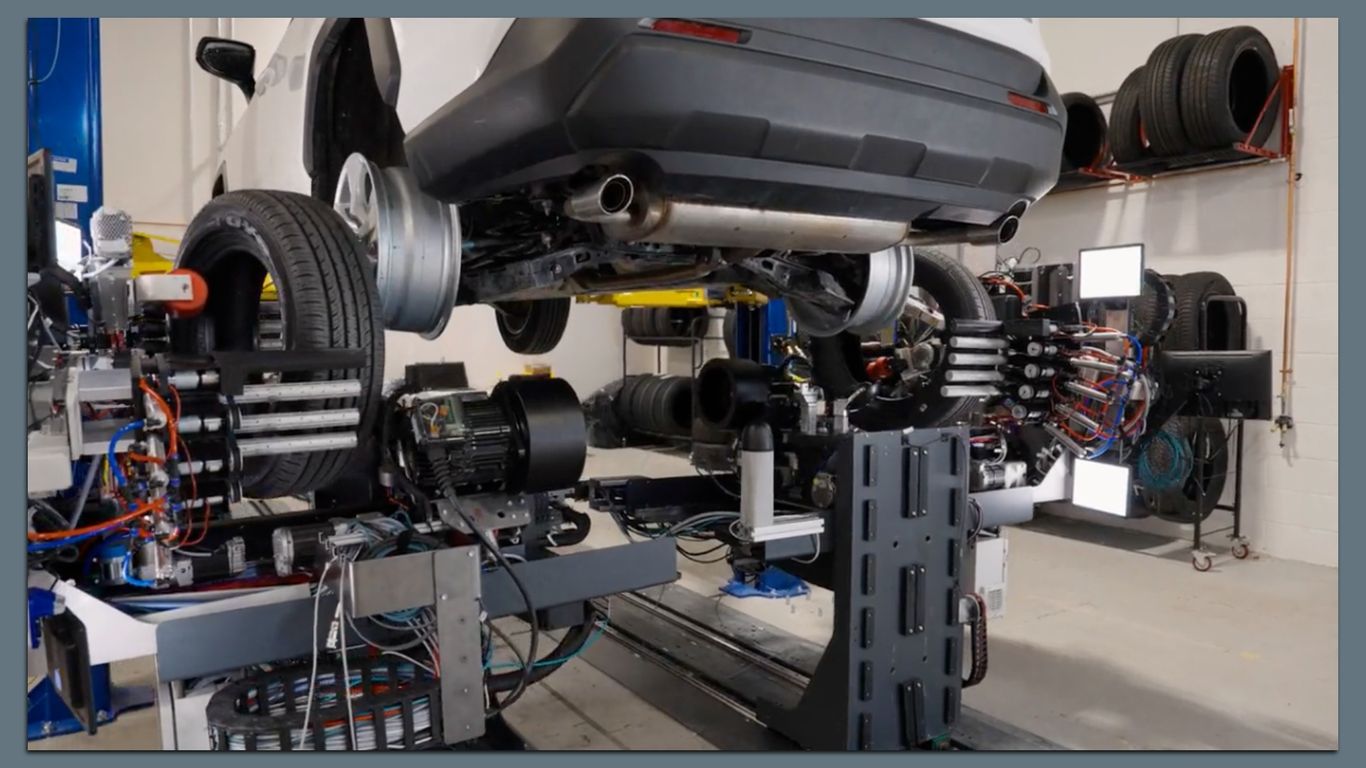
A new AI-powered robot called SmartBay can change and balance tires in about 30 minutes, much faster than the usual 75 minutes with humans. This system helps tire shops work faster and save money by letting one technician run multiple service bays at the same time.
Key Facts
SmartBay is a robotic system that inspects vehicles, changes tires, and balances wheels with little human help.
It uses AI to adjust its work based on the specific vehicle and collects data during the process.
The system fits into a standard 12-foot service bay.
One technician can manage up to three bays with the robot’s help.
Tire changes take about 30 minutes with the robot, compared to 75 minutes manually.
This means a technician can handle up to 24 tires per hour instead of just 4.
The company leases SmartBay to shops for $4,900 per month, which is cheaper than hiring an experienced technician.
The creator, Andy Chalofsky, has a history of building successful tire businesses and aims to modernize tire installation.
Read the Original
Want the full story? Tap a source to open the original
article.