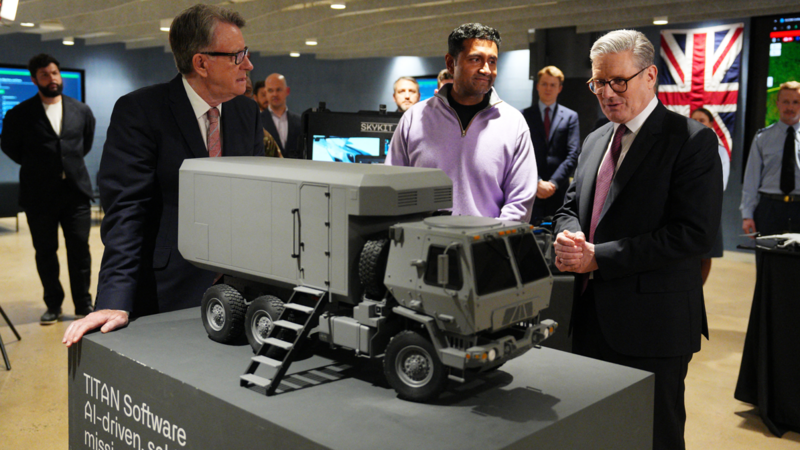
A small British company called Skycutter won a U.S. military drone competition with its attack drone, which was developed with a Ukrainian partner. The competition aims to improve drone technology for U.S. troops by creating many reliable and affordable drones.
Key Facts
The U.S. held a drone competition called Gauntlet in February at Fort Benning, Georgia.
Skycutter scored 99.3 points, beating other competitors like California’s Neros.
Skycutter’s drone is based on a Ukrainian design made by SkyFall, a company producing many drones very quickly.
The drone was redesigned to avoid using any Chinese parts, meeting U.S. program rules.
The drone can be controlled over fiber optic cable, which helps prevent electronic interference like jamming.
About 25 companies joined the competition, including Auterion and Teal Drones.
The U.S. Defense Department’s Drone Dominance program wants many affordable and expendable drones for the military.
Skycutter holds contracts for over 2,500 drones and plans to expand manufacturing in the U.S.
Read the Original
Want the full story? Tap a source to open the original
article.
Three companies—Waymo, Tesla, and Uber—are leading the development of self-driving vehicle technology in the United States. Each company has different strengths and strategies as they work to build large-scale autonomous vehicle services like robotaxis.
Key Facts
Waymo operates robotaxis in 11 cities and completes 500,000 paid trips per week.
Waymo has driven 200 million miles fully without drivers and has $16 billion in funding from its parent company Alphabet.
Waymo provides self-driving technology but does not make cars or run full vehicle maintenance.
Uber has a strong ride-matching platform from 15 years of experience and is investing $100 million in charging hubs for autonomous vehicles.
Uber partners with many autonomous vehicle developers but depends on others to supply and maintain robotaxi cars.
Tesla collects data from over 3 million vehicles, including 1.1 million on its supervised driving system, to improve its self-driving tech.
Tesla’s full self-driving system still requires driver supervision and has only a limited robotaxi service running.
Tesla’s robotaxi plans include a Cybercab without traditional controls, but it hasn’t yet received regulatory approval.
Read the Original
Want the full story? Tap a source to open the original
article.
Arc Raiders is a popular video game set in a dangerous future where players must avoid deadly robots and survive by scavenging. Unexpectedly, many players have chosen to cooperate, talk, and help each other instead of fighting, creating a more peaceful gameplay experience than the developers expected.
Key Facts
Arc Raiders is a shooter game released late last year with over 14 million copies sold.
The game takes place in a post-apocalyptic world where humans live underground and face killer AI robots called Arcs.
Players can shoot each other to steal loot, which is common in extraction shooter games.
About 20% of players have never attacked another player, and half have attacked fewer than 10 times.
Many players cooperate to fight robots together or sneak around to collect resources quietly.
Some players organize informal gatherings where they chat and play music through their microphones.
Conversations between players often include personal topics like family, work, and health struggles.
The game designers were surprised and pleased that players preferred cooperation over conflict.
Read the Original
Want the full story? Tap a source to open the original
article.
The article compares the approaches of the U.S. and China toward artificial intelligence (AI) development. While the U.S. leads in AI research and innovation, China has a strong national strategy that integrates AI into its industries and government planning, giving it an edge in practical AI use, especially robotics.
Key Facts
The U.S. created leading AI companies like OpenAI, Google, and Meta, supported by universities and investors.
The U.S. government released a short AI policy framework in March, which is a proposal, not a law, and may take years to implement.
China’s AI strategy is deeply linked to state planning and coordinated across industries, military, and the Communist Party.
Chinese AI companies include ByteDance, Baidu, Alibaba, Tencent, and Huawei.
China has been focused on AI for over 15 years and has developed strong national rules for robotics since 2015.
Unlike the U.S., China quickly integrates AI into factories and other real-world uses.
The U.S. is still debating whether it needs a national robotics strategy.
Experts warn that while the U.S. leads in AI models and chips, China may lead in data, implementation, and robotics, which could affect global power dynamics.
Read the Original
Want the full story? Tap a source to open the original
article.
A startup called You, Only Virtual uses artificial intelligence (AI) to create digital versions of people who have died. These AI replicas learn from a person’s past texts and voice recordings, allowing loved ones to interact with them again. This technology changes how people experience grief by offering a new way to stay connected.
Key Facts
You, Only Virtual is a company that builds AI versions of deceased people using their digital history.
Founder Justin Harrison created an AI version of his terminally ill mother in 2020 to help with his grieving process.
The company offers free text-based AI chats and paid options for voice calls with the AI.
Similar platforms like HereAfter AI, StoryFile, and Replika also use AI to help people interact with memories of deceased loved ones.
Advances in voice cloning and AI have made this technology more realistic and affordable.
These AI tools do more than preserve memory; they respond and interact in ways that feel like the person is still present.
Psychologists explain grief as the brain’s way of adjusting to a permanent loss, and AI may change how people experience this process.
Some critics are concerned about the ethics of charging for access to AI versions of dead people and the possible effects on emotional healing.
Read the Original
Want the full story? Tap a source to open the original
article.
A woman on TikTok shared a video showing how she used a £1 face paint bought at a farm market as a makeup foundation. Her video gained millions of views and sparked discussion about the product’s coverage, cost, and possible effects on the skin.
Key Facts
TikTok user Keeley posted a video applying cheap face paint as foundation, which went viral with 2.6 million views.
She bought the face paint for about £1 ($1.36) at a farm market.
The face paint covered both her face and a tattoo effectively.
Makeup foundation prices online range from 99 cents to $99.99.
A survey showed women spend on average $37 per month or $1,064 per year on beauty products.
Some viewers warned the face paint might dry out the skin, crack, or flake during the day.
Others said face paint can be breathable and work well as a base with powder makeup.
The woman said her face paint lasted 11 hours and rated it 7.5 out of 10 in wearability.
Read the Original
Want the full story? Tap a source to open the original
article.
Social media influencer Androgenic responded after fellow influencer Clavicular, whose real name is Braden Peters, was taken to the hospital for a suspected overdose. The incident happened during a livestream at a Miami bar when Clavicular suddenly became unresponsive.
Key Facts
Clavicular is a well-known member of the “looksmaxxing” community online.
During a livestream, Clavicular was seen slumped and unresponsive at a Miami bar.
Androgenic was with Clavicular and offered him “addy,” a slang term for Adderall, a prescription stimulant.
The livestream ended abruptly when the situation was noticed.
Androgenic said they quickly turned off the stream and took Clavicular to the hospital.
Androgenic explained that stimulants can sometimes reduce breathing problems but he did not give more once Clavicular became unresponsive.
No further medical updates about Clavicular have been shared yet.
This story is ongoing and more information may come later.
Read the Original
Want the full story? Tap a source to open the original
article.
Apple has released the new MacBook Air with the M5 chip, making it faster and more powerful than previous models. It starts at £1,099 and offers longer battery life, improved storage speed, and modern connectivity features like wifi 7 and Bluetooth 6.
Key Facts
The new MacBook Air uses Apple’s M5 chip, which is 10-20% faster than the previous M4 chip.
It offers 512GB of storage as a starting point, which is twice as fast as before.
Battery life can last over 17 hours of typical office work and about 10 hours for heavier tasks like video editing.
The laptop features a 13.6-inch screen with a 60Hz refresh rate, while faster 120Hz screens are reserved for higher-end Apple products.
Connectivity includes wifi 7, Bluetooth 6, and two Thunderbolt/USB 4 ports.
The MacBook Air is made with 55% recycled materials and has a battery designed to last more than 1,000 full-charge cycles.
Prices start at £1,099 for the 13-inch model and £1,199 for the larger 15-inch version.
The MacBook Air remains Apple’s thinnest laptop with a recycled aluminum body and a high-quality keyboard and trackpad.
Read the Original
Want the full story? Tap a source to open the original
article.
Newsweek and Statista are conducting the sixth annual survey to rank the World's Best Smart Hospitals. The survey looks at how hospitals use new technologies like virtual care, remote monitoring, and artificial intelligence to improve patient treatment.
Key Facts
Smart hospitals use advanced technology to improve healthcare services.
Technologies include virtual care platforms, remote patient monitoring, and AI-supported data workflows.
Newsweek and Statista partner to rank the world's best smart hospitals.
The survey evaluates hospitals’ progress in adopting these technologies.
Healthcare professionals worldwide are invited to participate.
The survey is open until June 5, 2026.
Results may be used for other related rankings in healthcare.
Read the Original
Want the full story? Tap a source to open the original
article.
Apple plans to release smart glasses by late 2026 or early 2027. These glasses will look similar to normal eyewear but have cameras, sensors, and voice assistant features linked to the iPhone without showing digital displays.
Key Facts
Apple is testing at least four different frame styles, including rectangular and rounded shapes.
The glasses will be made with premium materials and come in various colors and finishes.
They are designed for tasks like taking photos, making calls, and using a voice assistant.
The glasses will not have built-in screens but will provide audio feedback and connect to the iPhone.
Cameras on the glasses will have vertically oriented oval lenses with subtle lights to show when in use.
Artificial intelligence will help the glasses understand context and improve user experience.
Apple aims to make the glasses look natural and less noticeable compared to current smart glasses.
Public reactions show some people are concerned about privacy because of the built-in cameras.
Read the Original
Want the full story? Tap a source to open the original
article.
NASA astronaut Christina Koch returned to Earth after nearly 10 days in space on the Artemis II mission, which flew around the moon. She shared a video of her emotional reunion with her dog Sadie, showing the strong bond between them after her long trip.
Key Facts
Christina Koch was a mission specialist on NASA’s Artemis II flight.
The Artemis II mission was the first crewed lunar flyby in over 50 years.
The crew traveled as close as 4,067 miles above the moon’s surface.
The mission lasted nearly 10 days, launching on April 1 and returning April 10.
Koch shared a video on Instagram showing her dog Sadie excitedly greeting her at home.
Koch previously set a record for the longest single spaceflight by a woman with 328 days on the International Space Station.
After returning, the Artemis II crew went to Johnson Space Center for health checks and reconditioning.
The video highlighted the personal side of space travel through the bond between astronaut and pet.
Read the Original
Want the full story? Tap a source to open the original
article.
The article discusses research about how self-driving cars communicate with people on the road. It also looks at a marine traffic app used to track ships and updates to age checks on a children's gaming platform called Roblox.
Key Facts
Chris Vallance reports on research about self-driving cars' communication with other road users.
The article includes an experience with a virtual self-driving vehicle.
It mentions the MarineTraffic app, which tracks ship movements in the Strait of Hormuz.
The article discusses changes to how Roblox checks the ages of its child users.
The program is hosted by Chris Vallance and produced by Tom Quinn.
Read the Original
Want the full story? Tap a source to open the original
article.
The article explains that the unpredictability, or volatility, of cryptocurrency prices is not a flaw but a key attraction for investors. It argues that this volatility creates opportunities for high returns, making crypto a valuable, though small, part of a diverse investment portfolio.
Key Facts
Volatility in cryptocurrency is seen as a core feature, not a problem.
Some investors use crypto as a small part of their portfolio for potential high returns.
High-risk assets like crypto can lead to significant returns but come with uncertainty.
Bitcoin has experienced large price drops but remains among the top performers over the last decade.
A mature asset typically offers lower volatility and lower potential returns.
Volatility in crypto indicates it is still a developing asset class.
Including crypto in a portfolio can boost overall returns without excessive risk, if kept a small part.
Volatility might encourage short-term speculation but can benefit long-term investors.
Read the Original
Want the full story? Tap a source to open the original
article.
Amazon plans to spend $11.57 billion to buy the satellite company Globalstar. This purchase will help Amazon expand its satellite internet services, competing with Elon Musk's Starlink. The deal means Amazon will take over Globalstar's infrastructure and aims to have thousands of satellites in orbit by 2028.
Key Facts
Amazon will pay $11.57 billion to acquire Globalstar.
The purchase is part of Amazon's plans to grow its satellite internet business, known as Leo.
Amazon intends to deploy a new satellite system by 2028 to compete with Starlink.
Starlink, owned by Elon Musk, has over 10,000 active satellites and millions of users.
Amazon's Leo currently has around 200 satellites, with a goal of increasing to thousands.
Amazon's acquisition includes Globalstar's operations in several global locations.
Globalstar has been in satellite communications since 1991 and works with Apple for emergency services.
Amazon offers investors $90 per share or equivalent in Amazon stock for Globalstar shares.
Read the Original
Want the full story? Tap a source to open the original
article.
OpenAI has introduced a new plan to make advanced AI models for cybersecurity more available, while ensuring strict controls on access. The company released a model called GPT-5.4-Cyber to help with cybersecurity tasks, focusing on defensive work and verifying users to prevent misuse.
Key Facts
OpenAI launched GPT-5.4-Cyber, a model focusing on cybersecurity tasks.
The plan aims to balance access with security by verifying users' identities.
OpenAI wants to provide these tools to thousands of vetted users and security teams.
The Trusted Access for Cyber program offers different levels of access depending on verification.
The new approach allows more users while still trying to keep harmful users out.
OpenAI's rollout is gradual, starting with vetted vendors and organizations.
For now, U.S. government agencies do not have access to GPT-5.4-Cyber.
There are ongoing discussions about expanding access, reviewed through internal processes.
Read the Original
Want the full story? Tap a source to open the original
article.
Palantir, a tech company, is defending its data management services for the UK's National Health Service (NHS) following demands for more oversight from British lawmakers. The company has faced criticism over security concerns and its connection with foreign entities, while some politicians emphasize the importance of keeping patient data secure and within the UK.
Key Facts
Palantir is involved in a contract with NHS England to link various medical databases.
The contract is worth £300 million and will be reviewed early next year.
Some UK politicians are concerned about a foreign company's involvement with sensitive health data.
Palantir claims they do not have access to or use UK patient's personal data.
There are criticisms linked to Palantir's association with the CIA and its founder's political ties with President Trump.
Palantir says its software helps improve NHS efficiency by simplifying data access and management.
UK politicians emphasize that patient data must remain under NHS control.
Read the Original
Want the full story? Tap a source to open the original
article.
Apple is not investing heavily in AI technology like its competitors but may still benefit from the growing use of AI. The company focuses on selling high-end consumer products and leveraging its App Store, potentially gaining from others' investments in AI.
Key Facts
Apple isn't spending large amounts of money on AI model training or buying GPUs (graphics processing units).
The company does not focus on funding AI research labs like some other tech firms.
Apple's strategy includes selling high-end devices that could become more essential as AI grows.
Apple's emphasis on privacy might attract more customers as AI usage increases.
Apple gains financially from apps through the App Store, regardless of which apps are popular.
Apple is interested in improving its digital assistant, Siri, possibly using technology from Google.
OpenAI plans to create its own devices, which could challenge Apple's market position.
Many people use Apple's computers for coding and running AI programs.
Read the Original
Want the full story? Tap a source to open the original
article.
The Grammy-nominated rap duo EARTHGANG is releasing a new comic book called "EARTHGANG—WHEEL OF FATE" in collaboration with artists Julianne Grieppe and Alex Heywood. The comic follows a storyline where they try to stop an AI that threatens reality.
Key Facts
EARTHGANG members Olu and WowGr8 are launching their first comic book project.
The comic is titled "EARTHGANG—WHEEL OF FATE."
The storyline involves the duo on a journey to prevent an AI from destroying reality.
The artists illustrating the comic are Julianne Grieppe and Alex Heywood.
The comic series will be released with various collectible options, including signed covers and vinyl bundles.
A 4-issue subscription option is available for readers.
The comic's plot involves mixing ancient themes and digital technology in a battle against an AI.
Read the Original
Want the full story? Tap a source to open the original
article.
A report found Google's AI search overviews, using its Gemini model, are often inaccurate. Google disagreed with the findings, pointing out issues with the methods used to evaluate its AI. The report showed that inaccuracies in AI search results could lead to significant misinformation.
Key Facts
Google's AI Gemini model powers search overviews.
The report found 91% of AI search answers are correct.
Google's AI processes over five trillion searches yearly.
Inaccuracies can result in tens of millions of wrong answers.
Google criticized the study, saying it had "serious holes."
Researchers used SimpleQA to test the AI, which may have limitations.
Google noted that AI inaccuracies included citing incorrect websites and being misled by manipulated information.
Google provided examples where inconsistencies in source material contributed to errors.
Read the Original
Want the full story? Tap a source to open the original
article.
The article discusses the electric vehicle (EV) market as it is expected to be in 2026. It covers the growth of EV sales, particularly in China and Europe, and highlights factors like model availability, costs, and incentives that affect purchasing decisions. Despite challenges, the EV market is expanding globally with new developments in pricing and technology.
Key Facts
Global EV and plug-in hybrid sales are expected to reach almost 22 million units by 2026, a 25% increase from 2024.
China leads in EV sales, making up nearly two-thirds of global sales.
The U.S. accounted for about 7% of global EV sales in 2025, experiencing a slowdown potentially due to policy changes.
Traditional automakers are increasingly entering the EV market, offering more model choices.
Average transaction price for an electric vehicle in August 2025 was $57,245, higher compared to $49,077 for all vehicles.
Key costs to consider include fuel savings, maintenance, and insurance, with potential cost benefits appearing after several years.
EV technology improvements, such as better batteries, could lower vehicle prices over time.
Read the Original
Want the full story? Tap a source to open the original
article.