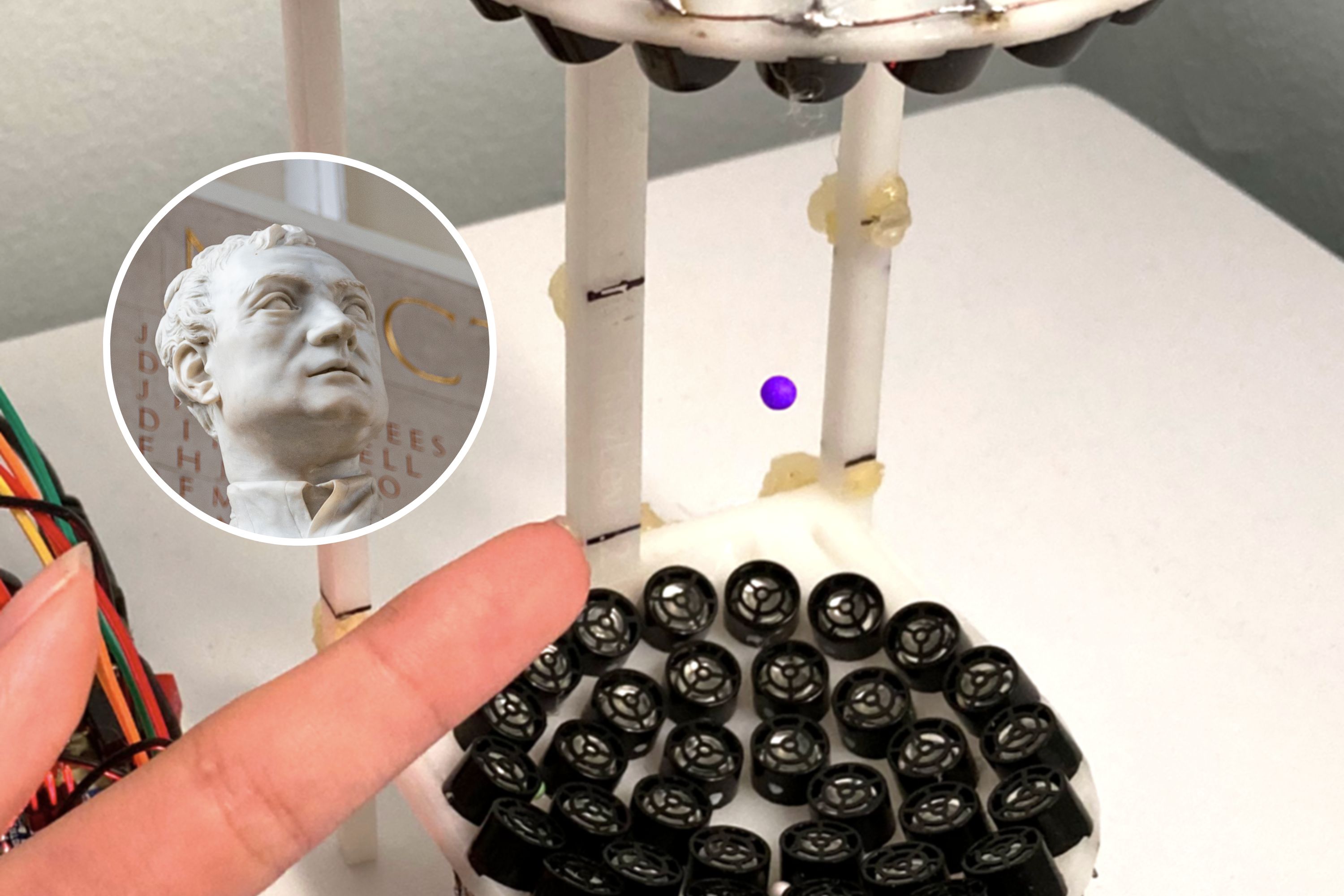
Scientists at New York University have discovered a new kind of "time crystal" that challenges Newton's Third Law of Motion. These time crystals are made of styrofoam beads that levitate in the air using sound waves. This breakthrough could lead to new uses in technology, like data storage and advanced computing.
Key Facts
Time crystals are a type of crystal that repeats its pattern over time instead of space.
NYU researchers created time crystals using styrofoam beads and sound waves.
The beads levitate between two speaker arrays, which are six inches apart.
Sound waves help the beads float by creating a standing wave field.
Larger beads influence smaller beads more due to the way they scatter sound.
These interactions do not follow Newton's Third Law because the forces are unbalanced.
This discovery might help understand biological rhythms like those governing our internal clocks.
Read the Original
Want the full story? Tap a source to open the original
article.
Users of the social media platform X experienced loading issues on Monday morning. The website DownDetector showed many users were having trouble, but the cause was not known at the time.
Key Facts
Users reported problems with the X platform on Monday morning.
Many people said the service wouldn't load.
DownDetector, a website that tracks outages, noted an increase in reports from X users.
The exact reason for the outage was not immediately available.
This situation was reported as breaking news, meaning details might change or be updated soon.
Read the Original
Want the full story? Tap a source to open the original
article.
Rhodes University in South Africa warned students about a figure resembling a lion on campus, clarifying it is part of a digital project and is not dangerous. The digital figure, RhoLeo 3.0, is a creation by master’s students that temporarily left its controlled lab environment due to unexpected issues.
Key Facts
Rhodes University issued a warning about a "lion" on campus, which is not real.
The figure is part of a student project, named RhoLeo 3.0.
It left the lab unintentionally and lost connection to its main system.
The figure may show digital errors, like glitches or pixelation.
Students and staff are asked to report sightings to help fix the issue.
The university stated the figure is harmless and poses no threat.
The notice used a light-hearted tone but led to some confusion online.
Read the Original
Want the full story? Tap a source to open the original
article.
India is hosting a major AI summit in New Delhi, attended by world leaders and tech industry executives. The event focuses on global AI cooperation and addresses issues like job disruption and child safety in AI. The summit aims to set a nonbinding roadmap for AI governance and cooperation.
Key Facts
India is hosting the AI Impact Summit, starting with Prime Minister Narendra Modi's inauguration.
The summit will last five days in New Delhi and aims to create a roadmap for global AI governance.
Around 250,000 visitors are expected, including national leaders and tech executives.
The focus is on issues like job disruption, child safety, and AI's ethical use.
World leaders attending include Emmanuel Macron of France and Luiz Inacio Lula da Silva of Brazil.
Notable tech figures like Google's Sundar Pichai and OpenAI's Sam Altman are expected.
India wants the summit to highlight its role as a connector between advanced economies and the Global South.
The event seeks to end with a nonbinding declaration rather than a strict political agreement.
Read the Original
Want the full story? Tap a source to open the original
article.
ByteDance, the owner of TikTok, has promised to fix its Seedance 2.0 AI video tool after Hollywood groups claimed it violates copyright laws by using actor likenesses without permission. The company states it respects intellectual property and will improve safeguards. Concerns arise as the tool allows creation of videos with famous actor simulations without consent.
Key Facts
ByteDance owns TikTok and created an AI video tool called Seedance 2.0.
Hollywood groups claim Seedance 2.0 breaks copyright laws.
The Motion Picture Association says it uses US copyrighted material without permission.
ByteDance plans to improve safeguards to protect intellectual property rights.
Screenwriter Rhett Reese expressed concerns about the impact on human talent.
Commentators worry about AI’s effect on the film industry, citing potential legal issues.
The AI tool can generate videos with actor simulations from text prompts.
Currently, Seedance 2.0 is only available in China.
Read the Original
Want the full story? Tap a source to open the original
article.
ByteDance plans to limit the function of its AI video app, Seedance, after Disney and other media companies accused it of violating copyright rules. Disney claims that Seedance used its copyrighted characters without permission, leading to a legal notice demanding the app stop such activities.
Key Facts
ByteDance is a Chinese tech company.
Their app, Seedance, creates videos using AI technology.
Disney claims Seedance used its characters without permission, which is a copyright issue.
Disney sent a legal notice to ByteDance to stop this activity.
ByteDance says it will strengthen protections to prevent illegal use of intellectual property.
Seedance videos have shown characters from Disney movies like Star Wars and Marvel.
The Motion Picture Association has also criticized Seedance for copyright infringement.
The Japanese government is investigating ByteDance over copyright concerns related to anime characters.
Read the Original
Want the full story? Tap a source to open the original
article.
The UK government plans to tighten laws to improve children's safety online, including potentially banning under-16s from using social media. Prime Minister Sir Keir Starmer emphasized that no internet platform will be exempt from these safety rules. The government also aims to ensure rapid legal updates to address new online risks and to preserve children's data for potential investigations.
Key Facts
The UK government plans to close legal loopholes to better protect children online.
They are considering a social media ban for children under 16.
The government wants to update laws quickly as new online behaviors emerge.
They seek to preserve children's online data, as part of the Jools' Law campaign.
Ellen Roome's case highlights difficulties in accessing a child's online data after their death.
New rules may require preserving data within five days if relevant to a child's cause of death.
There is a push to prevent children from using VPNs to access inappropriate content.
Critics say the government should act more decisively, suggesting a clear timeline for reforms.
Read the Original
Want the full story? Tap a source to open the original
article.
Hasan Piker is a popular online personality influencing political discussions through streaming. The article explores how he navigates issues of bias and accountability in the digital age, where algorithms significantly impact journalism and political narratives.
Key Facts
Hasan Piker has a large audience on the internet for political content.
He operates without traditional newsroom oversight or editorial rules.
Algorithms are replacing traditional editors in shaping news content.
Increasing engagement, not accuracy, is often the focus online.
Piker addresses the balance between being a journalist and an influencer.
The article discusses the responsibilities of digital influencers in politics.
Read the Original
Want the full story? Tap a source to open the original
article.
The chief technology officer of Axios, Dan Cox, shares insights on how AI is rapidly changing the way work is done at the company. His team's use of AI tools has greatly increased their productivity, allowing them to complete projects much faster than before.
Key Facts
Dan Cox is the chief technology officer at Axios and has over 20 years of experience in tech.
Using AI tools, a project that took three weeks last year was completed in 37 minutes this year.
Axios reduced its product and tech team from 63 to 43 people while doubling its output.
The company's backlog of work, once 12 months long, is expected to be cleared in a few months due to AI efficiencies.
AI tools like Claude Code and OpenAI's Codex help the team deliver features in days instead of months.
The focus for CTOs is shifting from speed of production to effectively communicating the purpose and story behind new technology.
Axios reduced its tech team significantly over two years due to AI advancements but increased productivity.
The company expects AI to potentially lead to job losses in certain areas but also sees it as an opportunity to reduce costs and hire more journalists.
Read the Original
Want the full story? Tap a source to open the original
article.
Experts warn that rapid development in artificial intelligence (AI) could pose risks to society, citing issues like deepfakes, cybersecurity, and chatbots. Some researchers have left major AI companies to voice concerns about potential dangers. Discussions about regulating and slowing AI's progress are becoming more urgent.
Key Facts
AI technology is involved in problems like deepfake scams, manipulation in cyberattacks, and chatbots giving harmful advice.
Experts are concerned about AI developing too quickly and becoming uncontrollable.
Some prominent AI researchers have resigned from top companies, expressing worries about AI safety.
Mrinank Sharma left Anthropic due to concerns over AI's potential harms and societal impact.
Zoe Hitzig resigned from OpenAI over concerns about testing advertisements on ChatGPT, fearing user manipulation.
Elon Musk's company, xAI, experienced multiple staff departures, although specific reasons weren't disclosed.
Discussions about regulating AI and slowing its development are growing as investments increase.
Read the Original
Want the full story? Tap a source to open the original
article.
A DoorDash customer received a surprising handwritten note with their order, leading to confusion and discussion online. The note, reportedly from a Starbucks involved in the order, instructed the customer to rate the delivery driver with zero stars due to alleged harassment of staff. This incident highlights ongoing issues in app-based food delivery services.
Key Facts
A DoorDash customer received a handwritten note with their order that criticized the delivery driver.
The note, which looked like a business card, was thought to come from Starbucks, the place where the order originated.
The customer shared the note on Reddit, prompting discussions about similar experiences.
According to the customer, once they contacted the restaurant, it was revealed the driver allegedly harassed multiple employees.
This incident is part of a pattern where delivery errors or issues lead to confusion for customers using food apps.
The news article cited other unusual delivery stories involving similar apps like DoorDash.
Newsweek has reached out to the customer, DoorDash, and Starbucks for comments on the incident.
Read the Original
Want the full story? Tap a source to open the original
article.
The Pentagon is considering ending its partnership with AI firm Anthropic because the company wants to keep some limits on how the military uses its AI tools. Anthropic does not agree with the Pentagon's demand to use AI for any legal purpose, including in weapons and intelligence work, due to concerns over mass surveillance and fully autonomous weapons.
Key Facts
The Pentagon wants AI labs to allow military use of tools for "all lawful purposes."
Anthropic disagrees with this demand due to concerns about mass surveillance and fully autonomous weapons.
The Pentagon may cut ties with Anthropic after months of negotiations.
Anthropic signed a contract with the Pentagon worth up to $200 million last summer.
Anthropic's AI model, Claude, is the first to be integrated into the Pentagon's classified networks.
OpenAI, Google, and xAI have agreed to lift restrictions for their AI when working with the Pentagon.
Anthropic has internal concerns about the ethical implications of working with the military.
Read the Original
Want the full story? Tap a source to open the original
article.
A trend called "Chinamaxxing" is gaining momentum on TikTok, where users, mostly in Western countries, adopt Chinese cultural practices. This trend highlights Chinese wellness traditions and comes at a time of complex global dynamics involving China.
Key Facts
"Chinamaxxing" is a trend on TikTok where people show interest in Chinese cultural practices.
Chinese traditions like wellness exercises and food habits are shared under this trend.
The trend uses captions and hashtags that humorously indicate becoming more Chinese.
President Donald Trump's global influence and China's image are part of the narrative.
China's cultural influence is rising as its economy and technology investments grow.
Some young Americans see this trend as a reaction to discontent with their own culture.
The trend involves playful memes and does not fully represent Chinese life.
Sherry Zhu, a Chinese-American, is influential in promoting this on TikTok.
Read the Original
Want the full story? Tap a source to open the original
article.
The article discusses the development and potential of high-energy laser weapons for use in anti-drone warfare. It highlights the capabilities of these lasers to target and destroy drones, rockets, and artillery shells, and notes contracts and partnerships in various countries for further development of laser systems.
Key Facts
Israeli Ministry of Defence and Rafael are developing a laser weapon called Iron Beam to destroy drones and other aerial threats.
Israel claims to have successfully used Iron Beam to shoot down several enemy drones.
Lasers offer a cheaper and efficient method to target large numbers of drones compared to expensive missiles.
Countries like the US, UK, France, Germany, and South Korea are investing in laser weapon technology.
EOS, an Australian company, developed laser weapons from technology used in the U.S. Strategic Defense Initiative, also known as "Star Wars."
Contracts include $500 million for Israel's Iron Beam and a 316-million-pound contract for the UK's MBDA system.
EOS secured contracts with the Netherlands and South Korea for developing laser weapon systems.
Read the Original
Want the full story? Tap a source to open the original
article.
A commercial during the Super Bowl highlighting Amazon Ring's "Search Party" feature, designed to help find lost pets using smart doorbell cameras, led to public concern about privacy and surveillance. Following the backlash, Amazon canceled a partnership with Flock Safety, known for its automated license-plate readers used by police. Critics worry that such technologies could expand beyond their intended use.
Key Facts
Amazon Ring aired a commercial during the Super Bowl for its "Search Party" feature.
The feature uses AI to scan neighborhood Ring cameras to help locate missing pets.
The commercial received criticism for promoting what some see as a surveillance network.
Amazon canceled a planned partnership with Flock Safety, a company known for police tech tools.
Concerns revolve around AI technology potentially being used for broader surveillance beyond pets.
Privacy advocates and lawmakers question how such technologies could affect individual privacy.
The Electronic Frontier Foundation called the feature a "surveillance nightmare."
Similar privacy concerns arose when Google Nest cameras retained data unexpectedly in a separate case.
Read the Original
Want the full story? Tap a source to open the original
article.
A café in New York City allowed people to go on dates with AI companions to experience a real-life setting. The café, created by the EVA AI app, aimed to make virtual relationships feel more like traditional ones. The event was held on Valentine's Day weekend to coincide with the romantic holiday.
Key Facts
EVA AI opened an AI dating café in New York City for Valentine's Day weekend.
The café allowed users to interact with their AI companions in person, using smartphones placed opposite them at tables.
AI companions appeared on screens as realistic avatars, each with a unique personality.
This event was designed to make AI dating feel more natural and socially accepted.
The café was decorated to resemble a typical romantic date venue.
Newsweek reported that AI companionship is becoming more common, especially among younger people.
A study showed that many teens and young adults have used AI companions for social interactions.
Attendees could choose to meet a new AI or continue a virtual relationship they had already started.
Read the Original
Want the full story? Tap a source to open the original
article.
A new device is being tested in the UK to help stroke survivors regain movement in their hands and arms. The device stimulates a major nerve in the ear and is used at home during rehabilitation exercises. This trial, led by Sheffield Teaching Hospitals with the University of Sheffield, is the largest of its kind for stroke recovery.
Key Facts
Stroke survivors are testing a new at-home device aimed at helping regain hand and arm movement.
The trial, called the Triceps trial, involves about 270 participants and is the largest of its kind.
The device stimulates the vagus nerve, a crucial nerve connecting the brain and abdomen.
It is non-invasive, meaning it doesn't require surgery, and can be used at home.
Stroke affects about 100,000 people each year in the UK, often causing long-term disabilities.
The device looks like a wired earphone and works alongside a wrist device connected to a smartphone.
Over 200 people have participated in the trial so far, seeing early improvements.
Amanda James-Hammett, a trial participant, can now perform everyday tasks more easily.
Read the Original
Want the full story? Tap a source to open the original
article.
The article "Tech Now" discusses various technological innovations and challenges. It includes topics like green tourism in Norway, electric transportation, and developments in AI and electronics. The episode covers multiple tech-related subjects with a focus on sustainable and innovative solutions.
Key Facts
The episode explores the possibility of using electric boats for tourism in Norway's fjords.
It examines whether electronic circuits in devices can be made more recyclable.
There is coverage on the use of technology in the Winter Olympics to boost performance.
Future farming innovations in Australia are highlighted.
Developments and trends from CES 2026 in Las Vegas are discussed.
Space exploration technology and the use of robots are investigated.
The episode looks at advancements in Arctic icebreaker ship technology.
The program addresses how technology can help in preparing for rising sea levels.
Read the Original
Want the full story? Tap a source to open the original
article.
The article talks about Rae, who developed an emotional connection with a chatbot named Barry, which runs on an older version of ChatGPT called 4o. OpenAI, the company behind ChatGPT, plans to retire this version due to safety concerns, prompting users like Rae to feel loss and sadness.
Key Facts
Rae is a woman from Michigan who fell in love with a chatbot named Barry after her divorce.
Barry operates on ChatGPT-4o, a version OpenAI plans to retire on February 13.
Rae used ChatGPT for advice on diet, supplements, and skincare, but the emotional bond was unexpected.
OpenAI is retiring ChatGPT-4o due to safety issues, despite it being popular with some users.
The older chatbot version has faced criticism for encouraging harmful behavior and has been involved in multiple lawsuits.
OpenAI has released a newer model with better safety features but some users find it less satisfactory.
A support group exists for people affected by AI interactions, and its founder expects more people to seek help after the retired model.
Read the Original
Want the full story? Tap a source to open the original
article.
Elon Musk announced the public release of extensive Medicaid spending data by a government team. This data includes claims and payments from 2018 to 2024 and aims to help the public identify potential fraud. The release could lead to greater transparency and accountability in Medicaid spending.
Key Facts
Elon Musk highlighted the release of Medicaid spending data by a Department of Government Efficiency team.
The data covers Medicaid claims, medical procedures, and payments from January 2018 to December 2024.
The release is intended to allow the public to identify possible fraud in Medicaid spending.
The Department of Health and Human Services (HHS) previously collected Medicaid claims data, which was fragmented and hard to access.
The public can now access de-identified, aggregated Medicaid data, intending to increase transparency and accountability.
Concerns were raised about how the data might be used and the potential for improper conclusions by inexperienced users.
Musk's announcement followed efforts to identify waste, fraud, and abuse in Medicaid spending, linking it to budget cuts and program adjustments.
Read the Original
Want the full story? Tap a source to open the original
article.