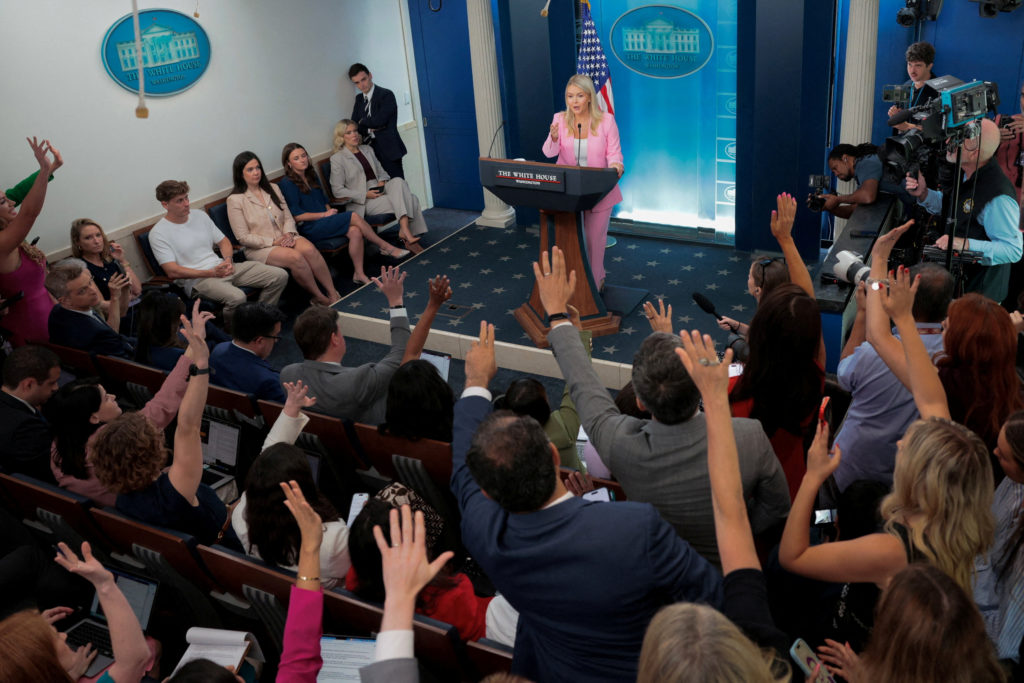
President Donald Trump gave a primetime speech from the White House claiming the U.S. election system is broken and vulnerable. He repeated false ideas about the 2020 election and outlined federal actions to protect future elections, despite no evidence of widespread voting problems.
Key Facts
President Trump delivered a televised address from the White House’s East Room about election integrity.
He stated the election system is so weak that no one can defend it.
Trump repeated false claims about the 2020 election being manipulated.
There is no proof that vote counts have been corrupted or manipulated.
He outlined steps the federal government will take to "protect" elections from non-existent threats.
Other presidents have used similar addresses only in times of real national crises or important announcements.
The article compares Trump’s speech to past presidents who used these addresses with seriousness and care.
Critics say Trump’s actions pose the biggest risk to election integrity rather than fixing it.
Read the Original
Want the full story? Tap a source to open the original
article.
The U.S. government announced new rules to shorten the length of visas for foreign journalists working in the country. Reporters from China will face even shorter visa times than others.
Key Facts
The Department of Homeland Security (DHS) introduced the new visa rules.
The previous system, called “duration of status,” allowed visas to last as long as a journalist’s status was valid.
The new rules set fixed-term visa lengths instead of open-ended stays.
The new fixed-term visas last 240 days, which is much shorter than before.
Chinese journalists will have even shorter visa durations than other foreign reporters.
These changes aim to review and control the time foreign journalists can stay in the U.S. more strictly.
The policy affects all foreign journalists working in the United States.
The change was announced during President Donald Trump’s administration.
Read the Original
Want the full story? Tap a source to open the original
article.
A federal appeals court struck down New Jersey’s ban on assault weapons like the AR-15, ruling it violates the Second Amendment. This is the first federal appeals court to do so as the U.S. Supreme Court prepares to review similar laws in Illinois and Connecticut.
Key Facts
New Jersey has banned semiautomatic rifles such as the AR-15 for many years.
The 3rd U.S. Circuit Court of Appeals ruled this ban unconstitutional under the Second Amendment.
The decision conflicts with other appeals courts that have upheld assault weapons bans in states like Illinois and Connecticut.
The U.S. Supreme Court accepted cases last month to decide if states can ban these rifles.
The Supreme Court’s 6-3 conservative majority has expanded gun rights recently but has not ruled on assault weapons bans specifically.
New Jersey plans to ask for a further review of the appeals court ruling.
The Supreme Court ruling could impact assault weapons laws nationwide.
The court’s ruling follows the 2022 Bruen decision, which set a new test for evaluating gun laws based on history and tradition.
Read the Original
Want the full story? Tap a source to open the original
article.
Declassified documents shared by President Donald Trump say U.S. election systems are hard to manipulate on a large scale. These reports suggest that while some parts of election infrastructure can be attacked, efforts to change the overall results would likely be found through audits and paper records.
Key Facts
Election systems that count and report votes are difficult to manipulate widely.
Voter registration databases and pollbooks connected to the internet have vulnerabilities to cyberattacks.
Audits and paper trails in almost all states would detect attempts to change vote results.
Foreign actors could manipulate votes only on a small, local scale, not nationwide.
Cyber attacks might delay voting but probably would not change official results.
Foreign countries like Russia, China, Iran, and North Korea can access election systems but no clear interference plans were found.
Russia tried to influence the 2020 election mostly through disinformation, focusing on supporting President Trump and attacking Joe Biden.
Election websites and voter registration databases are more likely to face disruptions than vote counting machines.
Read the Original
Want the full story? Tap a source to open the original
article.
Homeland Security Secretary Markwayne Mullin warned states that they could lose federal election aid if they do not cooperate with efforts to review and secure voter registration lists before the midterm elections. Mullin said the Department of Homeland Security (DHS) will search voter rolls for noncitizens and other ineligible voters and may pursue criminal penalties against election officials who do not comply.
Key Facts
DHS Secretary Markwayne Mullin stated states must allow DHS to review their voter rolls to keep receiving federal election funding.
Mullin said election machines must be secure and voter lists need to be "scrubbed" to remove ineligible voters.
DHS claims over 250,000 noncitizens are registered to vote in California, Pennsylvania, New Jersey, and Nevada, but provided no detailed explanation for this number.
Mullin claimed foreign adversaries could access U.S. voting machines but gave no evidence or explanation.
The Department of Justice previously sued states to obtain voter files, but courts rejected these cases.
Mullin threatened jail time and financial penalties for illegal voting, including for deceased persons listed on voter rolls.
Mullin’s announcement followed President Donald Trump’s speech revealing claims of election vulnerabilities and foreign interference.
Read the Original
Want the full story? Tap a source to open the original
article.
President Donald Trump gave a speech claiming serious problems with election security and said hundreds of declassified intelligence files expose these vulnerabilities. However, the reviewed documents do not show clear evidence of election fraud or interference that changed past election outcomes, including the 2020 election. The files confirm that China collected large amounts of voter data but do not prove it was used to tamper with elections.
Key Facts
President Trump spoke from the White House about election security and cited declassified intelligence files.
The reviewed files reveal China acquired more than 200 million U.S. voter records from at least 18 states.
There is no clear evidence in the documents that election interference or fraud altered the 2020 election result.
The files show China tried to influence U.S. public opinion but did not conduct large-scale election tampering like Russia did in 2016.
A 2021 U.S. intelligence report said China did not interfere in the 2020 election.
Voting machines and election infrastructure have been strengthened over the years, with bipartisan efforts to improve security.
Most U.S. votes are recorded on paper ballots managed by individual state governments.
President Trump used these claims to question the security of past and future U.S. elections.
Read the Original
Want the full story? Tap a source to open the original
article.
Nigel Farage, leader of Reform UK, said questions about his finances are part of a planned effort to hurt his party. He spoke at a rightwing event in London, criticizing political rivals and urging for a general election. Farage is also involved in a byelection in Clacton after stepping down as an MP amid financial scrutiny.
Key Facts
Nigel Farage claims critics are unfairly attacking him to stop Reform UK.
Two official investigations have started into how Farage’s campaign was funded.
Farage received a £5 million donation from crypto billionaire Christopher Harborne before the last election.
He spoke at the Conservative Political Action Conference in London, a rightwing event with international speakers.
Farage called for a general election to end political instability in the UK government.
Colin Sutton, a prominent police investigator, was recently elected Police and Crime Commissioner for Norfolk, which Farage said shows Reform UK’s strength.
Farage is running in the Clacton byelection after resigning as MP amid finance questions.
Mainstream parties boycotted the Clacton byelection, calling it a “circus,” with some local and fringe candidates participating.
Read the Original
Want the full story? Tap a source to open the original
article.
A study from the University of California, Santa Barbara found that people suggest lower pay for jobs when they believe more women do those jobs. This shows that the wage gap is partly because work linked to women is seen as less valuable, not just because women choose lower-paying jobs.
Key Facts
Women in the U.S. earn about 85 cents for every dollar earned by men.
The study focused on management consulting, a job usually seen as neutral in gender.
Participants were shown the same job with different percentages of women workers (25%, 45%, 67%).
People recommended nearly $1,000 less salary per year when the job was mostly done by women.
Both men and women suggested lower pay for female-dominated job descriptions.
The researchers say this happens because society values women’s work less, not because of obvious sexism or women’s preferences.
The study suggests employers should base pay on education, experience, and skills to reduce bias and promote fairness.
The findings support the idea that wage gaps result from undervaluing women’s work, not just job choice.
Read the Original
Want the full story? Tap a source to open the original
article.
Memorial services for Senator Lindsey Graham from South Carolina will begin on July 28 in Washington, D.C., followed by services in Columbia and Pickens County, South Carolina. These events were announced by the senator’s office.
Key Facts
Senator Lindsey Graham has passed away.
Memorial services will start on July 28 in Washington, D.C.
After Washington, services will be held in Columbia, South Carolina.
Additional memorials will take place in Pickens County, South Carolina.
The announcement was made by Senator Graham’s communications director, Taylor Reidy.
Read the Original
Want the full story? Tap a source to open the original
article.
A new poll shows Democrat Keisha Lance Bottoms leading Republican Rick Jackson in Georgia’s governor race. The current governor, Brian Kemp, cannot run again, making this an open and competitive contest.
Key Facts
Keisha Lance Bottoms is a former Atlanta mayor and the Democratic candidate for Georgia governor.
Rick Jackson, a healthcare company executive, is the Republican candidate.
Governor Brian Kemp is term-limited and cannot run for a third term.
Georgia’s governor race is rated a "toss up" by political analysts.
Georgia has been controlled by Republicans in the governor’s office since 2002.
Democrats won recent federal races in Georgia but face challenges in the governor’s race.
The poll surveyed 448 likely voters in Georgia.
President Trump won Georgia narrowly in the 2024 presidential election.
Read the Original
Want the full story? Tap a source to open the original
article.
A study compared how much everyday life cost for Americans in the 1970s versus today. While many costs like housing, healthcare, and college tuition have gone up a lot, incomes have generally grown enough to keep up with inflation, meaning most Americans today can afford more than those in 1974, though some expenses remain challenging.
Key Facts
Inflation and other issues in the 1970s caused high prices and economic problems called stagflation.
Today, Americans face high costs partly due to rising oil prices after a new Middle East conflict begun during President Trump’s current term.
ConsumerAffairs studied incomes, inflation, and major expenses from 1974 to 2024.
Overall buying power (what people can afford) increased by 73% over 50 years.
College tuition buying power dropped by almost 43%, and healthcare buying power fell by about 17%.
Electronics and appliances have become cheaper relative to income since the 1970s.
Median home prices rose from about $36,050 in 1974 to about $419,000 in 2024, more than inflation alone would explain.
Although homes cost more now, mortgage interest rates were higher in the 1970s, affecting affordability.
Read the Original
Want the full story? Tap a source to open the original
article.
President Donald Trump is stopping offshore wind energy projects because he believes they create a national security risk. His administration has paused major projects and is buying back leases used for offshore wind farms.
Key Facts
President Trump’s administration began opposing offshore wind projects late last year.
The opposition is based on national security concerns.
Work has been stopped on several major offshore wind projects.
The government is buying back leases used for these wind developments.
Interior Secretary Doug Burgum mentions a secret report from Defense Secretary Pete Hegseth.
This report is said to confirm that offshore wind projects pose a threat to national security.
Offshore wind projects involve building wind turbines out at sea to generate electricity.
Read the Original
Want the full story? Tap a source to open the original
article.
Senator Lindsey Graham passed away at age 71 from a serious heart condition. Funeral services will be held in Washington D.C. on July 28 and in South Carolina the next day. His sister, Darline Graham Nordone, has been appointed as interim senator for South Carolina until a special election is held.
Key Facts
Senator Lindsey Graham died from an acute aortic dissection, a tear in the body's main artery.
He died surrounded by family and close friends.
Funeral services will happen in Washington D.C. on July 28 and in Pickens County and Columbia, South Carolina the following day.
It is unclear if Graham's body will "lie in state" at the U.S. Capitol, as offered earlier.
Graham served over 30 years in Congress, including four House terms and Senate service starting in 2002.
He was known for work on national security, military, foreign policy, and bipartisan cooperation.
Initially critical of President Donald Trump during the 2016 campaign, Graham later became a close ally and supporter.
South Carolina Governor Henry McMaster appointed Graham’s sister, Darline Graham Nordone, as interim senator until a special election.
Read the Original
Want the full story? Tap a source to open the original
article.
The Department of Homeland Security (DHS) warned immigrants with Temporary Protected Status (TPS) that their legal status will end soon following a U.S. Supreme Court ruling. TPS holders from countries like Haiti and Syria have a limited time to return home with government assistance before their work permits and protections expire.
Key Facts
The Supreme Court ruled 6-3 to allow the Trump administration to end TPS protections for Haiti and Syria.
TPS provides temporary legal status and work permits to immigrants from countries facing problems like war or disasters.
DHS says conditions in these countries have improved enough for people to return home.
About 350,000 Haitians and 6,000 Syrians will be affected by the end of TPS.
DHS offered TPS holders $2,600 and a free flight to return to their home countries.
Some lower court judges have delayed lifting bans on ending TPS for some countries, causing confusion over work permit expiration dates.
Once TPS is revoked, affected immigrants could lose legal status and face removal from the U.S.
Groups warn that ending TPS could have serious effects on workers and the U.S. economy.
Read the Original
Want the full story? Tap a source to open the original
article.
Larry Dean Brown, a 79-year-old Vietnam veteran, has been charged with the 1981 murder of Beverly Bruneau in Texas. The case was solved after 45 years, using advances in DNA technology that have helped police solve other cold cases recently.
Key Facts
Beverly Bruneau, 35, was found strangled with an electrical cord in her apartment in Grapevine, Texas, in 1981.
Larry Dean Brown was arrested and indicted for her murder; he has no prior criminal record and served as a Navy pilot in Vietnam.
Brown was extradited from Colorado and is held without bond in Tarrant County.
Brown had conflicts with Bruneau related to a shared mortgage and housing agreements involving Bruneau's friend Thelma, who married Brown.
Bruneau’s house suffered two fires suspected to be arson before her death.
Brown tried to get an insurance appraisal done through his construction company, and pressured Bruneau about fraudulent insurance forms, which she refused.
Advances in DNA evidence helped solve this and other cold cases from the 1980s.
Brown initially cooperated with police but later refused fingerprinting, a polygraph test, and further cooperation.
Read the Original
Want the full story? Tap a source to open the original
article.
The Trump administration announced it will shorten visas for foreign journalists in the U.S. to 240 days, and for Chinese journalists to just 90 days. China warned it may respond with similar actions, and journalist groups expressed concern that the changes will limit press freedom.
Key Facts
The Department of Homeland Security will end the "duration of status" visas that allowed foreign journalists to stay for years, replacing them with fixed-term visas.
Foreign journalist visas will now last 240 days, but Chinese journalists’ visas will only last 90 days.
Visas can be extended, but the initial time period is much shorter.
The U.S. says the change helps it better check visa holders’ activities.
Media advocacy groups say the shorter visas restrict journalists’ ability to work and threaten press freedom.
China opposes the rule and may take reciprocal countermeasures.
This change reflects ongoing tensions between U.S. and China and tighter U.S. immigration policies under President Trump.
The rule will begin 60 days after it is published, and Congress has limited power to stop it.
Read the Original
Want the full story? Tap a source to open the original
article.
The Trump administration is building new border security infrastructure in Texas’s Big Bend National Park. This project involves waiving some environmental laws, which has upset local residents and officials worried about the park’s environment and economy.
Key Facts
The project is funded by a $46.5 billion bill passed in May 2025 to build a wall along the US-Mexico border.
Big Bend National Park is on the border and includes protected lands that the project will affect.
Plans initially showed a steel wall along the Rio Grande river but later shifted to using technology like cameras and sensors.
The US Customs and Border Protection (CBP) changed their plans quietly, causing confusion and opposition.
CBP said they do not plan to build a tall wall in the park but will add roads, barriers to stop vehicles, and detection equipment.
Locals and activists are concerned about the environmental impact and economic consequences of construction.
CBP claims it reviews environmental and cultural effects and seeks public input before construction.
Opponents worry that the plans may change again and criticize the lack of clear communication from CBP.
Read the Original
Want the full story? Tap a source to open the original
article.
Homeland Security Secretary Markwayne Mullin said that about 250,000 people who are not U.S. citizens are registered to vote in the United States. This claim was reported by CBS News.
Key Facts
DHS Secretary Markwayne Mullin made the statement about noncitizens registered to vote.
He claimed the number is around 250,000 people.
These people are not U.S. citizens but are on voter registration lists.
The information was shared through CBS News.
The details about where or how this data was collected were not provided in the article.
Voter registration typically requires U.S. citizenship.
The claim has been publicly noted but lacks additional context in this report.
Read the Original
Want the full story? Tap a source to open the original
article.
A recent CBS News poll shows that most Americans do not believe there is widespread voter fraud in elections. During a speech, President Donald Trump talked about election integrity and claimed, without proof, that China interfered in the 2020 election.
Key Facts
The CBS News poll asked Americans about their views on voter fraud.
Most people surveyed said they do not think voter fraud happens on a large scale.
President Donald Trump discussed election integrity in a primetime speech.
In his speech, President Trump claimed that China interfered in the 2020 election.
There is no evidence to support President Trump’s claim about China’s involvement.
Anthony Salvanto, CBS News executive director of elections and surveys, explained the poll results.
The topic of voter fraud remains a key issue in American political discussions.
Read the Original
Want the full story? Tap a source to open the original
article.
DHS Secretary Markwayne Mullin defended claims made by President Donald Trump that the 2020 US election had serious problems, including voter fraud by noncitizens and insecure voting machines. Election experts and state officials have disputed these claims, saying there is no strong evidence and that voting systems remain secure.
Key Facts
DHS Secretary Mullin repeated President Trump’s claims about noncitizen voter registrations in several states.
Mullin said 250,000 noncitizens were registered to vote in California, Pennsylvania, New Jersey, and Nevada, but experts say the data and methods behind this number are unclear.
State officials, like Pennsylvania’s Secretary of State Al Schmidt, said noncitizen voting is very rare and voters must prove their identity when voting.
Mullin claimed 28,000 noncitizens were found on voter rolls in 23 states working with DHS’s verification program.
Experts say the number of suspected noncitizen registrations is very small compared to the total number of voters.
Mullin repeated unsupported claims that voting machines are unsafe and could be hacked by foreign adversaries.
Cybersecurity experts say voting machines in the US are tested regularly and are not connected to the internet.
Claims linking Venezuela’s election technology to problems in the US election are part of an unproven conspiracy theory.
Read the Original
Want the full story? Tap a source to open the original
article.