Vice President Kamala Harris will campaign in several states over the last weeks before the midterm elections. She plans to visit Georgia, Mississippi, Nevada, New Hampshire, and Wisconsin to support Democratic candidates.
Key Facts
Vice President Kamala Harris announced a campaign tour for the midterm elections.
She will visit Georgia, Mississippi, Nevada, New Hampshire, and Wisconsin.
The campaign stops will focus on helping Democrats win various election races.
The tour covers the last few weeks leading up to the midterms.
The goal is to support Democratic candidates at many levels, including federal and local offices.
The announcement came from Harris’s office on a Wednesday.
Read the Original
Want the full story? Tap a source to open the original
article.
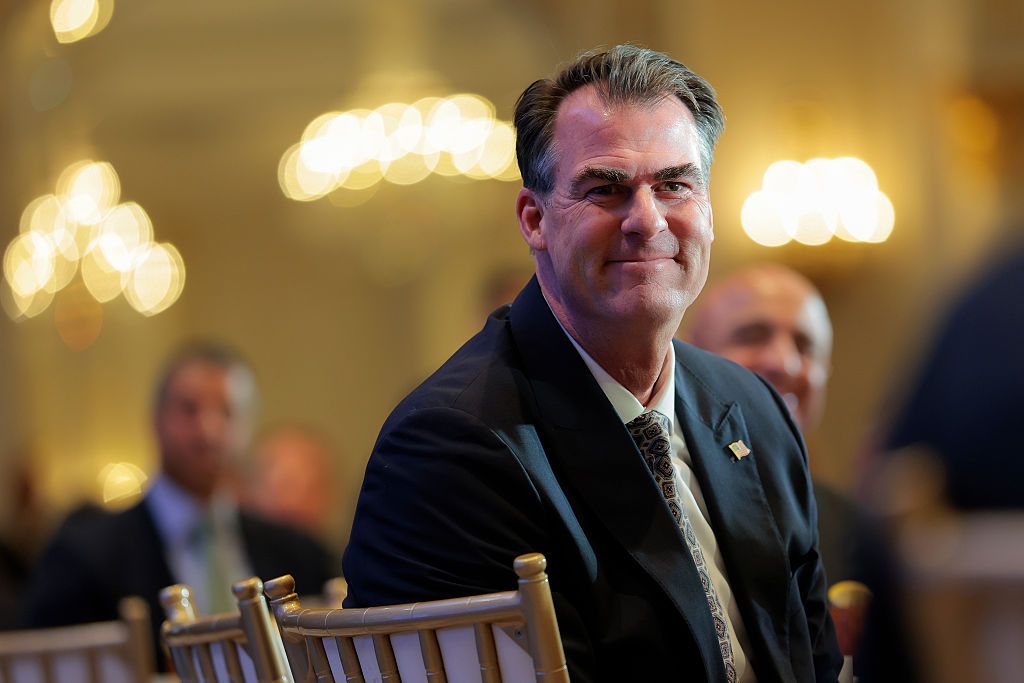
Oklahoma Governor Kevin Stitt disagrees with President Donald Trump’s plan to allow more Russian diesel fuel onto global markets. Stitt warns this plan might extend the war in Ukraine and may not significantly lower fuel prices, despite rising costs hurting farmers and businesses.
Key Facts
President Trump announced a deal to bring Russian diesel back to global markets to help lower fuel prices.
Governor Kevin Stitt expressed doubts that this plan will reduce prices much and warned it could prolong the Ukraine war.
Diesel fuel is important for transportation and farming, so high prices affect many Americans.
Russia plans to release about 300,000 metric tons (around 2.24 million barrels) of diesel initially.
This amount is small compared to daily U.S. and global diesel demand and may have limited price impact.
Some energy experts and analysts agree the Russian diesel supply will not greatly change prices.
Stitt recently allowed broader farm diesel use in Oklahoma to help farmers cut fuel costs.
A bipartisan group of 12 senators also expressed concern about allowing more Russian diesel exports because of the war in Ukraine.
Read the Original
Want the full story? Tap a source to open the original
article.
President Donald Trump has asked his White House legal team to look into claims made by his former attorney, Alina Habba, that former Kennedy Center leader Ric Grenell did not deposit a $5.6 million donation from her billionaire husband. Grenell denies the accusations, calling them untrue, while the White House has not confirmed the facts and is investigating the matter. The dispute involves complex political and business relationships tied to Venezuela and has created tensions among Trump advisers.
Key Facts
Alina Habba told President Trump that Ric Grenell failed to deposit a $5.6 million donation made by her husband to the Kennedy Center.
Grenell denies these claims, calling them lies and demanding proof.
The full alleged donation was nearly $6 million, but amounts initially mentioned were higher and changed as details emerged.
Habba and her husband, Turhan Mildon, are involved in a personal and business dispute with Grenell.
The conflict has roots in mutual interests related to Venezuela and U.S. diplomatic policy under Secretary of State Marco Rubio.
Grenell once pushed for normalizing relations with Venezuela’s then-leader Nicolas Maduro.
The White House counsel has requested documents related to the claims but has not yet received proof.
The dispute is described as a serious internal conflict within President Trump’s circle, involving money and influence.
Read the Original
Want the full story? Tap a source to open the original
article.
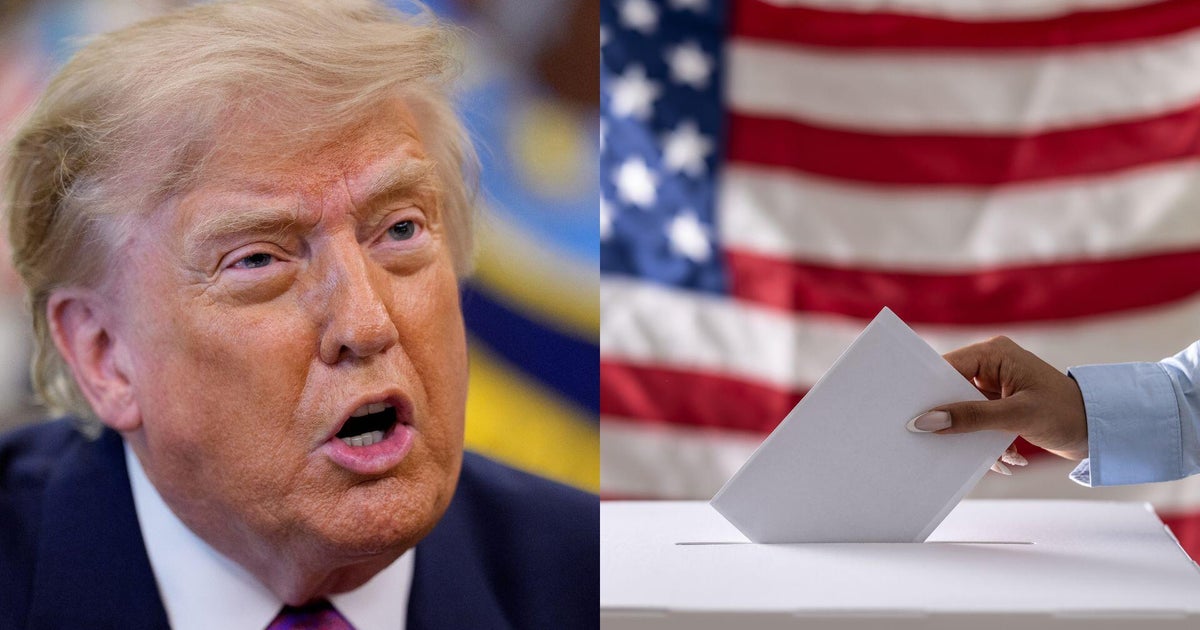
President Trump's approval rating is at its lowest point among Latino voters, according to a recent report. This shows a decline in his popularity within this community.
Key Facts
President Trump's approval rating has dropped to a record low among Latino voters.
The report was covered by CBS News and reported by Cristian Benavides.
The decline suggests growing dissatisfaction with President Trump in the Latino community.
The article mentions the decline but does not provide exact percentages or numbers.
This trend could affect political support from Latino voters going forward.
The report is part of ongoing coverage of President Trump's public approval.
Latino voters are an important demographic in American politics.
Read the Original
Want the full story? Tap a source to open the original
article.
Republicans are pulling back their campaign spending in several key House races while Democrats are increasing fundraising to support candidates in those areas. This shows Republicans are becoming more defensive as Democrats try to gain seats in the upcoming midterm elections.
Key Facts
The Congressional Leadership Fund, a major Republican super PAC, stopped spending in four battleground House races but increased spending in 16 others.
A pro-President Donald Trump super PAC cut back spending in Nevada’s 3rd District.
Republicans withdrew funding in Iowa’s 1st District, New Jersey’s 7th District, a Cincinnati-area district in Ohio, and a district in east-central Michigan.
Democrats’ House campaign committee hopes to raise millions to run ads in Republican-held districts they think they can win.
Some Republican incumbents face challenges due to local issues like Medicaid cuts, high fuel prices, and personal controversies.
The Republican strategy is now focusing on districts where President Trump narrowly defeated his Democratic opponent in 2024.
Democrats aim to increase voter turnout, especially among people who vote in presidential elections but not always in midterms.
Some GOP leaders see voter dissatisfaction with the Republican majority and President Trump’s policy setbacks as reasons for weakened support.
Read the Original
Want the full story? Tap a source to open the original
article.
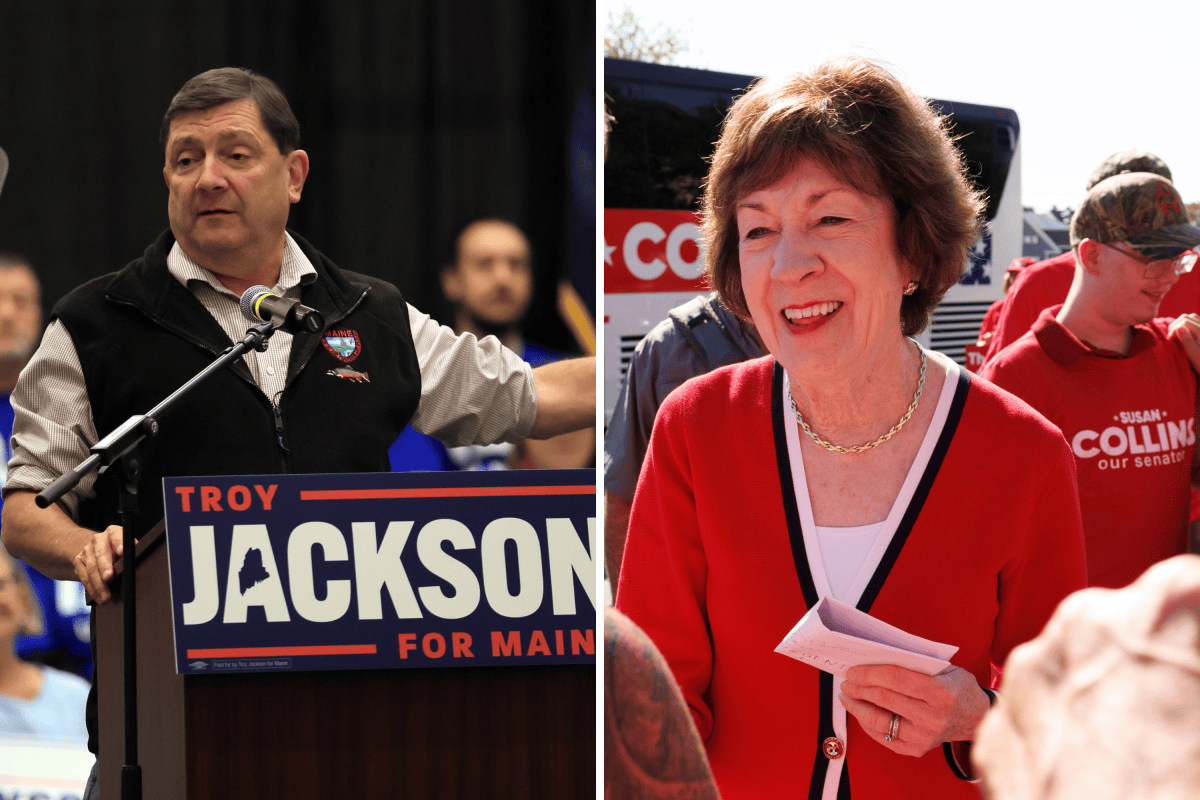
Troy Jackson, a Democrat running for Senate in Maine, is being urged to reveal his campaign donors as early voting starts. His opponent, Republican Senator Susan Collins, has questioned his financial disclosures and fundraising practices during their competitive race.
Key Facts
Troy Jackson is a Democratic candidate for the Maine Senate seat.
Susan Collins is the five-term Republican incumbent Senator facing Jackson in the 2024 election.
Collins’ campaign has criticized Jackson for not fully disclosing his campaign donors despite early voting.
Jackson pledged to reject corporate PAC money and funds from lobbyists but had a PAC accepting such donations two years ago.
Jackson said he would provide his campaign finance report by October 11, a few days before the deadline on October 15.
Early polling shows a close race between Jackson and Collins in Maine.
Jackson’s personal finances show income mostly from consulting and up to $430,000 in assets, while Collins is worth millions.
Maine is a key state in the midterm elections, with Democrats aiming to retain and gain Senate seats.
Read the Original
Want the full story? Tap a source to open the original
article.
Alignment Healthcare, a large Medicare Advantage insurer, is suing the Trump administration over the 2027 star ratings given to its Medicare plans. The company argues that the Centers for Medicare & Medicaid Services (CMS) used improper methods to calculate these scores, which could cost Alignment over $200 million in 2028 payments.
Key Facts
Alignment Healthcare filed a lawsuit against CMS in federal court in Washington, D.C.
The dispute concerns the 2027 Medicare Advantage star ratings, which dropped Alignment’s California HMO plan from 4 stars to 3.5 stars.
Star ratings affect both plan quality comparisons for consumers and quality bonus payments to insurers.
Alignment claims CMS used ten quality measures without proper rulemaking procedures required by law.
The lower star ratings could reduce Alignment’s payments by more than $200 million in the year 2028.
Alignment wants the court to void the 2027 ratings and force CMS to recalculate them without the disputed measures.
The company says using “technical notes” instead of formal rulemaking breaks the Administrative Procedure Act.
CMS released the 2027 star ratings on October 8, showing a big decrease in high-rated plans for Alignment members.
Read the Original
Want the full story? Tap a source to open the original
article.
A US judge has temporarily stopped President Trump's administration from sanctioning two US human rights groups that assist the International Criminal Court (ICC) with investigations into war crimes in Gaza. The judge ruled the sanctions likely violate the groups’ First Amendment rights, which protect free speech.
Key Facts
The court granted a preliminary ban on sanctions against Democracy for the Arab World Now (Dawn) and Taxpayer Alliance Against Genocide (Taag).
These groups sued after a 2025 executive order threatened sanctions on those helping the ICC’s Gaza war crimes investigation.
The US opposed ICC arrest warrants against Israeli leaders accused of war crimes.
The judge said the order likely breaks constitutional rights by restricting speech based on its content.
The ruling does not fully cancel the executive order or stop its enforcement against others.
Dawn and Taag work to help the ICC gather evidence about possible war crimes against Palestinians.
The State Department said the ICC poses a threat to US sovereignty.
Dawn said it will continue its work with the ICC after the court’s decision.
Read the Original
Want the full story? Tap a source to open the original
article.
President Donald Trump is holding campaign events in Arizona and Montana to support Republican candidates. These rallies are part of his efforts to help the GOP win in the November 3 midterm elections that will decide which party controls Congress.
Key Facts
President Trump is visiting swing-state Arizona and a Republican-leaning district in Montana.
He will speak at 3 p.m. EDT during these events.
The rallies are aimed at supporting Republican candidates in the midterm elections.
In Bullhead City, Arizona, Trump is backing Rep. Andy Biggs against Democratic Governor Katie Hobbs.
Trump will then go to Montana’s 1st District to support Aaron Flint, running for the House seat.
Aaron Flint worked for retiring Republican Rep. Ryan Zinke, who was Interior Secretary under Trump’s first term.
This visit follows previous stops in Ohio and Alaska earlier in the week.
The midterm elections on November 3 will decide which party controls the U.S. Congress.
Read the Original
Want the full story? Tap a source to open the original
article.
Protesters interrupted a panel on drones at the U.S. Army's yearly conference in Washington. Defense Secretary Pete Hegseth and other military leaders continued their talk despite the disruptions, focusing on expanding drone development through smaller businesses.
Key Facts
The event was the U.S. Army's annual conference held in Washington.
Six protesters shouted during a panel discussion about drone warfare.
Protesters mentioned concerns about the war with Iran.
Protesters also opposed President Trump's proposed $1.5 trillion military budget for next year.
Defense Secretary Pete Hegseth and other military leaders were speaking on the panel.
They discussed the need to open more military contracts to smaller businesses.
The goal is to develop more drones for military use.
Despite protests, the speakers continued their planned discussion.
Read the Original
Want the full story? Tap a source to open the original
article.
The 2027 Social Security cost-of-living adjustment (COLA) is set at 3.6 percent. Lawmakers have proposed changing the way COLA is calculated to better reflect the expenses of older Americans, which could increase benefit amounts in future years.
Key Facts
The current COLA uses the Consumer Price Index for Urban Wage Earners and Clerical Workers (CPI-W) to measure inflation.
Two bills propose using the Consumer Price Index for Elderly Consumers (CPI-E), which better reflects costs faced by seniors like healthcare and housing.
The Boosting Benefits and COLAs for Seniors Act would use the higher of CPI-W or CPI-E to calculate COLA increases.
The Social Security Expansion Act would replace CPI-W entirely with CPI-E and includes other Social Security benefit improvements.
Research suggests switching to CPI-E could add thousands of dollars to retirees’ benefits over 25 years.
The Bureau of Labor Statistics would publish an official older-consumer inflation index if these proposals pass.
Seniors spend a larger part of their income on costs like medical care and housing, which rise faster than other expenses.
The changes aim to better protect Social Security beneficiaries from rising costs they actually face.
Read the Original
Want the full story? Tap a source to open the original
article.
Texas Governor Greg Abbott's reelection race is much closer than expected, according to recent polls and a leaked recording of Attorney General Ken Paxton. Abbott is leading Democrat Gina Hinojosa by only a few points, despite spending much more money on his campaign and having strong name recognition.
Key Facts
Ken Paxton said in a leaked audio recording that Governor Abbott is "struggling" in his reelection campaign.
Abbott is running against Democrat Gina Hinojosa for Texas governor, with early voting starting soon.
Most recent polls show Abbott ahead by 1 to 4 points, while some polls show Hinojosa slightly leading.
Abbott has won his three previous governor races by large margins but faces a tighter race this year.
Abbott spent over $69 million on his campaign between July and September, while Hinojosa spent about $12 million.
Abbott's campaign has many large donations, averaging $784 each, while Hinojosa has more donations but smaller amounts, averaging $50 each.
Democrats hope to gain seats in the Texas Legislature during this election.
Prediction markets give Abbott around a 78-81% chance of winning the governor’s race despite the close polls.
Read the Original
Want the full story? Tap a source to open the original
article.
The Campaign for Accountability has asked the California State Bar to investigate White House press secretary Katie Zacharia. They want to check if Zacharia wrongly said she is a lawyer because reports say she is not licensed to practice law anywhere.
Key Facts
The complaint was filed by the Campaign for Accountability.
It was sent to the California State Bar Association.
The complaint targets White House press secretary Katie Zacharia.
Zacharia reportedly claimed to be a lawyer.
Reports say she is not licensed to practice law in any state.
The complaint requests an official investigation.
The investigation would determine if she misrepresented her legal status.
This issue concerns honesty about professional qualifications.
Read the Original
Want the full story? Tap a source to open the original
article.
Democrats have a real chance to win the majority in the U.S. Senate. Right now, Republicans hold 53 seats, while the Democratic group includes 45 Democrats and two independents who work with them.
Key Facts
Republicans currently hold 53 seats in the Senate.
Democrats have 45 official members in the Senate.
Two independents, Angus King and Bernie Sanders, caucus with the Democrats.
Some betting markets believe Democrats are likely to gain the Senate majority.
The article explores how Democrats might win and how Republicans could keep control.
Read the Original
Want the full story? Tap a source to open the original
article.
Senator Bill Cassidy, a Republican and head of the Senate Health Committee, criticized the Trump administration for not promoting measles vaccinations strongly enough during a large measles outbreak in 2026. He emphasized that vaccination is important because it prevents death from measles.
Key Facts
There is a large outbreak of measles in 2026 causing several deaths.
Senator Bill Cassidy leads the Senate Health, Education, Labor and Pensions Committee.
Cassidy is a medical doctor and concerned about public health.
He said everyone should receive the measles vaccine.
Cassidy spoke on CNN about the need for stronger vaccination efforts.
He suggested the Trump administration’s response to promote vaccines is insufficient.
Vaccination can prevent illness and death from measles.
Read the Original
Want the full story? Tap a source to open the original
article.
Some Democratic candidates running for the Senate in important states are cautious about supporting calls to impeach President Donald Trump during his second term. They focus more on issues like the economy and affordability, as impeachment is unlikely to succeed with Republican-controlled Congress and could distract from voters' main concerns.
Key Facts
Some Democrats want to impeach President Trump over tariffs, immigration, and the Iran war, but Republicans control Congress and oppose impeachment.
Democratic Senate candidates in swing states mostly avoid supporting impeachment to focus on economic issues.
Removing Trump through impeachment would require a two-thirds Senate majority, needing Republican support that is unlikely.
Sherrod Brown from Ohio said he does not support impeaching Trump regardless of midterm results.
New Hampshire’s Chris Pappas prioritizes cost of living and healthcare but wants accountability over Trump’s actions.
Candidates in Iowa, Kansas, and Texas have expressed little or no interest in pursuing impeachment.
More progressive Democrats are in favor of impeachment, but this is not the main approach for many Senate candidates.
Read the Original
Want the full story? Tap a source to open the original
article.
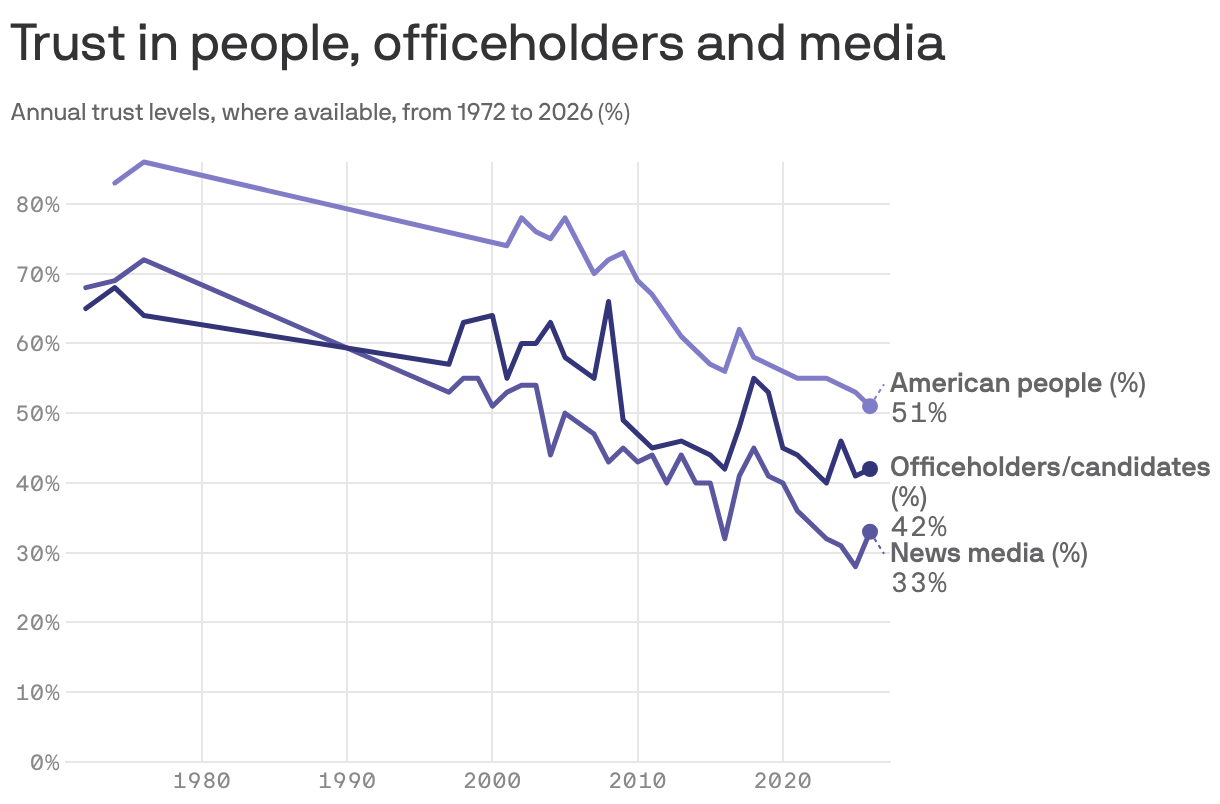
A recent Gallup survey shows that Americans trust their fellow citizens to make democratic decisions less than ever before in over 50 years. This lack of trust is shared similarly among Democrats, Republicans, and independents, and is lower than the trust people have in local or state governments.
Key Facts
Only 51% of U.S. adults trust other Americans to make democratic decisions, the lowest since Gallup started measuring in 1974.
Trust in fellow Americans was much higher in the past, with 86% in 1976 and around 78% in the early 2000s.
Distrust is similar across political parties: 53% of Democrats, 51% of Republicans, and 49% of independents trust voters.
More Americans trust their local government (67%) and state government (55%) than fellow citizens’ democratic judgment (51%).
Only 42% trust politicians who hold or seek public office, and just 33% trust the news media.
Confidence in U.S. institutions such as Congress, the presidency, and banks is also at historic lows.
The survey was conducted by Gallup from September 1 to 17, 2026, with 1,000 adults participating and a margin of error of plus or minus 4 percentage points.
Read the Original
Want the full story? Tap a source to open the original
article.
Georgia saw a record number of people vote early on the first day of midterm elections, with over 188,000 ballots cast. This is about 50,000 more than the first day of early voting in 2022, with a large portion of this increase coming from Black voters.
Key Facts
More than 188,000 people voted early in Georgia on the first day of midterm early voting.
This number is about 50,000 higher than the first day of early voting in 2022.
The Georgia secretary of state’s office provided these voting figures.
Black voters made up a significant part of the increase in early votes.
The turnout sets a new record for Georgia midterm early voting on Day 1.
Read the Original
Want the full story? Tap a source to open the original
article.
Cornell University President Michael Kotlikoff said he knew about a sexual assault report from a student in November 2024 but did not follow up with her afterward. The university is facing criticism and calls for his resignation as a lawsuit alleges members of a fraternity sexually assaulted the student.
Key Facts
A student, called "Jane Doe" in court papers, said she was sexually assaulted by seven Chi Phi fraternity members in October 2024.
The student reported the assault to Cornell University police in November 2024.
Two fraternity members were expelled, two suspended, and one barred from campus; others got lighter punishments.
None of the accused have criminal charges; the district attorney declined charges due to lack of evidence but will reopen the investigation.
New York Governor Kathy Hochul appointed State Attorney General Letitia James as special prosecutor for the case.
President Kotlikoff apologized and said he was sorry the student experienced the assault.
Kotlikoff did not know the student had dropped out until a lawsuit was filed last month.
Cornell will suspend fraternity parties for the rest of the academic year and add sexual assault investigators to its police force.
Cornell’s faculty senate may hold a vote of no confidence in Kotlikoff.
A special independent review of the handling of the case is being led by Sally Yates, a former deputy attorney general.
Read the Original
Want the full story? Tap a source to open the original
article.
Pollsters have many methods to predict election results, but they cannot accurately predict the difference between what people say they will do and their actual actions on Election Day. This gap could significantly affect the makeup of Congress.
Key Facts
Pollsters use various tools to estimate election outcomes.
Predicting true voter behavior is challenging.
People’s stated intentions often differ from their real votes.
This difference can change the results of elections.
Changes in voter behavior could affect control of Congress.
Election outcomes may be less predictable than polls suggest.
Understanding voter actions is key to accurate forecasts.
This issue is a concern for political analysts and campaigns.
Read the Original
Want the full story? Tap a source to open the original
article.