Brazilian voters are set to choose their next president in a runoff between current President Luiz Inácio Lula da Silva and Senator Flávio Bolsonaro. The article says Bolsonaro narrowly led Lula in the first round on October 4.
Key Facts
The presidential vote is scheduled for Sunday.
The candidates are President Luiz Inácio Lula da Silva and Senator Flávio Bolsonaro.
The article describes Lula as left-wing.
The article describes Flávio Bolsonaro as right-wing.
Flávio Bolsonaro is the son of former president Jair Bolsonaro.
Jair Bolsonaro is described in the article as imprisoned.
Flávio Bolsonaro narrowly beat Lula in the first round held on October 4.
Read the Original
Want the full story? Tap a source to open the original
article.
Brazilian presidential candidates Luiz Inácio Lula da Silva and Flávio Bolsonaro held rallies on the final day of campaigning before Sunday’s runoff election. Polling cited in the article showed a close contest, as the campaign highlighted divisions over economic policy, crime, and Brazil’s political direction.
Key Facts
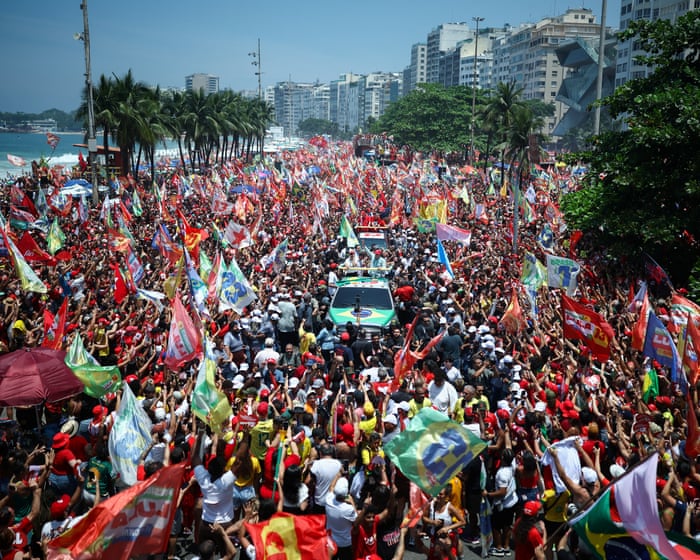
Lula addressed supporters at Copacabana Beach in Rio de Janeiro on Saturday.
Flávio Bolsonaro’s supporters rallied in Rio de Janeiro and in Minas Gerais.
Lula is seeking a fourth, non-consecutive presidential term.
Flávio Bolsonaro received 47 percent of the vote in the first round, while Lula received 45 percent.
A CNT/MDA poll released Saturday put Bolsonaro at 46.3 percent and Lula at 45 percent, with a margin of error of 2.2 percentage points.
Flávio Bolsonaro pledged to expand prison capacity and reduce government spending.
His father, former President Jair Bolsonaro, is serving a 27-year prison sentence for attempting a coup after losing the 2022 election to Lula.
The candidates’ final debate took place on Friday, and they traded accusations about the economy and their records.
Read the Original
Want the full story? Tap a source to open the original
article.
Iranian President Masoud Pezeshkian blamed the United States for the collapse of an interim agreement intended to end the war, but called for both sides to return to negotiations. The comments came as U.S. President Donald Trump suggested further strikes and Iranian officials warned of a forceful response to any attack.
Key Facts
Pezeshkian’s remarks were broadcast by Iran’s Press TV on Saturday.
Trump said on Friday that he might launch another operation, referring to it as “a little Epic Fury.”
Iran’s Islamic Revolutionary Guard Corps warned that even limited strikes would prompt a response several times greater, according to Fars News Agency.
Iranian Armed Forces Chief of Staff Ali Abdollahi said U.S. forces would not be allowed in the Gulf.
Government spokesperson Fatemeh Mohajerani said Iran sought peace but would defend itself against aggression.
Israeli Prime Minister Benjamin Netanyahu said he remained committed to overthrowing Iran’s government.
The article says Israel’s election is scheduled for Tuesday and U.S. midterm elections for November 3.
Iran’s judiciary chief met Supreme Leader Mojtaba Khamenei to discuss corruption and compensation for people affected by the war. It says Khamenei has not appeared in public since taking office in early March.
Read the Original
Want the full story? Tap a source to open the original
article.
Nearly 1,000 people were arrested after protests over living costs and school conditions across France on Saturday. Demonstrations were largely peaceful before clashes broke out in several cities, where police used tear gas and water cannon to disperse crowds.
Key Facts
France’s interior ministry estimated that 410,000 people took part in the protests; unions put the total at about 800,000.
Authorities deployed 70,000 police officers and imposed restrictions in several cities.
Clashes followed a march in Paris, where some protesters threw projectiles and masked youths smashed car dealership windows.
In Marseille, protesters set rubbish bins and street barricades on fire.
In Bordeaux, some protesters removed boards from a building to use in a barricade.
Police used tear gas to disperse a crowd in Lyon after the local prefecture had designated the area off-limits.
Interior Minister Laurent Nuñez said two people were seriously injured, one in Toulouse and one in Clermont-Ferrand.
Nuñez said nearly 1,000 people had been arrested and that the number was expected to rise.
Read the Original
Want the full story? Tap a source to open the original
article.
Yemen’s internationally recognised government and the Houthis reported attacks in Aden, Saudi Arabia and other parts of Yemen on Saturday. Claims about casualties and military operations remain unverified, while the Houthis disputed Saudi claims about their targets.
Key Facts
Yemen’s Transport Ministry said two ballistic missiles targeted Aden International Airport, which it described as the fourth such attack that month.
Yemeni authorities said the coastguard headquarters and another building in Aden were also hit.
The Houthis said they targeted al-Nasr camp and Aden’s naval military base.
Yemen’s army said a Houthi missile malfunctioned and killed three people at a family home in Houthi-held Sanaa on Friday.
Saudi Arabia’s civil defence said it intercepted two ballistic missiles launched toward Mecca and Medina and warned that shrapnel could fall.
The Houthis denied targeting Mecca and Medina, saying their targets were three Saudi airports, oil infrastructure and an airbase.
Houthi-run Al-Masirah TV said Saudi-led coalition air strikes killed civilians in Sanaa and Hodeidah; the report could not be verified, and Riyadh did not comment.
A Yemeni army spokesman claimed government forces carried out more than 700 operations and disabled military vehicles in the preceding 24 hours; the figures could not be independently verified.
Read the Original
Want the full story? Tap a source to open the original
article.
A train collided with a crane that had fallen onto railway tracks in São Paulo, Brazil. After the impact, crane wreckage fell into a street with traffic and pedestrians; the crane operator was injured.
Key Facts
A crane fell onto railway tracks in São Paulo, Brazil.
A train collided with the crane.
The collision sent crane wreckage into a street.
The street had traffic and pedestrians.
The crane operator was injured.
Video showed the collision.
Read the Original
Want the full story? Tap a source to open the original
article.
Hundreds of thousands of people demonstrated across France on October 24 against the rising cost of living. Clashes in Paris and other cities led police to use tear gas and arrest nearly 1,000 people, while Interior Minister Laurent Nuñez said the marches went better than demonstrations a week earlier.
Key Facts
Authorities and the CGT union estimated turnout nationwide at between 410,000 and 800,000.
Estimates for the main Paris march ranged from 110,000 to 250,000 people.
Authorities deployed 70,000 security forces across France.
Police used tear gas in Paris, Marseille, Lyon, Bordeaux, Lille, Toulouse, Montpellier and Nantes.
Nuñez said two people were seriously injured, one in Toulouse and one in Clermont-Ferrand.
The previous week's unrest included vandalism of public buildings, looting at hundreds of shops and 2,700 arrests.
The government imposed partial curfews in some areas and directed police to keep protesters away from city centres.
Read the Original
Want the full story? Tap a source to open the original
article.
The U.S. military has prepared options for possible strikes against Iran after the U.S. midterm elections. U.S. Central Command says it is ready to conduct follow-up strikes if the White House authorizes them; the headline says Tehran has threatened aggressive retaliation.
Key Facts
U.S. military planners have drawn up options for possible attacks on Iran.
The possible attacks could take place after the U.S. midterm elections.
The conflict described in the article has lasted more than eight months.
U.S. Central Command oversees U.S. forces in the Middle East.
Central Command has plans for follow-up strikes against Iran.
The White House would need to authorize the strikes.
The headline says Tehran has threatened aggressive retaliation.
Read the Original
Want the full story? Tap a source to open the original
article.
Bakeries across Gaza are struggling to find flour to make bread as families face dwindling food supplies. Aid agencies say a lack of funds is limiting their ability to provide basic assistance.
Key Facts
Bakeries across Gaza are struggling to obtain flour.
The flour shortage is affecting bakeries’ ability to make bread.
Families are queuing for dwindling food supplies.
Aid agencies are unable to provide basic assistance because of a lack of funds.
The Euro-Med Human Rights Monitor issued a warning about famine.
Read the Original
Want the full story? Tap a source to open the original
article.
Protests against the Albanian government entered their 12th day, with demonstrators and police clashing in the capital, Tirana. Police used water cannon, tear gas and rubber bullets after Prime Minister Edi Rama warned of strong action to quell the unrest.
Key Facts
The protests were on their 12th day.
The demonstrations were against the Albanian government.
Clashes took place in Tirana, Albania’s capital.
Protesters and police fought running battles.
Police used water cannon, tear gas and rubber bullets.
Prime Minister Edi Rama warned he would take strong action to quell the unrest.
Read the Original
Want the full story? Tap a source to open the original
article.
After two Israeli soldiers were killed in a shooting near Hebron, Israel launched a broad military operation and lockdown across the occupied West Bank. The article examines Palestinian accusations of collective punishment and asks whether far-right politicians are using the response to promote annexation and tougher policies ahead of Israel’s election.
Key Facts
Two Israeli soldiers were killed in a shooting near Hebron on Friday morning.
Israel responded with a military operation and lockdown across the occupied West Bank.
The article says entire communities were placed under lockdown, families were forced from their homes, and buildings were demolished.
Palestinians accused Israel of collective punishment.
Far-right politicians were described as using the attack to push for annexation and tougher policies toward Palestinians.
The article asks whether the crackdown could affect Israel’s election, which was days away.
Guests included political analyst Xavier Abu Eid, journalist Amnon Lord, and Chatham House fellow Yossi Mekelberg.
Read the Original
Want the full story? Tap a source to open the original
article.
Thousands of people protested in cities across Europe on Saturday over issues including education, corruption, war, pensions and housing. In Italy, authorities deployed extra security after violence and looting the previous weekend; Milan’s march ended peacefully, while brief clashes occurred in Rome and Turin.
Key Facts
Demonstrations took place in Italian cities including Milan, Rome and Turin, as well as Madrid, Lisbon and Tirana.
Italy sent an additional 500 soldiers to Milan, adding to hundreds already stationed there and about 5,000 police and other security personnel.
Milan’s march ended peacefully outside the Milan Polytechnic, more than 3 kilometers from the city center.
Police detained several minors in Milan as a preventive measure, according to local media.
Authorities said they were investigating a 30-year-old freelance journalist described as a suspected organizer of the Oct. 17 movement.
Police said violence and looting the previous weekend involved about 2,000 young protesters; officers arrested 45 people, including 34 minors, over two days.
A group of about 30 far-right activists briefly appeared at the Milan protest and chanted anti-immigrant and anti-Muslim slogans, police said.
Read the Original
Want the full story? Tap a source to open the original
article.
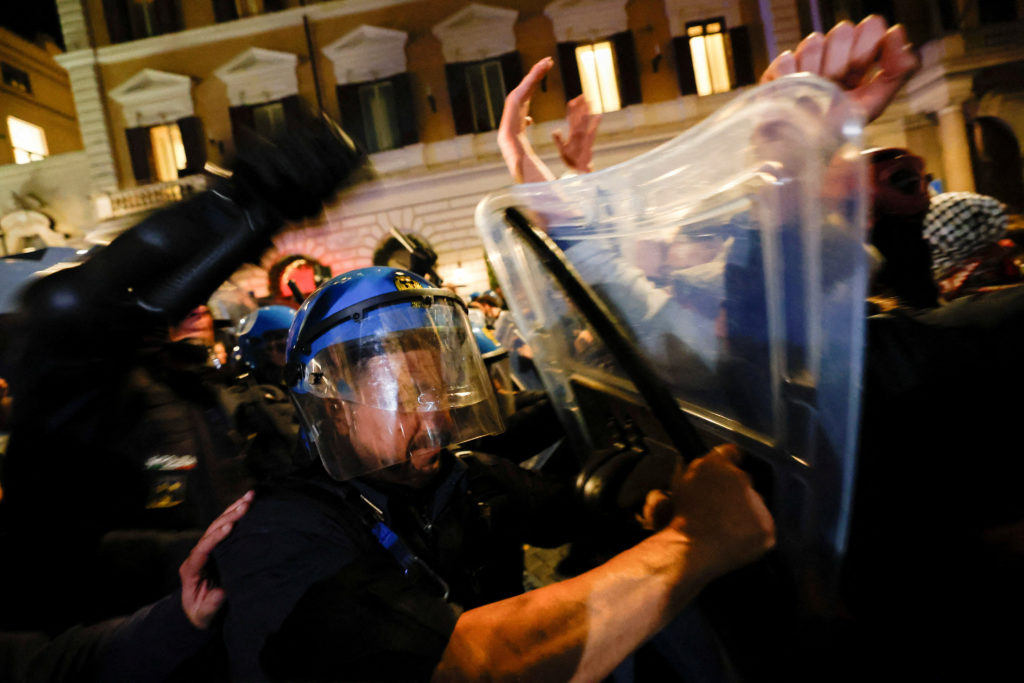
Protests in France were largely peaceful during the day but turned violent in some areas after nightfall on Saturday. Police used tear gas and water cannons as protesters threw objects and fireworks.
Key Facts
The Interior Ministry estimated that about 400,000 people took part in Saturday’s demonstrations.
Nearly 1,000 arrests were made, according to the report.
Around 70,000 officers were deployed across France for a second consecutive weekend.
Police and protesters clashed in Paris.
Police used tear gas and water cannons to disperse crowds.
Read the Original
Want the full story? Tap a source to open the original
article.
Thousands of Israelis rallied in Tel Aviv against Prime Minister Benjamin Netanyahu’s government, calling for an independent inquiry into the security failures that preceded the October 7, 2023, Hamas attack. The protest took place three days before a general election, with polls indicating a close contest and neither major bloc projected to win a parliamentary majority.
Key Facts
The October Council, founded by families of captives taken to Gaza, organized the rally at Hostages Square.
The group called for an independent state commission of inquiry into the government’s handling of the security failures before the October 7 attack.
Opposition figures Gadi Eisenkot and Yair Golan attended demonstrations in Tel Aviv.
Polls cited in the article showed Netanyahu’s bloc and Eisenkot’s bloc neck and neck ahead of the election.
Neither bloc was projected to secure a majority in Israel’s parliament.
Netanyahu’s coalition has rejected calls for an independent inquiry and proposed a commission whose members would be appointed by government and opposition politicians.
Opposition leaders said they would boycott a commission appointed by politicians.
Read the Original
Want the full story? Tap a source to open the original
article.
Thousands of people protested in Paris for a second weekend. French authorities banned demonstrations in central parts of the city after violence the previous weekend, while about 70,000 police were deployed across France.
Key Facts
Thousands of protesters gathered in Paris.
The protests took place for a second weekend.
French authorities banned demonstrations in central areas of Paris.
The ban followed violence the previous weekend.
About 70,000 police were deployed across France.
Read the Original
Want the full story? Tap a source to open the original
article.
Protests took place across France after riots the previous weekend and an alleged racist mass shooting near Paris. Police reported 110,000 demonstrators in Paris, while authorities made arrests, seized weapons and gas masks, and used tear gas in several cities.
Key Facts
French intelligence reports had forecast that up to 500,000 people might protest nationwide.
Police said 110,000 people demonstrated in Paris, matching the figure reported for the previous week.
Authorities changed the permitted protest route in Paris twice, keeping it away from the city centre.
Police said they seized weapons and gas masks during a morning crackdown.
Paris museums closed, and many businesses shut ahead of the protests.
Tear gas was fired in several cities amid confusion over last-minute changes to permitted protests.
The article reports that the French government later announced nearly 1,000 arrests connected to Saturday's protests.
Read the Original
Want the full story? Tap a source to open the original
article.
Ukrainian lawmaker Oleksandr Merezhko, chair of parliament’s Foreign Affairs Committee, called for U.S. envoy Steve Witkoff to step down, according to the program title. The report also says Ukraine’s access to Starlink and Starshield returned to its prior speeds, while diplomatic efforts toward negotiations and a localized ceasefire continued.
Key Facts
Volodymyr Zelenskyy said Ukraine’s Starlink and Starshield satellite links had returned to their pre-restriction speeds.
Zelenskyy said the restoration began overnight and was sufficient by Saturday morning.
The satellite-link disruption had affected front-line operations for more than a week, according to the article.
The article says Russia agreed to resume three-way negotiations with Washington and Kyiv next month.
Kyiv and Moscow agreed to a localized ceasefire around Oleshky in Ukraine’s Kherson region, brokered by first lady Melania Trump, the article says.
Oleksandr Merezhko is identified as a member of Ukraine’s parliament and chair of its Foreign Affairs Committee.
The program title quotes Merezhko calling for Steve Witkoff to step down.
Read the Original
Want the full story? Tap a source to open the original
article.
Thousands of people rallied in Tirana on Saturday against Albania’s government, and clashes with police left more than 300 protesters and officers injured, authorities said. The demonstrations reflect anger over school conditions, the cost of living, and corruption, with protesters calling for Prime Minister Edi Rama to resign.
Key Facts
Police used tear gas, water cannon, and rubber bullets to disperse crowds.
Authorities said more than 300 protesters and police officers were injured and dozens of demonstrators were arrested.
Some protesters threw stones and pushed burning bins toward the Ministry of Education building.
Organizers called on students and others from around Albania to attend the rally.
University professors, artists, and opposition parties announced support for or attendance at the demonstration.
The protests began in mid-October over poor school conditions and the cost of living.
Antigovernment demonstrations have occurred intermittently since May, after news emerged of a luxury hotel project linked to U.S. President Donald Trump’s family.
Rama called for dialogue and blamed foreign actors, including Russia and Iran, for online misinformation.
Read the Original
Want the full story? Tap a source to open the original
article.
Thousands of people marched in Tel Aviv on October 24, three days before Israel’s general election, to demand accountability for the failure to prevent Hamas’s October 7, 2023 attack. The October Council organized the rally and called for an independent state commission of inquiry; Netanyahu’s government has rejected that proposal and offered a commission with members appointed by politicians.
Key Facts
The demonstration began with marchers heading from Rabin Square toward Hostages Square.
The October Council was founded by families of people killed or taken hostage in the October 7 attack.
The council said the rally marked three years of campaigning to uncover the truth and establish accountability.
Polls published before a Friday night campaign blackout showed Netanyahu’s bloc and its main rival’s bloc tied, with neither projected to win a parliamentary majority.
The article identified Gadi Eisenkot as Netanyahu’s main centre-right rival.
Netanyahu’s government proposed a commission whose members would be split between ruling-coalition and opposition appointees.
Opposition leaders said they would boycott a commission appointed by politicians.
The October Council warned police about possible attempts to disrupt the rally by pro-government agitators.
Read the Original
Want the full story? Tap a source to open the original
article.
Tens of thousands of supporters of Brazilian President Luiz Inácio Lula da Silva gathered on Rio de Janeiro’s Copacabana Beach on Saturday, the day before the presidential runoff against Flávio Bolsonaro. Polls showed a close race after Bolsonaro led the first round, while recent scandals involving Bolsonaro appeared to help Lula regain ground.
Key Facts
Nearly 159 million Brazilians were expected to vote in the runoff on Sunday.
Flávio Bolsonaro won the 4 October first round with 47% of the vote, compared with Lula’s 45%.
Lula is seeking a fourth, non-consecutive presidential term.
Lula supporters held a large rally on Copacabana Beach in Rio de Janeiro on Saturday.
The article said polls showed a close contest and described Bolsonaro as a slight favorite, though Lula had recently gained ground.
Brazilian magazine Piauí reported that Flávio Bolsonaro attended a boat party during the 2020 coronavirus outbreak with sex workers and vaccine lobbyists.
Flávio Bolsonaro’s father, Jair Bolsonaro, is serving a 27-year prison sentence for plotting a coup after losing the 2022 election to Lula.
Read the Original
Want the full story? Tap a source to open the original
article.