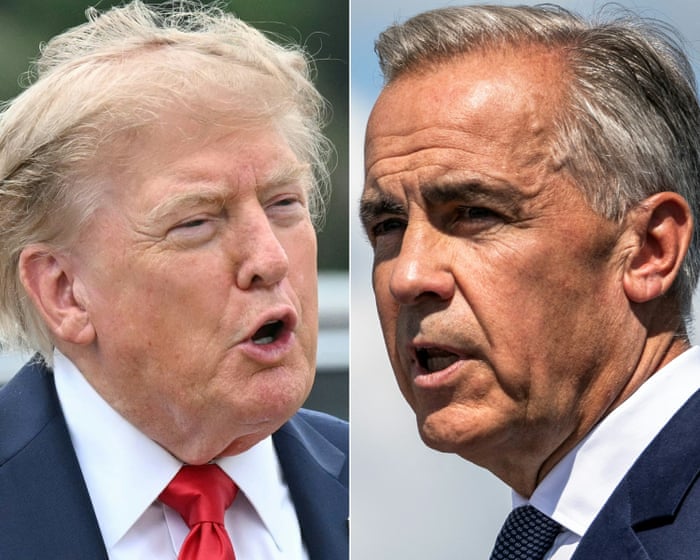
President Donald Trump threatened to impose serious tariffs on the European Union after the EU proposed making Canada its first associate member. EU leaders said the move was meant to strengthen cooperation, not to target anyone, while Canadian and European officials reacted with mixed views.
Key Facts
President Trump called the EU’s offer to Canada “laughable” and warned of heavy tariffs or stopping trade with Europe.
The European Commission president said the cooperation with Canada is for common strength and not against any country.
Canada is set to address the European Parliament about this proposal.
Germany’s Chancellor Friedrich Merz faces political challenges ahead of key state elections and canceled a planned UN trip.
Some Canadian conservatives criticized the idea, fearing higher taxes and more EU regulations affecting Canadian industries.
Experts said “associate membership” might lead to several agreements but not full institutional membership for Canada.
The proposal triggered debates about Canada’s role in international partnerships and its relationship with both Europe and the US.
Read the Original
Want the full story? Tap a source to open the original
article.
Russian forces launched missile and drone attacks on Ukraine's capital, Kyiv, injuring at least 16 people, including children. The attacks targeted over 10 locations in Kyiv and other regions, while Ukraine’s Air Force intercepted many of the incoming targets.
Key Facts
At least 16 people were injured in the attacks on Kyiv, including a 10-year-old girl and a 12-year-old boy.
India has warned that new U.S. tariffs on Russian oil could harm relations between the two countries. The U.S. Congress passed a bill allowing President Donald Trump to impose tariffs on countries buying Russian oil, aiming to press Russia over its invasion of Ukraine.
Key Facts
The U.S. House of Representatives passed a bill with sanctions and tariffs targeting Russia’s energy and defense sectors.
The bill allows President Trump to impose tariffs up to 100% on countries, including India, that buy Russian oil and gas.
The bill also extends sanctions on Iran and targets Russian officials and a fleet of tankers that bypass sanctions.
India is the third-largest oil importer in the world and buys a significant amount of Russian oil.
India’s government said it is committed to energy security for its 1.4 billion people.
India warned the U.S. that tariffs on Russian oil imports could affect India-U.S. ties and global energy markets.
India plans to protect its trade and economic interests and work with trade groups on the bill’s impact.
The bill has been sent to President Trump to sign into law.
Read the Original
Want the full story? Tap a source to open the original
article.
President Donald Trump has warned that he may impose heavy tariffs on the European Union if it goes ahead with a plan to make Canada its first associate member. The EU proposal aims to strengthen ties with Canada as both face challenges from global conflicts and tensions with the US and China.
Key Facts
President Trump called the EU’s plan to associate with Canada “laughable” and threatened tariffs or trade restrictions.
The EU proposal was made by European Commission President Ursula von der Leyen to deepen relations with Canada.
Canada’s Prime Minister Mark Carney is actively seeking closer links with the EU amid worsening US-Canada relations.
The US previously placed tariffs on large amounts of trade between the US and Canada.
EU diplomats expressed uncertainty about the meaning and feasibility of the associate membership proposal.
France’s Europe Minister said the US has no power to veto EU decisions on political partnerships.
The EU faces security risks due to Russia’s invasion of Ukraine and ongoing global trade tensions.
Mark Carney was scheduled to address the European Parliament to discuss the cooperation plans.
Read the Original
Want the full story? Tap a source to open the original
article.
Owen Ndlovu, a well-known South African sports broadcaster, was kidnapped and found dead with gunshot wounds near Johannesburg. Police are searching for three suspects and investigating the killing.
Key Facts
Owen Ndlovu was taken from his vehicle while picking up his wife from a church in Katlehong.
Three men forced Ndlovu into the back of the vehicle, one reportedly carrying a gun.
The vehicle was found abandoned in Walkerville, south of Johannesburg.
Ndlovu’s body was discovered the next morning in Thokoza, near Katlehong.
Police are treating the case as a murder and awaiting post-mortem results.
Ndlovu worked for South Africa’s public broadcaster SABC and was involved in sports and music rights.
Violent crime, including carjackings and murders, is a major issue in South Africa, with thousands of such crimes recorded recently.
Authorities ask the public to assist in the investigation and emphasize the priority of fighting crime.
Read the Original
Want the full story? Tap a source to open the original
article.
Israel is using artificial intelligence (AI) tools to monitor land in the West Bank and identify unauthorized changes. This technology helps Israel speed up demolitions of Palestinian homes by detecting buildings considered illegal in areas where Palestinians find it hard to get permits.
Key Facts
Israel employs an AI tool called ImiSight, developed by the Israeli weapons company Rafael, to monitor land in the West Bank and the Naqab desert.
ImiSight identifies changes in the landscape, which Israel uses to justify demolishing structures.
Many Palestinian and Bedouin communities have difficulty obtaining building permits from Israeli authorities.
Israel established a Land Authority enforcement unit in April 2025 to operate in the West Bank using AI technology.
Rights activists and organizations describe this use of AI as part of efforts to displace Palestinians and expand control over the territory.
New satellite technology processes images using AI directly in space, speeding up surveillance and detection.
The use of AI and satellite advances reduces the need for human review, allowing faster decisions on demolitions.
Israeli officials and ImiSight representatives did not respond to requests for comment from Al Jazeera.
Read the Original
Want the full story? Tap a source to open the original
article.
European and Arab military leaders met in Paris to discuss how to support Lebanon’s army as the UN peacekeeping mission (UNIFIL) in southern Lebanon is set to end by the end of 2026. They explored ideas for a new international force to help train and support Lebanese troops amid tensions between Israel and Hezbollah.
Key Facts
UNIFIL, a UN peacekeeping mission with about 7,500 personnel, will end its mandate at the end of 2026.
Lebanon and France want to extend the UN mission, but the US and Israel have not supported this extension.
Paris talks considered creating a new mission led by France and Italy, possibly outside the UN system, or a mission led by the European Union.
The new mission ideas focus on training, providing equipment, sharing intelligence, and mentoring the Lebanese army.
Lebanon’s army is financially weak and is under pressure from Israel’s military presence in southern Lebanon and Hezbollah, an armed group backed by Iran, which refuses to disarm.
A donor conference to raise money for Lebanon’s army is planned for late 2026 or early 2027.
Leaders from Lebanon, France, and Jordan are working to gain international support for Lebanon’s military.
The current conflict risks creating a security gap after UNIFIL withdraws, increasing concerns about renewed violence in southern Lebanon.
Read the Original
Want the full story? Tap a source to open the original
article.
A group of UK lawmakers called for a ban on nearly all gambling advertisements to protect people’s health. They suggest the ban would reduce problems like debt and addiction but might shrink the gambling industry. The gambling industry opposes the ban, saying it could increase illegal gambling.
Key Facts
The UK House of Lords report recommends banning most gambling ads, with exceptions for lotteries and racecourses.
Gambling ads have grown a lot since 2005, with industry spending around £2 billion on advertising in 2024.
About 1.4 million people in Great Britain have gambling problems.
The proposed ban aims to decrease harms such as financial trouble, family problems, and suicide linked to gambling.
The industry group Betting & Gaming Council (BGC) warns a ban could boost illegal gambling sites that keep advertising.
Regulators are working to stop illegal gambling, but legal market ads are also linked to harm.
Before 2005, only bingo, pools, and lotteries could advertise on TV in the UK.
Some industry measures already limit ads, such as not advertising during live sports games.
Read the Original
Want the full story? Tap a source to open the original
article.
Nearly half of England’s parliamentary areas have poor access to nature, with many homes located too far from parks or waterways. A wildlife charity warns this problem worsens health risks, especially during extreme heat, and urges the government to take faster action to ensure everyone can reach green or blue spaces within a 15-minute walk.
Key Facts
44% of parliamentary constituencies in England have at least 20% of homes more than 15 minutes’ walk from green or blue spaces.
Blue spaces include areas with water such as rivers, lakes, or seas.
Seven of the 10 poorest constituencies have low access to nature.
Extreme heat in England recently increased the need for cool, shaded natural areas.
The Wildlife Trusts and partners presented a green paper calling for better nature access and biodiversity protection.
The charity wants the government to let communities buy land for nature, treat green spaces as essential infrastructure, and require eco-friendly housing development.
Public consultation showed people rely on nature for physical and mental health benefits, especially during heatwaves.
Access to rivers in cities is proposed to become a legal right.
Read the Original
Want the full story? Tap a source to open the original
article.
The war in Yemen has intensified, with Houthi militants gaining control of key islands along the Red Sea, threatening important global shipping routes and oil supplies. The conflict has caused many civilian deaths and displaced over 100,000 people, creating a severe humanitarian crisis in Yemen.
Key Facts
Houthi militants have quickly advanced along Yemen's west coast.
They control islands near the Bab al-Mandab strait, a vital shipping route for 15% of world trade.
The strait of Hormuz, another key oil route, remains mostly blocked after US and Israeli airstrikes.
The conflict risks causing higher global oil prices.
Yemen’s civil war began in 2014 between government forces and Iran-backed Houthis.
Over 150,000 people have died, primarily from air strikes by the Saudi-led coalition.
Around 4.5 million people have been displaced over the past ten years.
More than 18 million Yemenis need humanitarian aid, according to the UN.
Read the Original
Want the full story? Tap a source to open the original
article.
The US House of Representatives has passed a bill allowing President Donald Trump to impose sanctions and up to 100% tariffs on countries buying Russian oil and gas. India, a major buyer of Russian crude oil, faces economic risks from this bill as it relies heavily on discounted Russian oil to meet its energy needs.
Key Facts
The US House passed a bill giving President Trump power to sanction countries buying Russian oil and gas, with tariffs up to 100%.
India buys about 37% of Russia's crude oil exports, making it one of the largest customers along with China.
Russian oil made up around 30% of India's crude imports in fiscal 2026, worth about $40.8 billion.
The bill could lead to tariffs on Indian exports to the US, impacting India's economy beyond just oil imports.
India says it is closely watching the situation and is committed to ensuring energy security.
Replacing Russian oil would increase costs due to higher crude prices, shipping, and insurance.
The bill pressures India to change its trading practices with Russia under threat of economic penalties.
The US may shorten the usual 180-day deadline for countries to reduce Russian energy imports.
Read the Original
Want the full story? Tap a source to open the original
article.
A study found that human-caused climate change contributed to the glacier collapse that caused deadly floods on the Nepal-Tibet border in August. The disaster was triggered by multiple factors including rising temperatures, melting glaciers, thawing frozen ground, and weak geology in the area.
Key Facts
Over 1,400 people died and thousands are missing due to floods and landslides on 26 August.
The glacier collapse caused a strong impact similar to a 5.2 magnitude earthquake.
July and August temperatures were about 1.5°C (2.7°F) warmer because of human influence.
Glaciers in the region are thinning by around half a meter (1.6 feet) each year.
Heavy snowfall in previous months increased meltwater contributing to the disaster.
A 2015 earthquake may have weakened the rock under the glacier, making collapse more likely.
Nepali leaders emphasize the country’s vulnerability to climate change despite low greenhouse gas emissions.
Nepal’s Prime Minister will speak at the UN General Assembly about the flood and climate justice.
Read the Original
Want the full story? Tap a source to open the original
article.
That's the point of this site, and readers keep it that way. Support for any amount and the daily digest lands in your inbox every morning at 7am Eastern.
Oasis Hub Bath, a community center in the city, received £272,702 from the National Lottery Community Fund to cover its main costs for three years. The hub runs two affordable food pantries serving around 600 people weekly and offers other support services such as health checks and advice sessions.
Key Facts
Oasis Hub Bath opened in 2018 in the city centre.
The hub operates two low-cost food pantries helping about 600 people each week.
The National Lottery Community Fund granted £272,702 to support the hub’s operations for three years.
Pantry members pay £5 or £7.50 per week for food and household items; some fresh food is free.
To join the pantry, households must earn less than £18,000 a year, struggle to afford food, and live in certain areas of Bath.
The hub also provides services like advice from Citizens Advice and health checks with healthcare partners.
Some pantry users say the services have helped them manage costs and health issues.
Read the Original
Want the full story? Tap a source to open the original
article.
Australia will tighten immigration rules for international students, visitors with working holiday visas, and people who switch between student visas. The government wants to reduce how many people migrate each year, especially targeting those who bring families or extend their stay through lower-level courses. Some visa limits will involve a lottery system, but UK citizens will not be affected by the new rules.
Key Facts
International students cannot automatically bring family members with them anymore, except for PhD students and some students from the Pacific and Southeast Asia.
Students must now choose higher-level courses to extend their stay, stopping "visa hopping" to lower qualifications or less reliable providers.
Working holiday visa holders (age 18-30) will face new limits using a lottery system to qualify for second and third years of stay.
The cap for the second year of the working holiday visa will reduce from 57,000 to 45,000, and the third year from 31,000 to 5,000 places.
British working holidaymakers are not affected due to Australia's free trade agreement with the UK.
Australia aims to reduce net overseas migration to 225,000 people by 2028.
The country’s population grew by 1.4% to 27.9 million in the year ending March 2026, including 292,100 net overseas migrants.
The migration policy changes respond to concerns about housing prices, the cost of living, and public services strain amid political debates on population growth.
Read the Original
Want the full story? Tap a source to open the original
article.
Young men wearing balaclavas are riding electric bikes and scooters illegally on public paths and roads in Scotland. These vehicles are often modified to go much faster than the law allows, causing safety risks and some fatal accidents. Police have new powers to seize these illegal vehicles and are considering more dedicated efforts to stop the riders.
Key Facts
Young men ride electric bikes and scooters while hiding their faces with balaclavas.
These vehicles are often modified to exceed legal speed limits and to run without pedalling.
Modifications are sold online, including parts that allow faster speeds and throttle controls.
Electric dirt bikes can reach speeds above 50 mph and require a licence and insurance to be used legally.
Riding some electric scooters on public roads is illegal except in special rental zones.
Police in England and Wales have new powers to seize and destroy illegal electric bikes quickly.
Scottish ministers support increasing police seizure powers but say some rules already allow seizure.
Police find it hard to catch offenders because the bikes are fast and can escape through narrow spaces.
Read the Original
Want the full story? Tap a source to open the original
article.
A British inquiry into claims that Special Air Service (SAS) soldiers killed unarmed Afghan civilians during operations has cost UK taxpayers £58 million so far. The inquiry started in 2023 and is still ongoing, with delays caused partly by slow information sharing from the Ministry of Defence.
Key Facts
The inquiry investigates alleged war crimes by SAS soldiers in Afghanistan between 2010 and 2013.
It focuses on accusations that SAS soldiers killed detainees and civilians, including children, during night raids against the Taliban.
The inquiry was started by former defence secretary Ben Wallace after BBC reports in 2022 raised the allegations.
Initially, the inquiry expected to report within 12-18 months but has been running for over three and a half years with no findings published yet.
The Ministry of Defence says the total cost of the inquiry and related work is £58 million by March 2026.
About 74 MoD staff spend more than half their time on the inquiry.
The SAS Regimental Association supports the inquiry but says the long process hurts the SAS’s reputation, morale, and military effectiveness.
Public inquiries like this one can take many years and be very expensive, similar to the Bloody Sunday Inquiry which lasted 12 years and cost over £190 million.
Read the Original
Want the full story? Tap a source to open the original
article.
Russia is holding a parliamentary election where the ruling party, United Russia, is expected to win again. The election is important to the Kremlin because it shows public support for President Putin and the war in Ukraine, even though critics say the election is not free or fair.
Key Facts
Russia’s political system is described as a “managed democracy,” where the Kremlin controls most decisions.
United Russia, the party supporting President Vladimir Putin, is predicted to dominate the new parliament.
The election selects 450 deputies for the lower house of parliament, called the Duma.
This is Russia’s first parliamentary election since its full-scale invasion of Ukraine.
Nearly 200 war veterans are running to promote their political careers.
All parties currently in the Duma have voted unanimously to support the war in Ukraine.
The only registered anti-war party, Yabloko, was removed from the election ballot by Russia’s Supreme Court.
Some Yabloko candidates still run in individual areas but face detentions and legal actions.
Read the Original
Want the full story? Tap a source to open the original
article.
Buckingham Palace has strongly denied claims made by Earl Spencer, the brother of Princess Diana, who said King Charles told him after Diana's death in 1997, "we'll forget her soon enough." The Palace said such claims are not accurate and that grief can affect memory. This dispute comes as King Charles is preparing to speak about the impact of artificial intelligence (AI) at a technology event.
Key Facts
Earl Spencer wrote in his upcoming book that King Charles expressed anger and said people would forget Diana soon after her death.
Buckingham Palace rejected this claim, saying it is out of character for King Charles, who was grieving at the time.
The Palace noted that grief can affect how people remember events, suggesting memories may differ.
Earl Spencer’s book is titled *Swan Song: Diana, My Sister* and offers an inside view of Diana’s life and death.
The disagreement highlights ongoing sensitivity around Diana’s passing and the royal family’s response.
King Charles is also preparing to host a meeting with leaders from major AI companies to discuss the future of artificial intelligence.
The King will emphasize the need to balance the benefits of AI with safety and ethical concerns.
Major tech companies like OpenAI, Nvidia, and Google DeepMind will take part in this discussion.
Read the Original
Want the full story? Tap a source to open the original
article.
There are no ads, so there is no reason to bait you. Readers who chip in keep it that way. Most choose $3.99/month, and get the daily digest every morning.
US journalist Austin Tice, who went missing in Syria in 2012, was kidnapped in a planned operation approved by then-Syrian President Bashar al-Assad, according to a BBC investigation. New evidence shows the abduction was deliberate, involving regime loyalists and a driver spying on Tice before he was taken.
Key Facts
Austin Tice, a journalist and former US Marine, disappeared in Syria in 2012 while reporting on the civil war.
Many thought his kidnapping was accidental, but the BBC found it was carefully planned for over a month.
A member of the group that captured Tice said Syrian President Bashar al-Assad ordered the abduction.
Tice’s driver was secretly working with Syrian regime forces and helped track his movements.
The operation was overseen by high-ranking regime security officials closely linked to Assad.
Despite searching multiple suspected detention sites, US authorities have found no sign of Tice.
Some say Tice was executed, but there is no proof or recovered remains.
Syrian intelligence files confirm the regime held Tice, but exact details of his fate remain unknown.
Read the Original
Want the full story? Tap a source to open the original
article.
A 13-year-old boy named Harry Sparkes is the new voice of Thomas the Tank Engine in the animated series Thomas & Friends: Railway Stories. The series, narrated by actor Henry Golding, will appear on YouTube and Netflix starting this September.
Key Facts
Harry Sparkes, from Harpenden, Hertfordshire, voices Thomas the Tank Engine.
He kept his acting role secret from friends for nine months by saying he was at physiotherapy.
The show uses 3D animation and features Henry Golding as the narrator.
Henry Golding follows famous narrators like Sir Ringo Starr and Pierce Brosnan.
The series will launch on YouTube on September 17, then stream on Netflix from September 30.
A full series is planned to debut in early 2027.
Thomas the Tank Engine is based on a classic book series by Reverend Wilbert Awdry from 1945.
Mattel, the franchise owner, says the new show refreshes the setting of Sodor while keeping the traditional railway action.
Read the Original
Want the full story? Tap a source to open the original
article.