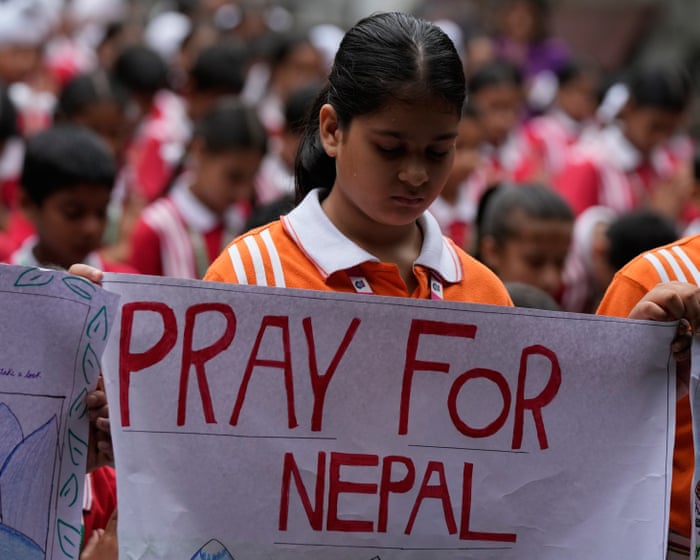
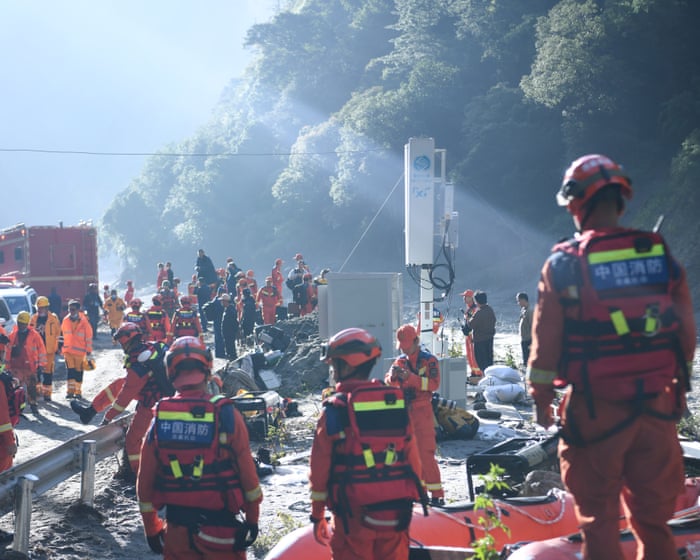
A flash flood caused by a melting glacier near the Nepal-Tibet border has killed at least 626 people and left nearly 3,000 missing. The floods destroyed homes, roads, and schools, and Nepal’s government is asking for financial help to recover and prepare for more possible flooding.
Key Facts
At least 626 people have died due to the flash floods near Nepal-Tibet.
Around 3,000 people are still missing after the disaster.
Entire communities were washed away, leaving many homeless or in temporary shelters.
Multiple bridges and major roads have been destroyed or damaged, making rescue efforts difficult.
18 schools have been destroyed and 20 more damaged, affecting about 10,000 children’s education.
The floods were caused by a glacier collapse that created a dangerous lake near the China-Nepal border.
Chinese authorities report the size of the lake has decreased, lowering the risk of further flooding.
Nepal’s finance minister estimates that up to $5 billion will be needed for recovery and rebuilding.
Read the Original
Want the full story? Tap a source to open the original
article.
Gunfire and explosions were heard near a military base at Niamey's international airport in Niger's capital, a site previously attacked twice this year by jihadist groups. The cause of the current attack is not yet known, and no official statement has been made.
Key Facts
The attacks happened near Base 101 by Niamey’s international airport.
The airport was attacked twice before in 2026, once by the Islamic State in the Sahel (EIS) and once by the Group for the Support of Islam and Muslims (JNIM), linked to Al-Qaeda.
Both previous attacks resulted in deaths among soldiers and attackers, but the military repelled them.
Niger has been ruled by a military junta since a 2023 coup.
Jihadist violence has been ongoing in Niger and the wider Sahel region for about ten years.
The government of Niger and its military allies withdrew from the regional group ECOWAS and reduced traditional Western partnerships, seeking closer ties with Russia.
Social media and local residents reported heavy gunfire and explosions; armored vehicles were seen near the airport.
The origin and details of the current violence remain unconfirmed as of the report.
Read the Original
Want the full story? Tap a source to open the original
article.
A large clinical trial led by Australian researchers found that taking statins daily can safely lower the risk of first-time heart attacks and strokes in people over 70 who are otherwise healthy. The study showed a 30% reduction in major heart events with low risks of serious side effects.
Key Facts
Statins are drugs that lower cholesterol and are already given to people under 75 with certain health risks.
Researchers studied nearly 10,000 people over 70 who had never had a heart attack or stroke.
The study lasted about 10 years and was a randomised controlled trial, which is a strong type of medical research.
Daily statin use reduced the risk of a first major heart event by 30%.
For every 37 older adults treated, one major heart event was prevented over almost six years.
The study excluded people who might be at risk from taking statins or who already needed them.
The research mostly involved white participants around 75 years old, so results may not apply to all groups.
The findings were published in the New England Journal of Medicine and presented at a major cardiology conference.
Read the Original
Want the full story? Tap a source to open the original
article.
Six months into the war involving Iran, the Gulf region is changing how it approaches security and defense. Gulf countries are building new partnerships and agreements to protect themselves better, moving beyond reliance on the United States alone. This new security system includes overlapping alliances with regional and international partners.
Key Facts
Iran launched a missile strike in June 2025 on Al Udeid Air Base in Qatar, marking a turning point in Gulf security.
Gulf states recognize increased risks to cities, energy facilities, airports, ports, and shipping routes from missiles and drones.
Traditionally, Gulf security depended mainly on the U.S. and the Gulf Cooperation Council (GCC), but that system is evolving.
Gulf countries are strengthening cooperation among themselves and also with new partners like Turkiye and European states.
The Mecca Joint Defence Agreement links Saudi Arabia, Turkiye, and Pakistan, treating an attack on one as an attack on all.
This new agreement expands collective defense beyond the GCC and resembles NATO’s idea but is more flexible and less centralized.
The emerging Gulf security framework involves overlapping partnerships rather than a single, unified alliance.
Leadership in this system is shared, reflecting the diverse views and threat perceptions of different countries.
Read the Original
Want the full story? Tap a source to open the original
article.
Europe is experiencing a severe summer drought that is reducing water levels in rivers, lakes, and fish farms. This dry and hot weather is threatening fish populations and harming the fishing industry in several countries, including Serbia, Hungary, Romania, and the Czech Republic.
Key Facts
Water levels have dropped drastically in the Danube River and other water bodies in northern Serbia.
Fish are confined to very small, shallow ponds where high water temperatures over 30°C (86°F) endanger their survival.
The drought and heat have damaged fish farms in multiple countries, causing millions of euros in losses.
Hungary has about 99% of its land under severe or extreme drought conditions, impacting its large fish pond areas.
Approximately 280 metric tons of fish died due to drying ponds in Hungary, with losses worth about $4.2 million.
Fish farmers have had to move water between ponds and drain some ponds to save fish.
Romania’s fish farms continue to suffer after severe droughts in previous years (2023 and 2024) compounding this year’s problems.
Governments and businesses are considering ways to handle future extreme weather events linked to climate change.
Read the Original
Want the full story? Tap a source to open the original
article.
Icelanders are voting on whether to restart talks to join the European Union after pausing negotiations 13 years ago. The decision comes at a time of rising Arctic security concerns, economic challenges, and mixed public opinion on EU membership.
Key Facts
Iceland last paused EU accession talks 13 years ago under a government that opposed membership.
The vote will decide if Iceland should begin new negotiations to join the EU.
If approved, a second referendum would follow to confirm full EU membership.
Public opinion is nearly evenly split, with polls showing about half of Icelanders for or against resuming talks.
Arctic security worries have increased due to Russia’s war in Ukraine and US threats toward Greenland.
Iceland’s lack of armed forces makes it dependent on NATO and the US for security.
Supporters believe EU membership could lower inflation, stabilize the currency, and reduce customs barriers.
Opponents worry about losing control over national policies and having less influence in the large EU bloc.
Read the Original
Want the full story? Tap a source to open the original
article.
Heavy floods and landslides struck areas along the Nepal-China border, killing over 600 people and leaving nearly 3,000 missing. Rescue teams are still searching for survivors as affected communities face large-scale damage and a long rebuilding process.
Key Facts
At least 633 people have died from the floods and mudslides in Nepal and Tibet.
Nearly 3,000 people remain missing after the disaster.
The floods were caused by a glacier collapse, avalanche, earthquake, and subsequent landslide.
Thousands of people, including workers on hydropower projects and pilgrims, are among the missing.
Around 500 people are staying in a relief camp in Kathmandu after losing homes.
The damaged area is difficult to reach, complicating rescue efforts.
Nepal’s finance minister estimates $4 billion to $5 billion is needed for rebuilding.
Some flood victims’ bodies may have been carried downstream as far as India.
Read the Original
Want the full story? Tap a source to open the original
article.
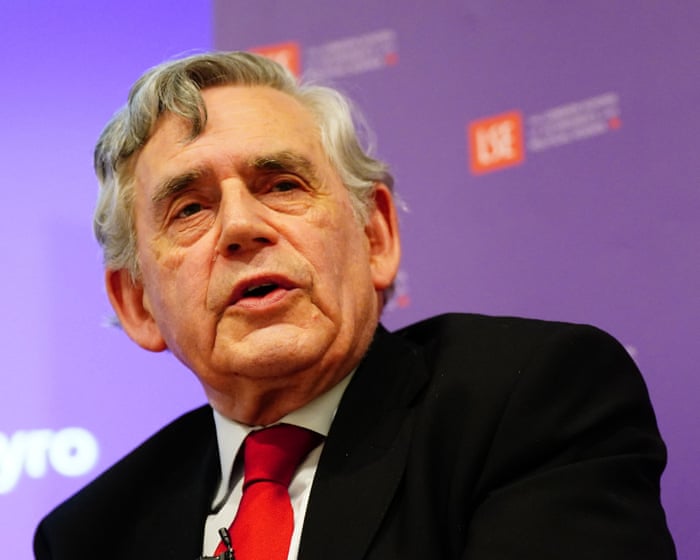
Gordon Brown said that Ireland will eventually become united, but this will be a long process that requires agreement from everyone involved. He contrasted this with Scotland’s situation, where he opposed independence, saying Scotland should work together with the rest of the United Kingdom.
Key Facts
Gordon Brown, former UK prime minister and chancellor, said Irish unity is inevitable in the future.
He emphasized that uniting Ireland will take time and must be based on mutual agreement.
Brown opposes Scottish independence and believes Scotland is closely linked to the UK geographically, economically, socially, and culturally.
Brown was involved in peace efforts in Northern Ireland, including during the 1998 Good Friday Agreement.
He supports continued oil and gas drilling in the North Sea as a way to help transition to renewable energy like wind, hydrogen, and carbon capture.
Brown suggested that North Sea energy development could involve a European partnership with countries like Norway, Germany, and the Netherlands.
He highlighted that environmental policies should be viewed as beneficial and that renewable energy costs are decreasing.
Brown released a new book called The Future Starts With Us.
Read the Original
Want the full story? Tap a source to open the original
article.
Dolly Parton, a famous country singer who died recently at 80, never called herself a feminist but showed values of independence and equality through her life and songs. Fans and writers see her actions and lyrics as reflecting feminist ideas, especially her breaking of double standards for women.
Key Facts
Dolly Parton appeared on the cover of Ms. magazine’s 12 Women of the Year in 1987.
She avoided political and feminist labels but lived with strong independence.
Her songs addressed issues like the double standard between men and women’s behavior.
At a 2019 festival, she sang “Just Because I’m a Woman,” highlighting gender inequality.
Fans like Lynn Melnick say Parton’s life and lyrics helped many, including those recovering from trauma.
Parton used humor and relatability to discuss serious topics without alienating listeners.
Music writer Caryn Rose said Parton made her looks and persona work in her favor, which is a feminist act.
Parton’s broad appeal crosses political lines, and many groups feel a connection to her.
Read the Original
Want the full story? Tap a source to open the original
article.
Six months after military strikes and efforts by the US and Israel to remove Iran’s government, Iran’s new leadership is firmly controlled by military generals and religious leaders. They show no trust in President Trump’s talks and threats, and they are prepared for a long conflict and to stop any unrest inside the country.
Key Facts
The US and Israel launched attacks to weaken Iran’s government six months ago.
Iran’s top leaders now are mainly hard-line military generals and clerics.
President Donald Trump hoped the attacks would bring more cooperative Iranian officials.
Iran’s leaders do not trust negotiations with President Trump after two attacks happened during talks.
Iran’s Supreme National Security Council secretary, Mohsen Rezaei, warned of strong retaliation if US sanctions and blockades continue.
Hossein Taeb, linked to harsh crackdowns on protests, was named head of the Basij, a Revolutionary Guard militia.
The younger Ayatollah Mojtaba Khamenei is Iran’s new supreme leader after his father was killed in the attacks.
Iran is focused on preventing protests and unrest amid worsening economic problems.
Read the Original
Want the full story? Tap a source to open the original
article.
Heavy flash floods along the Nepal-China border have killed nearly 600 people and left about 2,500 missing. Rescue teams are working despite bad weather, which has stopped helicopter aid, and authorities warn of more flooding from a newly formed lake caused by a glacier collapse.
Key Facts
Flash floods occurred on Wednesday along the Nepal-China border.
About 600 people have died and nearly 2,500 remain missing.
Poor weather led to the suspension of helicopter rescue operations.
Rescue teams are searching several locations in Nepal and Tibet, China.
Over 100 people may be trapped in a mud-filled tunnel at a hydropower project site in Nepal.
Rescuers use baskets and ropes but face difficult conditions with deep mud and few landing spots for helicopters.
Authorities warn of further flooding from a new lake formed by a glacier collapse.
The lake’s water level dropped by 10 meters according to Chinese monitoring on Friday.
Read the Original
Want the full story? Tap a source to open the original
article.
Fans of rapper Tupac Shakur have shown renewed interest and hope for justice as the murder trial of Duane “Keffe D” Davis, the only person charged in Tupac’s 1996 killing, nears its end. Tupac’s music and message continue to influence people around the world, with ongoing memorials and tributes marking his legacy.
Key Facts
Tupac Shakur was shot and killed in a drive-by shooting in Las Vegas on September 7, 1996.
Duane “Keffe D” Davis has pleaded not guilty to planning the shooting.
The trial is one of the first legal actions related to Tupac’s death nearly 30 years ago.
Fans gather regularly at the shooting location, leaving messages and tributes such as “RIP King” and “Tupac 4 Life.”
Tupac has a star on the Hollywood Walk of Fame and a street named after him in Oakland, California.
He will appear as a character in the upcoming video game “Stranger than Heaven.”
Tupac’s philosophy called T.H.U.G. L.I.F.E. focused on highlighting problems faced by Black communities and promoting change.
Supporters view Tupac not only as a musician but also as a social activist similar to figures like Malcolm X and Martin Luther King Jr.
Read the Original
Want the full story? Tap a source to open the original
article.
That's the point of this site, and readers keep it that way. Support for any amount and the daily digest lands in your inbox every morning at 7am Eastern.
Iceland is holding a vote to decide if it should restart talks about joining the European Union. This vote comes after U.S. President Donald Trump made threats about taking control of Greenland, which has caused concern in Iceland about its own security.
Key Facts
Icelanders are voting on whether to resume negotiations to join the European Union.
About 265,000 people in Iceland are eligible to vote in this referendum.
A yes vote will start talks with the EU covering many topics, including the economy and fishing rights.
Iceland is worried because Greenland, nearby and part of Denmark, was targeted by President Trump for potential U.S. control.
The Icelandic government believes EU membership could help protect the country from future threats.
President Trump has said he will not use force to take Greenland but his interest has worried Icelanders.
If the vote is no, Iceland likely will not restart EU talks for a very long time.
The current Icelandic government is left-leaning and supports joining the EU partly due to mistrust of U.S. intentions.
Read the Original
Want the full story? Tap a source to open the original
article.
King Harald V of Norway, who was Europe’s oldest king, died at the age of 89 after spending several days in the hospital. His son has become the new king, known as King Haakon VIII.
Key Facts
King Harald V was 89 years old when he died.
He was Europe’s longest-serving monarch.
The king had been in the hospital for several days before his death.
Upon his death, his son became King Haakon VIII.
Norwegians are mourning the loss of King Harald V.
King Harald V was often called "the whole country’s grandfather" by Norwegians.
The transition of the throne to King Haakon VIII happened immediately after King Harald’s death.
Read the Original
Want the full story? Tap a source to open the original
article.
Ratko Mladić, the Bosnian Serb military leader responsible for massive killings during the 1990s Bosnian war, has died in prison. While many around the world view him as a war criminal responsible for genocide and ethnic cleansing, some in Serbia consider him a hero and plan to honor him with full military and state honors.
Key Facts
Ratko Mladić led Bosnian Serb forces during the breakup of Yugoslavia in the 1990s.
He was responsible for about 100,000 deaths, including the Srebrenica massacre where at least 8,000 Bosnian Muslim men and boys were killed.
Mladić oversaw the siege of Sarajevo, lasting 1,425 days, causing thousands of deaths, including many children.
An estimated 20,000-50,000 women and girls were sexually assaulted during the conflict, and 2.7 million people were forced to leave their homes.
Mladić was convicted of genocide, war crimes, and crimes against humanity, and he was serving a life sentence when he died.
Despite international condemnation, the Serbian government announced Mladić would be buried with full military and state honors.
The war and Mladić’s actions remain highly divisive in the Balkans, with some viewing him as a national hero.
The Srebrenica massacre was declared a failure of the international community, including the United Nations, which had promised to protect the area.
Read the Original
Want the full story? Tap a source to open the original
article.
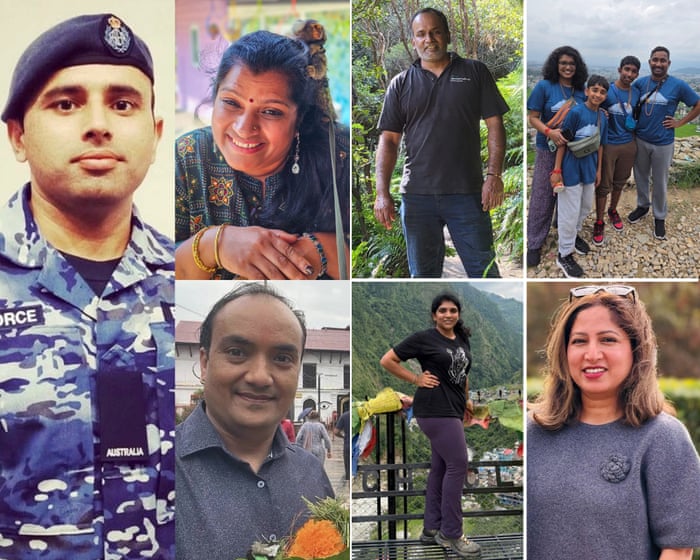
At least 41 Australians are missing after deadly flash floods and landslides hit the Nepal-Tibet border area. Many of the missing were pilgrims and trekkers, including groups from tour companies and members of the Australian Defence Force. Rescue efforts continue amid widespread devastation affecting about 93,000 people.
Key Facts
Flash floods and landslides struck the Nepal-Tibet border, causing many people to go missing.
About 41 Australians are among the nearly 2,500 people reported missing.
Around 93,000 people have been affected by the disaster according to the Red Cross.
Fifteen Australians went missing while on a pilgrimage to Mount Kailash with Himalayan Glacier Adventures.
The missing include multiple families and individuals, such as medical students and a young child.
Six Australians are missing from the Kailash Journeys tour group, including a Royal Australian Air Force member.
Narayan Panthi, a volunteer from Brisbane, is also missing after charity work in Kathmandu.
Another 11 Australians are missing after traveling with the Isha Foundation pilgrimage group.
Read the Original
Want the full story? Tap a source to open the original
article.
An Ecuadorian court found former President Lenin Moreno guilty of bribery related to the country's largest hydroelectric plant. He was sentenced to five years in prison and banned from holding public office. Several of his family members and others were also convicted in the corruption case.
Key Facts
Lenin Moreno was found guilty of bribery connected to the Coca Codo Sinclair hydroelectric plant.
He received a five-year prison sentence and a lifetime ban from public office.
The corruption involved bribes paid by the Chinese state-owned company Sinohydro, totaling about $76.1 million from 2009 to 2018.
Moreno’s wife, daughter, two brothers, and their wives were sentenced to 2.5 years in prison.
China’s former ambassador to Ecuador, Cai Runguo, was sentenced to five years in prison.
Money flowed through overseas bank accounts and shell companies in tax havens before reaching the accused.
Prosecutors say Moreno and his close family received over $1 million during his term as vice president (2007–2013).
Moreno denies the charges, saying he did not sign or oversee the project’s contracts.
Read the Original
Want the full story? Tap a source to open the original
article.
Rescuers have resumed flood recovery efforts near the Nepal-Tibet border after a pause due to fears of a second flood from a newly formed glacial lake. The disaster, caused by a glacier collapse, has killed at least 584 people and left thousands missing in Nepal and Tibet.
Key Facts
A glacier collapsed on Wednesday morning in the Himalayas at about 5,200 meters altitude.
The collapse caused a huge landslide that hit the Lende River and caused flooding downstream in Nepal.
At least 579 people have died and 1,924 are missing in Nepal; in Tibet at least 5 have died and 558 are missing.
Flood waters raised the Trishuli River by 9 meters within 30 minutes.
A new lake formed at the glacier collapse site, causing fears of a second flood and a temporary stop to rescue operations.
Rescuers have resumed work after officials judged the risk from the new lake as manageable.
Chinese Premier Li Qiang and President Xi Jinping have directed focused rescue efforts and monitoring of glacial lakes.
International aid has come from India, the UN, the Red Cross, Australia, South Korea, and the US.
Roads and access remain damaged, so rescuers are still reaching some isolated areas.
Read the Original
Want the full story? Tap a source to open the original
article.
A Chinese rescue team reached the heavily damaged Gyirong border crossing between China and Nepal and found only ruins. The glacier collapse and floods in the Himalayan region have killed over 600 people and left nearly 3,000 missing. Nepal is asking for foreign help with technical tasks like identifying and storing bodies and restoring transport but is handling rescue efforts on its own.
Key Facts
The Gyirong border crossing was destroyed by flooding caused by a glacier collapse.
At least 626 people have died in Nepal and 7 in China’s Tibet from the disaster.
Nearly 3,000 people are still reported missing, with over 2,400 in Nepal and 550 in Tibet.
Nepal has requested foreign aid for technical help, such as DNA testing and repairing transport routes, but not for general search and rescue.
India sent flights with relief supplies and a special tunnel rescue team to Nepal.
Over 100 people are trapped inside a hydropower tunnel in Nepal, with rescue operations ongoing under dangerous conditions.
Nepal and China continue to monitor nearby glacier lakes that could cause further flooding.
China has called for international aid but has not specified what assistance it is sending to Nepal.
Read the Original
Want the full story? Tap a source to open the original
article.
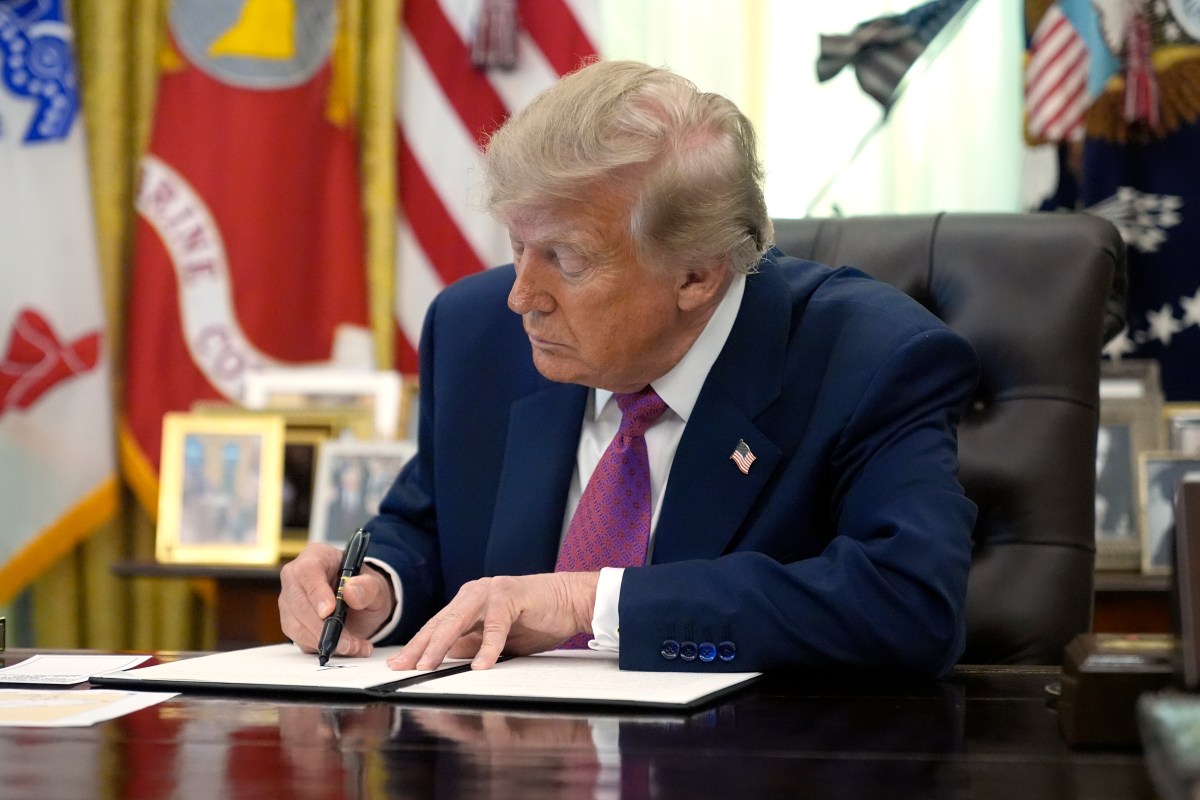
President Donald Trump signed an order renaming Lake Ontario as "Lake America" for use by the U.S. government after trade talks with Canada failed. Some companies, like MapQuest, and officials in the U.S. and Canada have refused to use the new name.
Key Facts
President Trump issued an executive order renaming Lake Ontario to "Lake America" for U.S. federal government use.
The order was part of tensions following the collapse of trade talks between the U.S. and Canada.
The U.S. Geological Survey has updated its electronic documents to reflect the new name.
MapQuest stated it will not change the lake’s name and created a tool for users to name the lake themselves.
Canadian Prime Minister Mark Carney rejected the new name, citing the name’s longstanding history and Indigenous origins.
New York Governor Kathy Hochul said New York would not recognize the name change.
The order does not affect Canadian use or private companies’ naming choices.
A similar renaming happened previously with the Gulf of Mexico, called the Gulf of America by the U.S. government.
Read the Original
Want the full story? Tap a source to open the original
article.