James Webb telescope finds ice older than the star it orbits
Summary
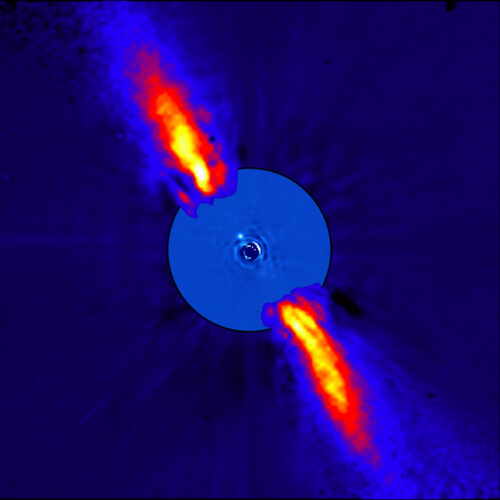
The James Webb Space Telescope detected water and carbon dioxide ice in the debris disk around Beta Pictoris, a star about 20 million years old and 64 light-years from Earth. The ices are mixed within glassy water ice, a composition that may help them survive the star’s ultraviolet radiation and resembles ice found in comets in our Solar System.Key Facts
- Researchers led by Sarah Betti observed Beta Pictoris with Webb’s Near Infrared Spectrograph on December 7, 2023.
- The team detected water ice and carbon dioxide ice in two regions about 100 astronomical units from the star.
- The carbon dioxide appeared to be trapped within water ice rather than forming separate grains.
- Researchers estimated that carbon dioxide makes up about 11 percent of the ice, or slightly more than one molecule per 10 water molecules.
- The water ice is glassy rather than crystalline.
- The ice mixture’s proportions are roughly similar to those measured in comets in our Solar System.
- Beta Pictoris is surrounded by a debris disk where collisions among comets and small planetary building blocks replenish dust and gas.
- Astronomers have found three planets around Beta Pictoris.
Read the Full Article
This is a fact-based summary from The Actual News. Click below to read the complete story directly from the original source.