Organizations called baby banks, which give essential items to families with babies, have seen a big rise in the number of people who need their help. One baby bank in Lincolnshire, called Market Rasen Baby Bank, reported that the number of families they help has increased significantly over the past six months. Across the UK, more families are using these services, and many are struggling with basic costs.
Key Facts
Baby banks provide items like nappies, cots, and clothes to families in need.
The Market Rasen Baby Bank in Lincolnshire saw demand increase from 19 to 76 families in six months.
Many families using baby banks are working but still struggling with costs.
The Baby Bank Alliance reported that 220,000 families in the UK used baby banks in 2024, up from 163,000 the previous year.
Over 3.5 million items were given out by baby banks last year, 143% more than the year before.
Little Treasures Baby Bank in Horncastle has also seen double the number of referrals this year.
Items like cots and prams are especially needed, leading to urgent appeals for donations.
Read the Original
Want the full story? Tap a source to open the original
article.
Lower energy costs have reduced the amount of money needed for a basic retirement lifestyle, according to a report by the Pensions and Lifetime Savings Association. However, people aiming for a more comfortable retirement now need more income than before. The report provides estimates for different retirement living standards, which do not include housing costs.
Key Facts
Lower domestic gas and electricity prices have made basic retirement living cheaper.
A single person now needs £13,400 a year for a basic retirement, down by £1,000.
A two-person household requires £21,600 annually, decreased from £22,400.
For a moderate lifestyle, a single person needs £31,700, up by £400 from before.
A moderate lifestyle for two people requires £43,900, increased by £800.
A comfortable retirement, including luxuries, costs £43,900 for a single person and £60,600 for two people, both higher than previous figures.
The report’s calculations exclude housing costs, assuming many retirees have paid off mortgages.
The research shows younger generations are less likely to own homes outright by retirement compared to older people.
Read the Original
Want the full story? Tap a source to open the original
article.
The article discusses the challenge of buying a home due to high house prices. It explores if current property costs make it hard for people to own a home.
Key Facts
The article talks about the difficulty of buying a house.
High house prices are a major concern.
The issue is whether people can still afford to buy homes.
The focus is on the property market.
The topic relates to the ability to get on the "property ladder," which means being able to buy a home and start building equity.
Read the Original
Want the full story? Tap a source to open the original
article.
Thames Water is facing financial trouble after the investor KKR decided not to invest £4 billion in the company. As a result, Thames Water is trying to find other options to avoid going into administration, which means the government could take over if the company doesn't recover financially. Thames Water provides water services to a large part of the UK, and its services will continue as normal despite the financial issues.
Key Facts
KKR was set to invest £4 billion in Thames Water but has now pulled out.
Thames Water is the largest water company in the UK, serving about a quarter of the country's population.
The company has 8,000 employees and operates mainly in London and parts of southern England.
Even if ownership changes, Thames Water's water services will continue to operate normally.
Thames Water faces the possibility of going into government-supervised administration if it cannot raise enough funds.
The company is owned by its lenders, who have a separate plan to raise the needed funds.
A review of the water industry suggests the current regulatory system is too complex and expensive.
Thames Water's current debt is about £19 billion, up from no debt when it was privatized in 1989.
Read the Original
Want the full story? Tap a source to open the original
article.
An independent review found that the water sector in England and Wales is struggling and needs stronger rules to protect both the environment and customers. The review, led by Sir Jon Cunliffe, stated issues with pollution and mismanagement and suggested the need for clearer government strategies and more powerful regulation.
Key Facts
An independent review by the Water Commission highlighted problems in the water sector of England and Wales.
The review pointed out issues like pollution, financial trouble, and poor management.
It suggested that new laws and a clearer government direction are needed.
The review was prompted by public concerns over sewage problems and rising bills.
Nationalizing the water sector was considered too costly by the government and not effective.
The review emphasized stronger roles for regulators like the Environment Agency and Ofwat to ensure companies act in public interest.
Over 50,000 responses from various groups contributed to the findings.
A full report with recommendations is expected later in the year.
Read the Original
Want the full story? Tap a source to open the original
article.
A study by the Guernsey Community Foundation found that many young people in Guernsey are considering leaving due to high living costs. Rising prices, especially for housing, are making it hard for them to see a future on the island.
Key Facts
A new study by the Guernsey Community Foundation surveyed 3,000 islanders.
Many young people in Guernsey feel they cannot afford to live on the island due to rising living costs.
Myles Duquemin, a local, says many of his friends have already left Guernsey.
Housing prices are a significant concern; average rent in Guernsey is £2,037 per month.
Rent costs have increased by 50% in the last five years.
Young people like Lilleth Tolley find returning to Guernsey after studying unrealistic due to high costs.
There are ongoing discussions among young people about moving to the UK for better affordability.
Read the Original
Want the full story? Tap a source to open the original
article.
The UK government plans to take legal action against Roman Abramovich to ensure the money from the sale of Chelsea Football Club aids Ukraine. The £2.5 billion proceeds are currently frozen due to sanctions, and there is a disagreement on how the funds should be used.
Key Facts
The UK government wants the money from the sale of Chelsea to help people in Ukraine.
The funds are frozen in a UK bank account since Mr. Abramovich was sanctioned after Russia invaded Ukraine in February 2022.
Mr. Abramovich wants the proceeds to go to all victims of the war, not just Ukraine.
UK officials are ready to go to court if a settlement cannot be reached.
Abramovich, a billionaire in oil and gas, is alleged to have ties to Russian President Putin, which he denies.
Under UK sanctions, Abramovich cannot access the sale money, though the money legally belongs to him.
A UK report criticized the lack of resolution on the funds, saying it reflects poorly on both Mr. Abramovich and the government.
Read the Original
Want the full story? Tap a source to open the original
article.
TikTok users are selling food items on TikTok Shop without listing necessary allergen information, which goes against UK legal requirements. When informed, TikTok removed these listings but sellers continue to post products without proper allergy labels. Allergy experts warn that buying these products without allergen details can be dangerous for individuals with allergies.
Key Facts
TikTok Shop listings showed people selling food without allergy information.
UK law requires food businesses to declare 14 main allergens.
TikTok deleted listings without proper allergen details after the BBC informed them.
One seller labeled allergens as "not applicable," while others used vague terms like "spices."
The BBC found sellers posting products without full allergen information.
TikTok stated it aims to provide a safe shopping experience and will enforce its policies.
Allergy safety advocates call for more stringent checks to protect consumers.
"Natasha’s Law" requires clear allergen labeling after an allergy-related death influenced new safety rules.
Read the Original
Want the full story? Tap a source to open the original
article.
Marks & Spencer's chief executive, Stuart Machin, received a yearly pay of £7 million before a cyber attack affected the company's online orders and payments. This attack is expected to reduce profits by £300 million, yet the board decided not to adjust his performance-related pay due to these circumstances. The company expects insurance to cover some financial losses, with disruptions likely continuing into July.
Key Facts
Stuart Machin's total pay increased from £5 million to £7 million, largely due to share awards.
A cyber attack in April affected M&S's online orders, contactless payments, and store stocks.
The company expects a £300 million reduction in profits due to the attack.
M&S's remuneration committee decided not to change performance-related pay following the cyber attack.
Insurance is expected to cover some financial losses from the attack.
The attack disrupted services over the Easter weekend and has ongoing effects expected until July.
The cyber attack was linked to a hacker group that also targeted the Co-op and Harrods.
M&S is speeding up its digital transformation plans to improve cybersecurity.
Read the Original
Want the full story? Tap a source to open the original
article.
Jonathan Anderson, a fashion designer from Northern Ireland, has been named the new creative director for both women's and men's collections at Dior, a famous French fashion brand. Anderson will present his first collection, Dior Men Summer 2026, during Paris Fashion Week in June 2026.
Key Facts
Jonathan Anderson is from Magherafelt in County Londonderry, Northern Ireland.
He will lead both the women's and men's fashion lines at Dior.
Anderson previously worked as the creative director at Loewe for over 10 years.
The previous directors for Dior's women's and men's collections recently stepped down.
Anderson's first collection for Dior will be showcased in June 2026 at Paris Fashion Week.
He is known for his innovative and gender-fluid designs.
Anderson designed notable outfits, such as Rihanna's Super Bowl outfit and Ariana Grande's Met Gala dress.
He started his fashion career in Prada's marketing department and launched his own brand, JW Anderson, in 2008.
Read the Original
Want the full story? Tap a source to open the original
article.
Working parents in England can apply for up to 30 hours of free childcare a week for children from nine months old, starting in September. The program aims to help more parents return to work, but there are concerns about whether there will be enough staff and places to meet the increased demand.
Key Facts
The free childcare initiative applies to children from nine months old, starting in September.
All three and four-year-olds in England already get 15 hours of free childcare, regardless of their parents' work situation.
To qualify for the 30 hours, parents must earn more than £9,518 but less than £100,000 a year.
Parents can apply for 15 hours of free childcare when their child is 23 weeks old.
Free childcare hours are typically available during school terms, but some providers spread them over the entire year.
Extra costs like meals and nappies may not be covered by the free hours, leading some parents to face additional fees.
The Department for Education estimates that an additional 35,000 staff and 70,000 places will be needed by 2025.
Recent research shows that some areas, known as "childcare deserts," have fewer childcare options and higher poverty levels.
Read the Original
Want the full story? Tap a source to open the original
article.
First-time homebuyers in the UK are now taking out mortgages that last an average of 31 years, compared to 28 years a decade ago. This change is due to higher mortgage rates, which lead buyers to opt for longer terms to keep their monthly payments lower, even as overall borrowing costs increase. Despite recent falls in interest rates, affordability issues remain significant, and long mortgage terms are still common.
Key Facts
First-time buyers now average a 31-year mortgage term, up from 28 years ten years ago.
Longer mortgage terms help keep monthly payments low despite high interest rates.
About 40% of new mortgages have terms that last into retirement.
The maximum mortgage term allowed by lenders is generally 40 years.
Monthly payments are lower with long terms, but the total cost is higher due to extended interest payments.
UK Finance reports that mortgage payments take up a large part of buyers' income.
Stamp duty changes in April led to a spike in property completions before the deadline.
There has been a decrease in mortgage approvals for house purchases, indicating affordability challenges.
Read the Original
Want the full story? Tap a source to open the original
article.
The UK government plans to update flight paths to make air travel faster and reduce delays. This involves creating the UK Airspace Design Service to redesign routes that are now outdated.
Key Facts
The UK plans to update its flight paths for quicker and smoother flights.
The UK Airspace Design Service (UKADS) will lead this redesign.
Current flight paths were established about 70 years ago.
The changes will focus first on the airspace around London.
There could be new flight paths over homes that aren't currently affected.
The goal is also to cut down on air travel pollution and accommodate future technologies like flying taxis.
UK airspace will undergo its biggest redesign since the 1950s.
The UKADS is expected to be fully operational by the end of the year.
Read the Original
Want the full story? Tap a source to open the original
article.
The Panorama episode titled "Is Britain Broke?" aims to explore how the UK government spends money and why politicians face difficulties when trying to reduce spending. The program is hosted by Ros Atkins and is available for more than a year on iPlayer.
Key Facts
The episode "Is Britain Broke?" is part of the Panorama series.
Ros Atkins hosts this episode, which looks into the UK government's spending.
The focus is on understanding the challenges politicians encounter when attempting to cut spending.
The episode first aired at 8 p.m. on June 2, 2025.
This program is available on iPlayer for over a year.
Panorama is a documentary-style show that investigates various topics.
Read the Original
Want the full story? Tap a source to open the original
article.
China claims that the United States has broken their recent trade agreement by not following through on agreed terms. The disagreement follows a recent deal where both countries had reduced tariffs on each other's goods.
Key Facts
China accuses the US of breaking their trade agreement from a Geneva meeting by undermining the deal.
The US and China had previously agreed to lower tariffs, with the US decreasing tariffs on Chinese goods from 145% to 30%.
China reduced its tariffs on US goods from 125% to 10%.
China objects to US actions such as stopping sales of computer chip design software to Chinese firms and canceling visas for Chinese students.
US President Trump accused China of violating the agreement but did not give specific details.
US Trade Representative stated China did not remove non-tariff barriers as promised.
Talks between Xi Jinping and Trump may happen soon to resolve trade disagreements.
The US recently announced increasing tariffs on steel and aluminum from 25% to 50%.
Read the Original
Want the full story? Tap a source to open the original
article.
The Institute for Fiscal Studies (IFS) reports that the UK government must make difficult decisions about public spending, especially for areas outside the NHS, defense, and education. Although there have been increases in funding for several sectors, these increases will not continue annually, raising concerns about potential budget cuts in other departments.
Key Facts
The IFS says the government needs to make tough spending decisions soon.
Spending increases will stop for transport, net zero, hospitals, schools, and prisons after 2024.
A spending review on June 11 will decide how much money each department gets for the next few years.
More money for the NHS could lead to less funding in other areas.
The plan is to increase NHS spending to £202 billion by 2025-2026.
Increasing defense spending may mean cutting funds from other services.
The government has a goal to raise military spending to 2.5% of the national income by 2027.
The IFS warns that focusing too much on healthcare and defense could mean cuts in other important areas.
Read the Original
Want the full story? Tap a source to open the original
article.
The UK Treasury has sold its final shares in the NatWest Group, ending the government's ownership stake nearly 17 years after the bank was bailed out during the 2008 financial crisis. This completes a significant event in British banking history that initially involved a large financial rescue to prevent a collapse. The sale raises questions about the current stability and safety of banks in the UK.
Key Facts
The UK Treasury sold its last shares in the NatWest Group, taking the bank back to full private ownership.
The government bailout of NatWest (then RBS) began in 2008 to prevent the bank's collapse during the global financial crisis.
The government spent £45 billion to rescue the bank, which equates to £73 billion in today's money.
In 2008, RBS's balance sheet, representing its loans, was larger than the UK economy.
The bailout was intended to protect the economy, not just the banks, from the financial crisis.
About £10 billion of taxpayers' money from the bailout will not be recovered.
Risky loans and mortgages in the US had contributed to the financial crisis affecting banks globally.
Current questions focus on whether UK banks are still vulnerable to crises and if they remain "too big to fail."
Read the Original
Want the full story? Tap a source to open the original
article.
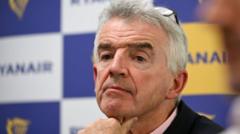
Ryanair's CEO, Michael O'Leary, is set for a bonus over €100 million if he stays with the airline until July 2028. This follows Ryanair's shares meeting a key target by maintaining a high value for 28 days in a row. The bonus plan includes holding onto the shares for three more years as a condition.
Key Facts
Ryanair shares stayed above €21 for 28 days, hitting a performance target.
Michael O'Leary, Ryanair's CEO, can receive 10 million shares, valued at over €111 million, if he remains with the company until 2028.
The bonus is one of the largest potential payouts in European corporate history.
O'Leary has been with Ryanair since 1988 and became CEO in 1994.
The bonus plan started in 2019 when O'Leary became group chief executive.
A think tank known as the High Pay Centre criticized the size of the bonus.
A similar bonus plan exists for Wizz Air’s CEO, József Váradi.
Ryanair recently dealt with a legal issue involving salary increases for flight attendants in Spain.
Read the Original
Want the full story? Tap a source to open the original
article.
Plans are underway to open a temporary banking hub in an underused office space in Crowthorne, Berkshire, next to the Baptist church. This hub by Cash Access UK will provide basic banking services, filling in for closed bank branches in the area.
Key Facts
Cash Access UK plans to convert an office space near Crowthorne Baptist Church into a banking hub.
The proposed conversion is temporary and expected to last up to three years.
The hub will offer cash and basic banking services from various banks.
Bracknell Forest Council has received the application and will make a decision.
Over 150 similar banking hubs have opened in the UK to replace closed bank branches.
The converted space is located away from main church activities and the community hall.
The goal is to ensure local access to banking services while a permanent solution is sought.
Read the Original
Want the full story? Tap a source to open the original
article.
The US Court of International Trade ruled against some of President Donald Trump's tariffs, saying he did not have the authority under a specific law to impose them. The ruling affects tariffs aimed at stopping fentanyl smuggling and those announced on April 2, but not tariffs on steel, aluminum, or car parts. A federal appeals court temporarily allowed the tariffs to stay while the decision is being appealed.
Key Facts
The court blocked some tariffs imposed under the 1977 International Emergency Economic Powers Act (IEEPA).
The ruling affects Trump's "fentanyl" tariffs on Canada, Mexico, and China.
The 10% universal tariff on all imports announced on April 2 is also affected.
Tariffs on steel, aluminum, and car parts remain in place because they were imposed under a different law.
A federal appeals court allowed the tariffs to continue temporarily during the appeal process.
Tariffs affected by this ruling had brought in $11.8 billion since February 2025.
The unaffected tariffs, such as those on metals and car parts, brought in about $3.3 billion.
Analysts predict the court's decision could reduce the US's average tariff from 15% to 6.5%.
Read the Original
Want the full story? Tap a source to open the original
article.