Health technology innovations are improving people's lives and boosting the economy. Examples include a cancer vaccine, an Alzheimer's test, and an exoskeleton that helps movement.
Key Facts
Health technology includes new tools and treatments that improve health.
A cancer vaccine is an example of a health innovation.
There is a new blood test for Alzheimer's disease.
An exoskeleton is a device that helps people move more easily.
These innovations can lead to better living conditions.
Health technologies can also positively impact the economy.
Read the Original
Want the full story? Tap a source to open the original
article.
A French streamer named Raphaël Graven, also known as Jeanpormanove, was found dead during a live broadcast in his sleep. Police are investigating his death by interviewing witnesses and seizing equipment and videos. The investigation is trying to find out if previous videos of violence and humiliation contributed to his death.
Key Facts
Raphaël Graven was a French streamer, known for extreme online challenges.
He was found dead in a village near Nice, France, during a live stream.
Police have interviewed people who were present at the time of his death.
Equipment and videos were seized to understand events leading to his death.
An autopsy is scheduled to determine the cause of his death.
Graven was involved in content that included apparent violence and sleep deprivation.
A separate investigation began 8 months ago into alleged violent acts against vulnerable people in online videos.
Graven and another streamer denied being victims, saying they staged events for attention and money.
Read the Original
Want the full story? Tap a source to open the original
article.
The UK's equality regulator, the Equality and Human Rights Commission (EHRC), has criticized the Metropolitan Police's use of live facial recognition technology. The EHRC argues that the current use of the technology violates human rights laws by not being necessary and proportionate. The Met Police, however, claims their use is legal and necessary for catching criminals.
Key Facts
The Equality and Human Rights Commission (EHRC) criticized the Metropolitan Police for using live facial recognition technology.
The EHRC claims the technology is used in a way that violates human rights laws.
The technology scans people's faces on CCTV and compares them to a watchlist of people sought by the police.
The Met Police states that over 1,000 arrests have been made using this technology since January 2024.
There is an upcoming judicial review in January 2026 where the EHRC will participate.
The EHRC believes the current policy of the Met Police does not meet necessary human rights standards.
Civil rights groups argue the technology invades privacy and risks misidentification.
The Met Police defends its use due to potential crime reduction benefits, despite lacking specific UK legislation on its use.
Read the Original
Want the full story? Tap a source to open the original
article.
A study has shown that brain implants, known as brain-computer interfaces (BCIs), can decode the internal monologue of paralyzed people, raising privacy concerns. These devices can translate imagined speech, not just attempted speech, into words with significant accuracy, utilizing artificial intelligence.
Key Facts
Brain-computer interfaces (BCIs) help paralyzed people speak by decoding signals from the brain.
New research shows BCIs can translate a person's inner thoughts, or imagined speech, into spoken words.
The study was published in the scientific journal Cell.
BCIs work by using tiny electrode arrays placed on the brain’s motor cortex.
Researchers achieved up to 74% accuracy in decoding sentences from inner speech.
The enhancement may allow faster and easier communication for users but also brings up privacy concerns.
The study involved monitoring brain signals from four people already using BCIs.
There is concern that inner thoughts could be unintentionally revealed when using these devices.
Read the Original
Want the full story? Tap a source to open the original
article.
President Donald Trump has suggested imposing high tariffs on semiconductor imports unless companies agree to manufacture within the United States. The move aims to increase domestic investment in manufacturing but could disrupt global supply chains. Few details have been shared, but exemptions will be provided for companies that commit to building facilities in the US.
Key Facts
Trump plans to impose tariffs up to 300% on semiconductor imports.
Companies investing in US manufacturing may receive tariff exemptions.
The tariffs are meant to encourage companies to move production to the US.
Specific details about the tariffs are expected to be released soon.
Some foreign companies, like TSMC and Samsung, may not be affected due to existing US investments.
The tariffs address US dependency on imported semiconductors and are part of a larger trade strategy involving China.
The US has already implemented tariffs of 10-40% on most trade partners since August 7.
The semiconductor tariffs could impact negotiations with China over trade policies.
Read the Original
Want the full story? Tap a source to open the original
article.
Sarah Ezekiel, who lost her voice due to motor neurone disease (MND), had her real voice recreated using artificial intelligence (AI) from just eight seconds of audio from an old VHS tape. The AI technology helped her regain a sense of her identity after speaking for years with a synthetic voice. Assistive technology, including eye-gaze systems, has also enabled her to communicate and paint again.
Key Facts
Sarah Ezekiel lost her voice and hand use due to motor neurone disease (MND) at age 34.
A company used AI to recreate her original voice from eight seconds of audio on a VHS tape.
Eye-gaze technology, which tracks eye movements to select letters, allows Sarah to communicate.
Before AI restored her voice, Sarah used a synthetic voice for 25 years to speak.
MND, also called ALS, is a degenerative disease that usually leads to loss of speech.
AI-generated voice has helped Sarah feel more connected to her identity.
Advances in assistive technology have also enabled Sarah to return to painting.
Read the Original
Want the full story? Tap a source to open the original
article.
The BBC launched a new weather game called "Cooler Than Me?" that lets users compare the weather in their city with other cities around the world. The game is available online and players can find more information, including frequently asked questions, on the BBC Weather website.
Key Facts
The game is named "Cooler Than Me?" and involves comparing weather conditions.
Users can compare their local weather with cities worldwide.
The game aims to engage users by offering a unique way to explore weather patterns.
Additional details and a FAQ section are available on the BBC Weather website.
The game is part of the BBC Weather's online offerings.
Read the Original
Want the full story? Tap a source to open the original
article.
Cobalt-free batteries are now more common in Chinese electric vehicles (EVs), while the United States continues to use lithium batteries that contain cobalt. Cobalt is a metal associated with human rights concerns, but remains widely used because of its current advantages in technology.
Key Facts
China mainly uses cobalt-free batteries, which rely on iron phosphate, in its electric vehicles.
The U.S. still predominantly uses lithium batteries with cobalt in EVs.
Cobalt has raised human rights issues due to the conditions in which it is mined.
Cobalt-free batteries, like iron phosphate, are becoming more popular in China.
Henry Sanderson has written a book covering the evolution of EV batteries and their impact on the green transition.
There is ongoing competition between different types of EV battery technologies.
Read the Original
Want the full story? Tap a source to open the original
article.
Hasan Piker is a well-known political commentator on Twitch, a platform where people stream video content. He uses his platform to discuss politics and has a large audience. Recently, he has been vocal about issues in Gaza and shares views that often oppose right-wing politics in the U.S.
Key Facts
Hasan Piker is a popular political streamer on Twitch.
He has nearly 3 million followers.
Piker uses humor and culture to discuss politics.
He targets young men who may be influenced by the alt-right, a U.S. political movement.
He is a strong voice for Palestine, particularly regarding Gaza.
Piker's views often challenge right-wing perspectives in the United States.
Read the Original
Want the full story? Tap a source to open the original
article.
The Edinburgh Festivals featured a show that combines technology and performance art. This event highlighted how tech can enhance artistic experiences.
Key Facts
The event took place at the Edinburgh Festivals.
It focused on combining technology and performance art.
The result of this combination was described as spectacular.
The show took place on August 19, 2025.
The program is available for over a year on BBC Sounds.
Read the Original
Want the full story? Tap a source to open the original
article.
A new energy storage system has been installed in eleven social housing homes in the Borders, Scotland. The system uses solar panels and batteries with artificial intelligence to help lower energy bills by up to 85%. The pilot project could expand if successful, aiming to help reduce electricity costs and carbon emissions.
Key Facts
Eleven homes in the Borders, Scotland, have new energy storage systems installed.
The systems are part of a trial by the Scottish Borders Housing Association.
The energy system uses solar panels and long-lasting batteries for energy storage.
Artificial intelligence helps trigger the best electricity rates to keep bills low.
Deputy First Minister Kate Forbes visited one of the homes and noted reduced costs.
If successful, the project could expand to other areas in Scotland in the future.
Knight PowerHub, the energy firm involved, hopes for mass production in southern Scotland.
The project also aims to reduce both fuel poverty and carbon emissions.
Read the Original
Want the full story? Tap a source to open the original
article.
Musicians in 2025, like the duo Disiniblud, are creating music that connects with their childhood selves. They aim to make playful and imaginative music, blending unique sounds to capture the essence of being a child.
Key Facts
Disiniblud is a music duo featuring Rachika Nayar and Nina Keith.
Their album cover features a dragon head similar to one from the 1984 movie, "The NeverEnding Story."
The album blends various sounds like synths and piano to create a magical effect.
Songs often mix playful elements with intense layers of electronic sounds.
The album expresses reconnecting with childhood while being aware of past pain.
The duo are both trans women, which adds personal depth to their music.
Similar artists like Horsegirl and Ninajirachi also explore themes of childhood and creativity.
Read the Original
Want the full story? Tap a source to open the original
article.
The UK has decided not to require Apple to create a "back door" for accessing encrypted data of American users. This change follows discussions between the UK and US about ensuring privacy and protecting civil liberties. The decision appears to have ended a privacy dispute between the two countries.
Key Facts
The UK dropped its demand for Apple to provide access to American users' encrypted data.
This decision ends a privacy disagreement between the US and UK.
US Director of National Intelligence, Tulsi Gabbard, announced the UK’s decision.
The UK government stated it has security arrangements with the US that protect privacy.
Apple did not comment on the UK's new decision.
Earlier, Apple's decision to stop offering advanced data protection in the UK was linked to a controversial UK order.
The UK’s Investigatory Powers Act allows authorities to request tech companies to remove encryption.
End-to-end encryption scrambles data so only the sender and receiver can read it, securing privacy from third parties.
Read the Original
Want the full story? Tap a source to open the original
article.
The UK has withdrawn its request to access Apple users' encrypted data. The request would have required Apple to create a "back door" to its encrypted data, which Apple opposed. Apple previously removed its toughest security option from the UK market and began legal action against the request.
Key Facts
The UK originally asked Apple for access to encrypted data of its users globally.
Apple has a security feature called Advanced Data Protection (ADP) that prevents anyone but the user from accessing their data.
Apple cannot view data protected by ADP because it would require breaking its own encryption.
Apple removed the ADP feature from the UK market in response to the request.
Apple is taking legal action against the UK government regarding the request.
The UK has withdrawn its request for access to the encrypted data.
The issue is connected to a law called the Investigatory Powers Act.
A legal agreement between the US and UK allows data sharing for law enforcement.
Read the Original
Want the full story? Tap a source to open the original
article.
A study shows that some doctors might rely too much on artificial intelligence (AI) after using it to help spot health issues during medical tests. The study observed doctors in Poland who performed colonoscopies, finding that their ability to identify problems worsened after using AI tools. The research suggests that dependency on AI could decrease doctors' skills over time.
Key Facts
A study on gastroenterologists in Poland looked at the use of AI in colonoscopies.
Doctors were about 20% less effective at spotting polyps when not using AI.
The findings were published in the journal Lancet Gastroenterology and Hepatology.
The study suggested that doctors might quickly become dependent on AI.
Johan Hulleman, a researcher, questioned the study, noting the short time frame of three months.
AI is increasingly used in various routine medical scans, such as for eyes, breast, and colon diseases.
Some clinics in Poland tested AI systems that analyze video footage from colonoscopies.
AI systems highlighted areas of interest for doctors, potentially impacting their natural detection skills.
Read the Original
Want the full story? Tap a source to open the original
article.
Researchers are using artificial intelligence (AI) to recreate the faces of Welsh convicts sent to Australia in the 19th century. They used historical records, prisoner documents, and photos of modern descendants to estimate what the convicts might have looked like. More than 60 Welsh criminals were traced, many of whom were deported for minor offenses like theft.
Key Facts
AI technology was used to create images of Welsh convicts who were sent to Australia in the 1800s.
Researchers used old prisoner records, sketches, and photos of descendants to design these images.
At least 1,000 Welsh individuals were among the estimated 162,000 convicts sent to Australia.
Some crimes leading to deportation were minor, such as stealing a handkerchief or trampling crops.
Reasons for deportation included overcrowded UK and Irish prisons and the need for labor in Australia.
About 20% of Australians, and 70% in Tasmania, are thought to be descendants of convicts.
AI-generated images contribute to a growing interest in convict heritage in Australia.
Read the Original
Want the full story? Tap a source to open the original
article.
Algorithms on social media platforms like TikTok and Instagram are changing how people speak by popularizing new words and phrases. These platforms use engagement metrics and viral content to influence language quickly.
Key Facts
Social media is creating new words and ways of speaking.
Platforms like TikTok and Instagram are influencing language trends.
Engagement metrics on these platforms determine what becomes popular.
Viral memes are a big part of how language changes online.
Adam Aleksic wrote a book called "Algospeak" about this topic.
The changes in language are happening very fast due to technology.
Read the Original
Want the full story? Tap a source to open the original
article.
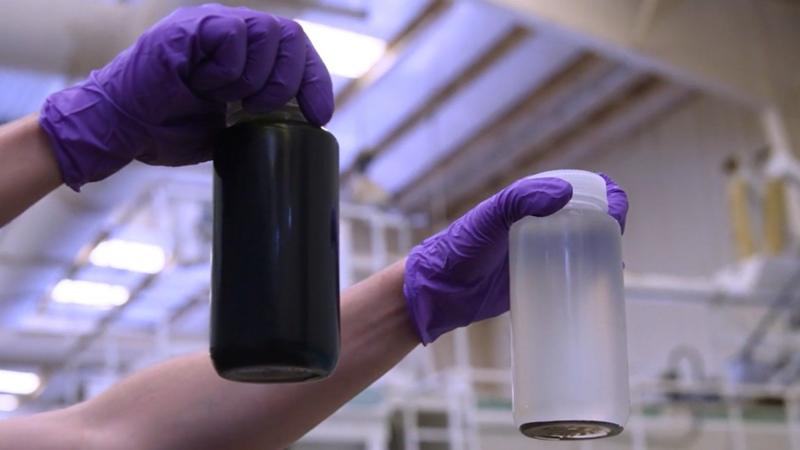
The article discusses new technologies that can destroy PFAS, also known as "forever chemicals." These chemicals are widely used in products like non-stick pans and waterproof clothing but do not break down easily and can cause health problems. Companies in the US and other countries are developing methods like electrochemical oxidation and supercritical water oxidation to tackle PFAS waste more effectively.
Key Facts
PFAS are strong, man-made chemicals used for their water and grease resistance.
They are often found in products like waterproof clothing and non-stick pans.
PFAS do not break down easily in the environment and have been linked to health issues.
Current disposal methods are costly and may release toxic emissions.
New technologies, such as electrochemical oxidation and supercritical water oxidation, aim to destroy PFAS by breaking their chemical bonds.
There is a large market for these technologies, especially in the US.
Businesses and government entities, including the US military, are testing these new methods.
Legal and regulatory pressures are pushing for more effective PFAS destruction solutions.
Read the Original
Want the full story? Tap a source to open the original
article.
The Cambridge Dictionary has added new words like "skibidi," "delulu," and "tradwife," which have become popular through social media. These additions highlight the influence of internet culture on the English language. The dictionary uses data to determine the staying power of words before adding them.
Key Facts
The words "skibidi," "delulu," and "tradwife" have been added to the Cambridge Dictionary due to their internet popularity.
Cambridge Dictionary evaluates how often and where new words are used before adding them.
"Skibidi" can mean "cool" or "bad," or it can have no specific meaning.
"Delulu" is a humorous take on the word "delusional," often referring to believing things that aren't real.
"Tradwife" refers to a woman adhering to traditional gender roles, often shared on social media.
The word "broligarchy," combining "bro" and "oligarchy," refers to wealthy men in tech with political influence.
Internet slang increasingly influences dictionaries and language trends.
Read the Original
Want the full story? Tap a source to open the original
article.
A U.S. senator is investigating Meta after claims surfaced that its AI chatbots engaged in inappropriate conversations with children. The internal Meta document, leaked to Reuters, reportedly showed guidelines allowing AI to have "sensual" chats, which the company states go against its policies.
Key Facts
A leaked document suggests Meta's AI had "sensual" chats with children.
U.S. Senator Josh Hawley is leading the investigation into Meta.
Meta claims these document examples were incorrect and removed.
Meta's policies ban content that sexualizes children or involves inappropriate role play.
The document also said chatbots might give false medical info or have controversial interactions.
Senator Hawley wants clarification on the document and the related products.
Facebook, WhatsApp, and Instagram are platforms owned by Meta.
Read the Original
Want the full story? Tap a source to open the original
article.