President Donald Trump will attend the dignified transfer of four U.S. service members killed in the Middle East at Dover Air Force Base. The soldiers died in Iranian missile and drone attacks in Jordan and Iraq during ongoing hostilities.
Key Facts
The dignified transfer is a ceremony where the remains of fallen service members are returned to their families.
This will be President Trump’s third time attending such a transfer since the war in Iran began in February 2026.
Two soldiers, Tyler James Feehan and Isabella Gonzales, were killed in missile and drone attacks in Jordan.
A third soldier, Angel S. Rampersad, missing after the Jordan attacks, is now believed to be deceased.
The fourth soldier, Michael Emmanuel Swinton, died in Iraq during an Iranian drone detonation.
Since the war started, 18 U.S. service members have been killed.
The U.S. has carried out strikes against Iran amid a failed interim peace agreement.
President Trump stated that the U.S. would respond strongly to each American soldier killed by Iran.
Read the Original
Want the full story? Tap a source to open the original
article.
New York Mayor Zohran Mamdani said the city cannot arrest Israeli Prime Minister Benjamin Netanyahu despite a war crimes arrest warrant from the International Criminal Court. Mamdani urged the U.S. federal government, which has legal authority, to enforce the warrant if Netanyahu visits New York for the U.N. General Assembly.
Key Facts
The International Criminal Court (ICC) issued an arrest warrant for Israeli Prime Minister Netanyahu in 2024 over alleged war crimes in Gaza.
Mayor Mamdani called Netanyahu a "war criminal" and said he is not welcome in New York City.
New York City lacks the legal power to arrest Netanyahu and cannot enforce the ICC warrant.
Mamdani asked the federal government to join the ICC and carry out the arrest warrant.
President Donald Trump stated that Netanyahu will not be arrested in the United States.
Netanyahu faces accusations related to using starvation as a method of warfare and targeting civilians, which Israel denies.
The Israeli ambassador to the UN criticized Mayor Mamdani, saying he should focus on serving New Yorkers.
Netanyahu is expected to attend the U.N. General Assembly in New York City in September.
Read the Original
Want the full story? Tap a source to open the original
article.
U.S. Rep. Andy Biggs won the Republican nomination for Arizona governor and will run against the current Democratic Governor Katie Hobbs in the November election. Biggs is known for his strong support of President Donald Trump and leadership in the House Freedom Caucus.
Key Facts
Andy Biggs defeated Rep. David Schweikert in the Republican primary for Arizona governor.
Biggs is a close ally of President Donald Trump and was chair of the House Freedom Caucus from 2019 to 2022.
He voted against certifying the 2020 election results in Arizona and other states after the January 6 Capitol riot.
Schweikert criticized Biggs as unelectable but struggled to raise money and lacked Trump’s endorsement.
Biggs received support from Trump and a conservative group called Turning Point Action.
Both parties are also choosing candidates for important state offices like secretary of state and attorney general.
Democrats plan to campaign against Biggs by calling him an extremist focused more on Trump than Arizona residents.
The race between Biggs and Hobbs is expected to be very close and important for Arizona’s political future.
Read the Original
Want the full story? Tap a source to open the original
article.
Alexander Kolodin, an Arizona state representative and lawyer who challenged the 2020 election results, is expected to win the Republican primary for Arizona secretary of state. He will run against the current Secretary of State, Adrian Fontes, who is a Democrat, in the November election.
Key Facts
Alexander Kolodin is an Arizona state representative and election lawyer.
He is known for disputing the 2020 election outcomes.
Kolodin is projected to win the GOP primary for Arizona secretary of state.
His primary opponent was Gina Swoboda, a former state GOP chair.
The general election will be against Adrian Fontes, the Democratic incumbent secretary of state.
The information comes from Decision Desk HQ projections.
The Arizona secretary of state oversees elections in the state.
This election is scheduled for November.
Read the Original
Want the full story? Tap a source to open the original
article.
Mark Lamb won the Republican primary for Arizona's 5th Congressional District despite allegations of sexual misconduct that he denies. He will likely replace GOP Rep. Andy Biggs, who is running for governor, in the November election.
Key Facts
Mark Lamb is a former Pinal County sheriff (2017-2024).
He won the Arizona GOP primary for the 5th Congressional District.
Lamb defeated Daniel Keenan, who spent over $1.5 million on his campaign.
Several women accused Lamb of sending explicit messages and photos, making threats, and inappropriate behavior.
Lamb denies all misconduct allegations.
One woman said her complaints about Lamb were ignored by church leaders of the Church of Jesus Christ of Latter-day Saints.
President Trump endorsed and supported Lamb during the primary race.
Andy Biggs, the current representative, is running for governor and is expected to be replaced by Lamb if he wins the general election.
Read the Original
Want the full story? Tap a source to open the original
article.
Andy Biggs won the Republican primary for Arizona governor and will face the current Democratic governor, Katie Hobbs, in the general election. Biggs, supported by President Donald Trump, appeals to conservative voters in a key swing state that has shifted politically in recent years.
Key Facts
Andy Biggs, a conservative congressman endorsed by President Trump, won the Republican nomination for Arizona governor.
He defeated fellow Republican David Schweikert and two businessmen, Ken Miceli and Scott Neely.
Katie Hobbs, the Democratic incumbent governor, ran unopposed in her primary.
Arizona has shifted from a Republican stronghold to a competitive state due to population growth and changing voting patterns.
Democrats now hold the governor’s office, attorney general, secretary of state, and both U.S. Senate seats in Arizona.
President Trump narrowly won Arizona in the 2024 presidential election after losing it in 2020.
The gubernatorial race is seen as important nationally because of Arizona’s role in recent election disputes.
Republicans face challenges in the midterms, with Democrats hoping to gain seats in Congress, including in Arizona’s key districts.
Read the Original
Want the full story? Tap a source to open the original
article.
Governor Katie Hobbs is leading in polls against Representative Andy Biggs in the race for Arizona governor. Biggs won the Republican primary with about 70% of the vote, but Hobbs, the Democratic incumbent, is favored to win in the November 2026 election.
Key Facts
Andy Biggs won the 2026 Republican primary for Arizona governor with roughly 70% of the vote.
Katie Hobbs, the current Democratic governor, holds a lead in recent polls over Biggs.
In one poll, Hobbs led 41% to 37%, with more voters unsure about Biggs.
Hobbs is popular among moderate voters, with 48% supporting her versus 20% for Biggs.
Independent voters in Arizona are the largest voter group and are unpredictable in their choices.
President Trump won Arizona by more than 5 points in the 2024 presidential election.
Experts say Biggs may need to soften his strong conservative image to win over independents.
Political analysts classify the Arizona governor’s race as leaning Democratic but still competitive.
Read the Original
Want the full story? Tap a source to open the original
article.
Republican Andy Biggs will run against Arizona Governor Katie Hobbs in the upcoming governor's race. Biggs, supported by President Donald Trump, won the Republican primary against David Schweikert.
Key Facts
Andy Biggs is a Republican representative from Arizona.
He defeated David Schweikert in the Republican primary for governor.
Biggs has President Donald Trump’s support.
Katie Hobbs is the current governor of Arizona and a Democrat.
Hobbs did not face any challengers in her party's primary.
Arizona was won by President Trump in both the 2016 and 2024 presidential elections.
The governor’s race in Arizona is expected to be closely contested.
The election will take place in the fall.
Read the Original
Want the full story? Tap a source to open the original
article.
Rep. Andy Biggs has won the Republican nomination for Arizona governor, endorsed by President Donald Trump. He will run against the current Democratic Governor Katie Hobbs in a close race expected in 2026.
Key Facts
Andy Biggs is a member of Congress representing Arizona’s 5th District and has served five terms.
Biggs is a strong supporter of President Trump and backed Trump's claims of election fraud, which have not been proven.
He was subpoenaed by the Jan. 6 committee for his possible involvement in Trump's efforts around the 2020 election.
Biggs defeated several competitors, including Rep. David Schweikert, to win the GOP nomination.
Governor Katie Hobbs narrowly beat Trump-backed Kari Lake in 2022 by less than 1%.
Arizona voted for President Trump in 2024 but is currently led by Democrats in the governor’s office and in the Senate seats.
Republicans still control six of Arizona’s nine congressional districts, showing the state remains politically mixed.
Political analysts say the governor’s race leans slightly toward Democrats but remains competitive.
Read the Original
Want the full story? Tap a source to open the original
article.
Democratic Representative Greg Stanton is expected to win the primary election in Arizona’s 4th Congressional District. He defeated Kai Newkirk, a progressive challenger, who criticized Stanton for accepting corporate donations and supporting a specific vote.
Key Facts
Greg Stanton is the current Democratic representative for Arizona’s 4th Congressional District.
Stanton faced a primary challenge from Kai Newkirk, a progressive organizer.
Newkirk criticized Stanton for taking campaign money from corporations.
Newkirk also opposed Stanton’s vote on a particular issue, referred to as the Laken vote.
Decision Desk HQ projects Stanton will win the primary easily.
This primary took place on a Tuesday.
Read the Original
Want the full story? Tap a source to open the original
article.
The U.S. House of Representatives voted against a proposal to stop Pentagon money from being used for most Ukraine security aid, except for protecting the U.S. embassy there. The amendment was part of a defense spending bill and was defeated by a large margin.
Key Facts
Rep. Eli Crane from Arizona introduced the amendment.
The amendment aimed to block Pentagon funds for Ukraine security aid, except for embassy protection.
The vote took place on a Tuesday night.
The amendment was rejected by 350 votes to 76.
The proposal was part of the National Defense Authorization Act (NDAA), a bill on U.S. defense spending.
The decision allows Pentagon funding to continue supporting Ukraine's security efforts beyond just embassy safety.
The vote was mostly against the amendment, showing strong support for ongoing aid to Ukraine.
Read the Original
Want the full story? Tap a source to open the original
article.
New York City Mayor Zohran Mamdani said he cannot arrest Israeli Prime Minister Benjamin Netanyahu if he visits New York City for the United Nations General Assembly. Mamdani explained that the city does not have the legal power to enforce such an arrest warrant.
Key Facts
Mayor Zohran Mamdani is the mayor of New York City.
He initially said he would arrest Prime Minister Netanyahu if he visited the city.
Netanyahu may visit New York City in September for the United Nations General Assembly.
Mamdani later clarified he does not have the legal authority to carry out such an arrest.
The arrest warrant in question cannot be enforced by the city alone.
Read the Original
Want the full story? Tap a source to open the original
article.
A preliminary court hearing is underway in Los Angeles for David Anthony Burke, known as singer D4vd, who faces charges of murdering and sexually abusing 14-year-old Celeste Rivas Hernandez. Graphic crime scene photos were shown in court for the first time, depicting the victim's dismembered body found in Burke's car.
Key Facts
David Anthony Burke, 21, known as D4vd, is charged with murder and sexual abuse of 14-year-old Celeste Rivas Hernandez.
The victim’s body was found dismembered inside a Tesla registered to Burke in Hollywood in September 2025.
Prosecutors say Burke stabbed and dismembered Celeste using a chainsaw to hide the crime after years of alleged abuse.
Burke ordered items like a body bag, chainsaws, an inflatable pool, and a shovel online after Celeste’s death.
This hearing is to show evidence and prove there is enough to proceed to trial; it is not the trial itself.
Celeste’s parents witnessed the graphic images, which was very distressing, but they chose to stay in court to support their daughter.
The courtroom was crowded with journalists and public members watching the proceedings.
Burke appeared quietly in court, wearing an orange jail uniform and restrained during the hearing.
Read the Original
Want the full story? Tap a source to open the original
article.
The US House of Representatives passed a temporary government spending bill to avoid a shutdown before the November midterm elections. The bill allows government funding to continue until December 4 and now moves to the Senate for approval.
Key Facts
The House vote to approve the stopgap spending measure was 220-205, mostly along party lines.
The current government funding authority expires on September 30.
Republicans want to pass this bill early to prevent a government shutdown caused by Senate Democrats blocking funding.
Last year, Democrats blocked funding for 43 days over healthcare cost issues and did so twice this year to demand immigration enforcement reforms.
The Senate has not passed any appropriations measures for the 2027 fiscal year, while the House passed three.
Senate Democrats and Republicans remain far apart in spending talks.
House Democrats support a temporary funding bill but oppose this Republican version because it lacks immigration agency reforms.
Congress must pass funding bills or continuing resolutions every year to keep the government running and avoid shutdowns.
Read the Original
Want the full story? Tap a source to open the original
article.
The House of Representatives passed a short-term funding bill to keep federal agencies operating at current budget levels until December 4. This action aims to prevent the government from shutting down when the new fiscal year starts on October 1.
Key Facts
The House voted 220-205 to approve the stopgap funding measure.
The bill maintains funding at current levels through December 4.
The measure was passed to avoid a government shutdown starting October 1.
Six Democrats and Representative Kevin Kiley (Independent from California) voted with the majority to pass the bill.
The federal government's fiscal year ends on September 30.
This funding plan is temporary and will require further action before the December 4 deadline.
Read the Original
Want the full story? Tap a source to open the original
article.
The U.S. House of Representatives voted against adding a rule to a military spending bill that would have made President Trump’s order banning transgender people from military service into law. The vote was close, with some Republicans joining Democrats to block the amendment.
Key Facts
The House voted 212 to 217 against the amendment.
The amendment aimed to make President Trump's executive order on transgender military service permanent law.
Rep. Lauren Boebert from Colorado sponsored the amendment.
Four Republican members voted with Democrats to oppose the amendment.
The amendment was part of the National Defense Authorization Act (NDAA).
The rejection means the current ban under the executive order will not be codified into law by Congress at this time.
Read the Original
Want the full story? Tap a source to open the original
article.
New York City health officials reported a fifth death in a Legionnaires’ disease outbreak linked to cooling towers in the Upper East Side. The bacteria causing the illness was found in multiple cooling towers in the area, and the city is actively cleaning them to prevent further infections.
Key Facts
Five people have died in the Legionnaires’ disease outbreak in New York City.
Over 60 people have been sickened, with eight still hospitalized and 56 discharged.
The bacteria was found in 34 cooling towers across 33 buildings, which are being cleaned.
The cause of the bacteria spreading has not been definitively identified yet.
Legionnaires’ disease is a type of pneumonia caused by Legionella bacteria found in warm water.
People catch the disease by breathing in contaminated water droplets; it does not spread person-to-person.
The city increased inspections and hired more staff to monitor and clean cooling towers after a previous outbreak.
Despite stronger regulations and more testing, the bacteria still appeared in several buildings, including schools and museums.
Read the Original
Want the full story? Tap a source to open the original
article.
The US Federal Communications Commission (FCC) announced new rules to ban imports of advanced military-grade drones from China, over concerns about national security. The rules will stop drones with special features like swarming and thermal imaging from entering the US, while allowing some exemptions to avoid supply problems.
Key Facts
The FCC plans to ban military-grade drones imported mainly from China.
The ban targets drones with swarming abilities and high-resolution infrared thermal sensors.
Exemptions for drone parts made outside China have been extended until January 2028.
The ban focuses on Chinese drone makers such as DJI and Autel Robotics.
This action follows President Trump’s recent accusations of Chinese interference in the 2020 US elections.
The FCC says the ban is needed to protect the drone supply chain and prevent foreign access to sensitive US data.
Previously, in 2022, the FCC banned Chinese telecom and surveillance gear from companies like Huawei and ZTE over security risks.
The new rules show a strong US government effort to limit foreign tech that may threaten national security.
Read the Original
Want the full story? Tap a source to open the original
article.
The House of Representatives approved a short-term government funding extension until December 4 to avoid a funding fight during the November midterm elections. The bill now moves to the Senate for approval, aiming to prevent a government shutdown before the end of the fiscal year on September 30.
Key Facts
The House passed a continuing resolution (CR) with a vote of 220 to 205.
The CR extends current government funding levels without adding new conditions.
The House plans to leave for a five-week recess shortly after passing the CR.
The Senate is expected to consider the bill before its August recess.
Government funding expires on September 30, risking a shutdown if no deal is reached.
The CR does not include a provision to block funding for Border Patrol, which some Democrats oppose.
House Republicans say the CR avoids shutdown risks and keeps the process simple.
Senate Majority Leader John Thune mentioned the possibility of using the House’s budget resolution to fund the government through November via a reconciliation process.
Read the Original
Want the full story? Tap a source to open the original
article.
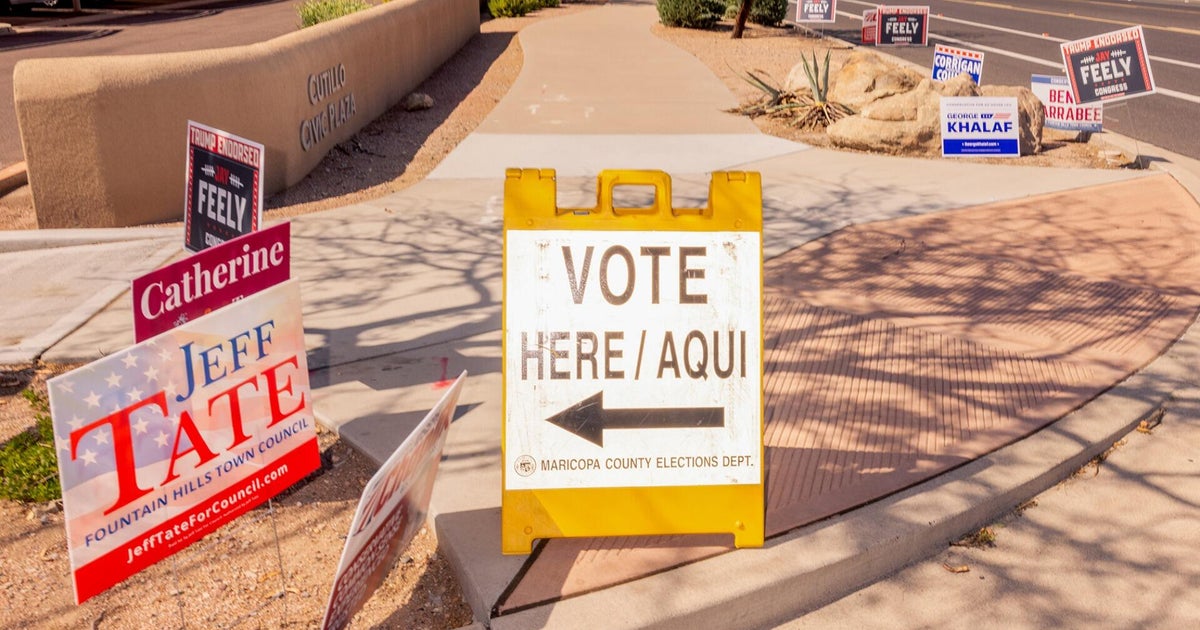
Voters in Arizona went to the polls on Tuesday to participate in primary elections. These races will help decide who will represent their parties in the general election later this year.
Key Facts
The election took place in Arizona on Tuesday.
Voters were selecting candidates for various primary races.
Primary elections determine party nominees for the general election.
The results will influence the November elections in Arizona.
CBS News covered the voting process and results.
Read the Original
Want the full story? Tap a source to open the original
article.