The Western Sahara dispute began more than 50 years ago as Spanish colonial rule ended. Morocco and the Polisario Front both claim the territory, and recent U.S. and Russian opposition to proposals to extend a United Nations peacekeeping mission’s mandate has raised questions about the risk of renewed fighting.
Key Facts
The Western Sahara dispute began with the end of Spanish colonial rule in the region.
Morocco and the Polisario Front both claim Western Sahara.
The United Nations pursued a settlement in the 1990s and deployed a peacekeeping mission to the region.
Last week, Russia and the United States blocked proposals to extend the mission’s mandate.
The article asks whether the failure to extend the mandate could lead to renewed fighting.
The program featured political analyst Samir Bennis, University of Exeter lecturer Irene Fernandez-Molina, and Sahrawi human rights advocate Mahjoub Mleiha.
Read the Original
Want the full story? Tap a source to open the original
article.
Grocery stores in at least eight European countries were hit by a suspected cyberattack on freezer systems. The European Union called the incident a deliberate attempt to disrupt food supplies, and retailers discarded food after refrigeration temperatures rose overnight.
Key Facts
The attack affected grocery stores from Sweden to Portugal on Monday.
At least eight countries were affected, including Belgium, Estonia, Finland, Ireland, Luxembourg and the Netherlands.
The attack targeted supermarket freezer systems.
Rising refrigerator temperatures spoiled or put food at risk of spoiling.
Retailers were forced to discard affected produce.
The incident occurred three weeks after a cyberattack disrupted French grocery stores.
Read the Original
Want the full story? Tap a source to open the original
article.
Two teenage boys have been arrested on suspicion of attempted murder after five teenagers were stabbed at a Halloween party in Chandler’s Ford, Hampshire. Two victims remain in hospital with serious injuries, including a 17-year-old in life-threatening condition, and police are seeking information and video footage from witnesses.
Key Facts
Police were called to Park Road shortly after 22:30 GMT on Saturday.
Police said an unknown group had gained entry to the party.
Five teenagers were stabbed; three have been discharged from hospital.
The two boys in hospital suffered serious injuries, and one 17-year-old is in a life-threatening condition.
A 17-year-old and a 16-year-old, both from Southampton, were arrested and remain in police custody.
Witnesses told the BBC that a fight began after a group entered over a garden fence; the motive for the stabbings was unclear.
Police have asked partygoers and people with CCTV, phone, dashcam, or doorbell footage to contact them.
Local officers plan to visit schools and colleges during the week to offer advice and support.
Read the Original
Want the full story? Tap a source to open the original
article.
Iran offered to open the Strait of Hormuz during negotiations, but made the offer conditional. Iranian officials are seeking the lifting of U.S. sanctions and the release of billions of dollars in frozen Iranian assets, while President Donald Trump has said he is open to authorizing major combat operations against Tehran after the November midterm elections.
Key Facts
Iran made its offer during negotiations.
Iran’s offer to open the Strait of Hormuz included conditions.
Iranian officials are demanding that the U.S. lift sanctions.
Iranian officials are seeking the release of billions of dollars in frozen Iranian assets.
President Donald Trump has said he is open to authorizing major combat operations against Tehran.
Trump’s stated timing for potentially authorizing the operations is after the November midterm elections.
Read the Original
Want the full story? Tap a source to open the original
article.
A South African court found Imanuwela David guilty of stealing $580,000 in cash from Phala Phala, a farm owned by President Cyril Ramaphosa, and of conspiring to break in. Cleaner Froliana Joseph was found guilty of conspiracy, while her brother was acquitted; the case also drew scrutiny of Ramaphosa, who has denied wrongdoing.
Key Facts
The court said the theft took place at Phala Phala farm in Limpopo in February 2020.
David was accused of taking the cash from a sofa on the property.
The court rejected David’s claim that he earned the money through businesses involving diamonds and Bitcoin.
The court found that David was the only convicted person with any of the stolen cash in his bank account.
David spent money on cars, watches and a house, according to the article.
Sentencing proceedings are scheduled for 13 November.
The theft became public in 2022 after former intelligence chief Arthur Fraser accused Ramaphosa of hiding it from police and tax authorities.
South Africa’s Constitutional Court ruled in May that Parliament acted unlawfully when it shelved a panel report on the matter.
Read the Original
Want the full story? Tap a source to open the original
article.
A study found that patients who improved their fitness while waiting for an organ transplant were about 50% less likely to die before receiving one. The article does not provide details about the study or the fitness program.
Key Facts
Researchers reported findings from a study.
The study involved patients waiting for organ transplants.
Some patients improved their fitness while waiting.
Patients who improved their fitness were about 50% less likely to die before receiving an organ.
The measured risk was death before receiving a transplant.
The article does not identify the transplant types or the fitness program.
Read the Original
Want the full story? Tap a source to open the original
article.
Human Rights Watch urged Zambia’s authorities to stop arrests and other measures against opposition members and government critics after the August 2026 election. The group called for access to lawyers and medical care for detainees, the release of people held arbitrarily, and investigations into alleged abuses by security forces.
Key Facts
President Hakainde Hichilema won a second term in Zambia’s disputed August 2026 election.
Human Rights Watch said police and military personnel detained, beat, threatened, and forcibly disappeared people before and after the election.
The group said opposition members, lawyers, journalists, and government critics were among those targeted.
Opposition leader Brian Mundubile was detained on treason allegations after saying the opposition had won.
Police raided Mundubile’s home the day after the August 13 election, and former cabinet member Mutotwe Kafwaya was shot and killed during the operation.
Human Rights Watch called for an independent investigation into Kafwaya’s death.
About a dozen other opposition figures who questioned the election results were arrested, according to the article.
Zambian police said the sudden closure of courts two weeks after the election was an intelligence-led preventive measure; Human Rights Watch said it blocked election challenges.
Read the Original
Want the full story? Tap a source to open the original
article.
A woman displayed a sign reading “I support genocide” at a London protest against the proscription of Palestine Action. The article says the sign alone does not provide grounds for arrest under UK law, and she did not appear to face police action.
Key Facts
The protest took place in London.
The demonstration opposed the proscription of Palestine Action.
A woman held a sign reading “I support genocide.”
The woman did not appear to be arrested.
The article says that holding such a sign, by itself, is not grounds for arrest under UK law.
Read the Original
Want the full story? Tap a source to open the original
article.
President Donald Trump told Axios he is in no rush to decide whether to resume fighting Iran, saying his administration is allowing negotiations to continue while preparing for possible renewed military action. Qatar is circulating a draft plan to restart direct U.S.-Iran talks, as officials in both countries signal that diplomacy remains possible and disagree over the terms.
Key Facts
Trump said the United States would take action one way or another but had no immediate decision on renewed fighting.
Qatari mediators drafted a sequence of confidence-building steps intended to help resume direct negotiations between the United States and Iran.
A diplomat familiar with the talks said Qatar was waiting for feedback from both countries on the draft agreement.
The article describes three approaches being urged to Trump: seek a deal, resume military action, or maintain economic pressure without war or an agreement.
Iranian President Masoud Pezeshkian said Supreme Leader Mojtaba Khamenei had given the government authority to pursue an agreement through diplomacy.
Iranian Foreign Minister Abbas Araghchi said diplomatic exchanges had intensified and said talks would resume if the United States accepted Iran's conditions for reopening the Strait of Hormuz.
Russian President Vladimir Putin discussed diplomatic efforts with Iran's Secretary of the Supreme National Security Council, Mohsen Rezaei; Russia has also offered to take part in a nuclear agreement.
Read the Original
Want the full story? Tap a source to open the original
article.
After Israel’s election produced no clear winner, President Isaac Herzog is preparing to consult parliamentary factions about forming a coalition. Efrat Shapira Rosenberg says rival camps have stated whom they will not join, but have not identified partners, and divisions also run within the opposition bloc backing Gadi Eisenkot.
Key Facts
Israel’s election ended in a deadlock, with no clear winner.
President Isaac Herzog is preparing to consult parliamentary factions on forming a new coalition.
Efrat Shapira Rosenberg expects Herzog to urge rival camps to form a coalition.
Shapira said political camps have named partners they reject but have not said whom they would join.
Shapira said divisions exist within the opposition bloc supporting Gadi Eisenkot.
Shapira is a co-host of the Israeli politics podcast Miflaget Hamakshavot.
Read the Original
Want the full story? Tap a source to open the original
article.
Australia’s High Court is set to hear two challenges to the country’s ban on social media access for children under 16. The Digital Freedom Project argues the ban limits free communication, while Reddit says it raises privacy and political-rights concerns; the government says the policy protects children.
Key Facts
The hearings are scheduled to begin Tuesday and last two days.
The ban took effect on 10 December last year.
Ten platforms, including Facebook, Instagram, TikTok, YouTube and Reddit, must take reasonable steps to prevent under-16s from accessing their services.
Platforms can face fines of up to A$99 million for serious or repeated violations.
No company had been fined since the ban began, according to the article.
The eSafety Commissioner has opened investigations into alleged non-compliance by Facebook, Instagram, Snapchat, TikTok and YouTube.
The Digital Freedom Project filed its constitutional challenge before the ban began; two teen plaintiffs later withdrew from the case.
WhatsApp, Roblox, Discord, YouTube Kids and Google Classroom are not covered by the ban.
Read the Original
Want the full story? Tap a source to open the original
article.
Fighting intensified after a rare ceasefire in Ukraine’s Kherson region ended Sunday. Ukrainian officials reported deadly Russian strikes in Zaporizhzhia and attacks on a medical facility in Kharkiv, while Russia said it had struck Ukrainian energy and port infrastructure. U.S.-led talks between Russia and Ukraine are expected to resume next week, according to U.S. envoy Steve Witkoff.
Key Facts
A ceasefire in the Kherson region enabled a humanitarian mission to reach Russian-occupied Oleshky; it ended Sunday.
Zaporizhzhia authorities said Russian bombing killed 29 people on Tuesday; an acting regional governor had earlier reported at least 26 deaths.
Kharkiv regional officials said a strike on a medical facility wounded 25 people and led about 200 patients to evacuate.
Ukraine warned of ballistic missile threats to Kharkiv, Kyiv, Dnipro and Sumy.
Russia’s Defence Ministry said it had carried out a massive strike on Ukrainian energy facilities and port infrastructure in the Odesa region.
Moscow Mayor Sergei Sobyanin said nearly 500 drones heading toward the capital region had been destroyed.
Britain and France announced military exercises in Poland involving about 2,800 troops from 10 European countries; the force would deploy only after a ceasefire.
U.S. envoy Steve Witkoff said U.S.-led talks between Russia and Ukraine were expected to resume the following week.
Read the Original
Want the full story? Tap a source to open the original
article.
Iran says its seven-step proposal for a ceasefire and renewed talks with the United States can now be implemented within two days, rather than a week. Tehran says the proposal depends on U.S. acceptance of its conditions, while Qatar and Pakistan continue to facilitate indirect talks amid the ongoing conflict.
Key Facts
Iran’s proposal includes reopening the Strait of Hormuz and resuming talks on Iran’s nuclear programme.
Foreign Ministry spokesman Esmaeil Baghaei said Iran had condensed the proposal so it could be implemented within two days.
Iran’s stated conditions include lifting the U.S. naval blockade of its ports, removing sanctions, ending strikes, and agreeing to a regional ceasefire.
Baghaei did not say that Iran had changed its demands or that the United States had accepted the proposal.
Iranian state news agency IRNA reported that Supreme Leader Mojtaba Khamenei gave the government authority to accelerate talks with the United States.
Qatar and Pakistan are helping facilitate indirect negotiations.
President Donald Trump said the war would end “very soon one way or the other” and that Iran would either make a deal or the United States would end it.
Read the Original
Want the full story? Tap a source to open the original
article.
IG Metall, Germany’s largest union, began strikes on Monday in a wage dispute affecting about 3.7 million workers in metal and electrical engineering. The union seeks a 5 percent pay rise and job protections, while employers have offered a delayed one-time payment and a later wage increase; strikes are expected to continue through the week.
Key Facts
The strikes have affected major manufacturers including Audi, Mercedes-Benz and Tata Steel.
IG Metall is seeking higher wages, protections for jobs and production sites, and profit-sharing in strong-performing sectors.
Employers offered a one-time payment equal to 1 percent of pay in July 2027 and a 1.3 percent wage increase from July 2028.
The employers’ offer would let companies facing financial difficulties withhold the one-time payment.
IG Metall rejected the offer, saying it would reduce workers’ pay in real terms, and called for expanded industrial action.
The union plans to publish strike participation figures on Friday.
More than 100,000 workers took part on peak days during the previous bargaining round in 2024.
Thousands rallied in Berlin and more than 30 other German cities on Saturday amid wider European protests over living costs and workplace conditions.
Read the Original
Want the full story? Tap a source to open the original
article.
A hacked emergency alert app sent Ukrainians false warnings of nuclear strikes, chemical attacks and street fighting on Sunday night. Ukraine’s Air Force said the app had been compromised and that there was no radiation threat; the incident caused unease but many people quickly doubted the alerts and shared jokes about them.
Key Facts
The false alerts appeared on Sunday night and included warnings of nuclear strikes, chemical attacks and combat in Kyiv.
Ukraine’s Air Force said the alert app had been compromised and clarified that there was no radiation threat.
The Air Force issued its initial statement within 15 minutes, but more than an hour passed before it sent all-clear messages.
Some alerts were written in Russian, and one included a link to a Telegram channel apparently associated with a hacker group.
Cybersecurity expert Yevhen Baliutov said the incident appeared to be a Russian hack, but the article noted that the informal wording could point to hacktivists not formally directed by either government.
Baliutov said people who clicked the Telegram link could face further disinformation, phishing attempts or data breaches.
Several Ukrainian apps provide air-raid notifications using the same data as the official government-backed app.
Residents described initial fear and stress, but said many people soon questioned the warnings and discussed the incident in group chats.
Read the Original
Want the full story? Tap a source to open the original
article.
Palestinian-led parties won 15% of the vote in Israel’s election, complicating efforts to form a government. Prime Minister Benjamin Netanyahu’s bloc received the most support but had not secured enough Knesset seats to form a coalition, leaving leaders to consider partnering with non-Zionist parties or facing political gridlock.
Key Facts
Palestinian-led parties won 15% of the vote.
Netanyahu’s bloc received the most support among voters.
Netanyahu’s bloc did not have enough Knesset seats to form a coalition at the time described.
Israel’s leadership faced a choice between partnering with non-Zionist parties and accepting political gridlock.
Ofer Cassif is a member of one of the Palestinian-led parties.
Cassif said Israel’s future should involve Jewish-Palestinian partnership rather than exclusion.
Read the Original
Want the full story? Tap a source to open the original
article.
At least 24 people were killed when Russian bombs struck a humanitarian aid centre in Komyshuvakha, in Ukraine’s Zaporizhzhia region, Ukrainian officials said. Rescue crews continued searching the rubble, while officials reported that Russian drone attacks repeatedly interrupted their work.
Key Facts
At least nine aerial bombs, each weighing 3,000 kilograms, hit the village on Monday, according to regional head Mykhailo Semikin.
Ukraine’s state emergencies service said the dead included two rescuers and four police officers.
Five people were injured, and 27 were initially reported missing.
President Volodymyr Zelensky said the first strike hit a school used for humanitarian purposes and a second hit a place where people were sheltering.
Semikin said people remained under the rubble as rescue teams searched the site.
The Russian military had not publicly commented on the attack at the time of the report.
Read the Original
Want the full story? Tap a source to open the original
article.
A Russian strike destroyed a school being used as a humanitarian aid centre in Komyshuvakha, in Ukraine’s Zaporizhia region. Ukrainian President Volodymyr Zelenskyy reported 24 people killed and five injured; regional officials said 27 people were missing.
Key Facts
The aid centre was in a school in the southeastern village of Komyshuvakha.
Zelenskyy said an initial air strike was followed by nine more bombs aimed at the shelter.
Those killed included a police officer and two State Emergency Service rescuers, according to regional Governor Mykhailo Semikin.
Ukrainian emergency services released footage showing rescuers working among the smouldering rubble.
Drone strikes in the eastern Kharkiv region injured 12 people and damaged a refrigeration facility, greenhouses and homes.
Five people were reported injured in Odesa, where a warehouse was targeted and homes were damaged.
Russia’s Ministry of Defence said it shot down 212 Ukrainian drones overnight.
Read the Original
Want the full story? Tap a source to open the original
article.
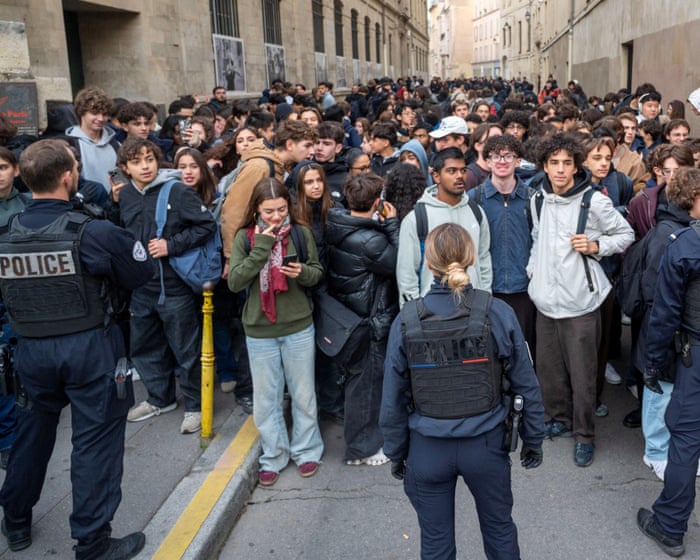
Students blockaded high schools across France on Monday to demand more teachers, school repairs and better conditions, as unions prepared further campus protests and a nationwide strike later in the week. The education minister warned that weeks of missed lessons could jeopardize coursework and final exams for some pupils.
Key Facts
The education ministry reported that 41 high schools were blocked, about 1% of the national total; student unions estimated 150.
Students used wheelie bins to barricade school entrances in Paris and suburbs, Lille, Toulouse and Marseille.
University students’ unions planned more barricades on Tuesday.
Trade unions called for a large-scale strike on Thursday, with rail workers, teachers and private-sector employees expected to join demonstrations.
Students demanded more replacement teachers, repairs to school buildings and better access to higher education.
Education Minister Édouard Geffray said some final-year pupils had missed four or five weeks of classes, counting the holiday, and warned that their school year was at risk.
The government’s proposed measures included limits on some class sizes and a review of the university applications platform.
In Montpellier, police arrested a 53-year-old school nurse at a barricade; the local prefect said she had insulted officers and resisted police.
Read the Original
Want the full story? Tap a source to open the original
article.
France 24 host Jennie Shin interviewed Éric Fassin, a sociologist and professor at Université Paris 8, about France’s student protests. Fassin said the protests reflect broader disputes over socioeconomic policy, racism, democratic participation and the government’s response to dissent; he described that response as part of what he called an “illiberal turn.”
Key Facts
The France 24 segment was issued on November 2, 2026.
Jennie Shin interviewed Éric Fassin, a sociologist and professor at Université Paris 8.
Fassin said elections matter in a democracy but do not mark its endpoint.
Fassin interpreted the student protest movement as challenging socioeconomic policy.
He linked the treatment of working-class and racialized youth to wider limits on dissent.
Fassin argued that racism and democratic participation are central to understanding the unrest.
He challenged claims that the left was responsible for the unrest and discussed the government’s response in relation to the far right.
Read the Original
Want the full story? Tap a source to open the original
article.