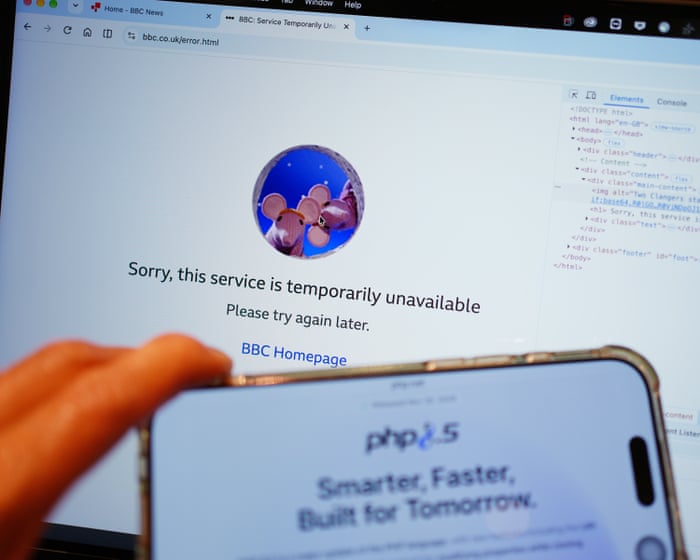
A serious flaw was found in PHP, a computer language used by about 70% of websites globally. This weakness led to millions of attempts by hackers to attack websites, causing many governments and companies to temporarily take their sites offline to fix the problem.
Key Facts
The PHP flaw was discovered recently and affects many websites worldwide.
The US National Security Agency warned the flaw could let attackers control web servers and steal data.
Around 32 UK government services were taken offline as a safety measure.
No major public services have been hacked, but some were temporarily offline while being fixed.
Millions of attack attempts were detected shortly after the flaw became public.
The vulnerability has been called the most serious internet software flaw in five years.
Cybersecurity companies noticed attackers trying to exploit the flaw even before the patch was released.
The flaw can allow hackers to use websites’ resources for attacks or unauthorized activities like crypto mining.
Read the Original
Want the full story? Tap a source to open the original
article.
A serious security problem was found in PHP, a programming language used to build many websites. The issue lets hackers run harmful code on websites, potentially stealing personal information. Fixes were released quickly after details leaked online, but experts warn many sites could still be at risk.
Key Facts
PHP is a programming language used by over 70% of websites, including government and online shops.
Two critical security flaws, nicknamed PHP2Shell, were found using artificial intelligence by two cybersecurity companies.
The flaws allow hackers to run code on websites and access sensitive data like passwords from server memory.
These vulnerabilities have been in PHP code for more than 10 years before being discovered.
Fixes were released urgently and users are strongly advised to update PHP immediately.
Attempted hacking was detected before the security problems were publicly announced.
The affected PHP versions include all releases from 5.4 onward, covering over a decade of PHP software.
The flaws scored 9.2 out of 10 on the severity scale, meaning they are very dangerous.
Read the Original
Want the full story? Tap a source to open the original
article.
The TV show *The Audacity* is a dark comedy that looks at the world of powerful tech CEOs, especially those involved with artificial intelligence (AI). It follows Duncan Park, a wealthy but morally flawed tech founder, and criticizes the tech industry’s culture, lack of diversity, and environmental impact.
Key Facts
*The Audacity* is created by Jonathan Glatzer, a writer who previously worked on the show *Succession*.
The show’s tagline is “Move fast and break people,” a take on Facebook’s old motto “Move fast and break things.”
Duncan Park, the main character, is a half-billionaire tech CEO who wants to become a billionaire and be seen as god-like.
The show uses strong language and satire to highlight the tech world’s arrogance and problems.
It emphasizes the mostly male, white or South Asian makeup of Silicon Valley and how hiring is often based on biased algorithms favoring people from certain universities.
The environmental damage caused by AI data centers is a theme, showing how tech ambitions can harm the planet.
Zach Galifianakis plays Carl Bardolph, a wealthy tech genius who disrupts the industry out of boredom and represents the lack of empathy among tech leaders.
The show critiques real tech figures’ personalities and the industry’s cultural and emotional issues.
Read the Original
Want the full story? Tap a source to open the original
article.
AI technology helped find a big security problem in the internet system that could let hackers cause trouble. The PHP software, used by over 70% of websites, had weak spots that were fixed by updates from its developers.
Key Facts
AI detected severe security flaws in PHP software.
PHP runs more than 70% of websites, including Wikipedia and shopping sites.
These flaws had been in the software for years before being found.
Patches (software fixes) were quickly released to address the problem.
Cyber-security experts called this the most serious internet security issue ever found.
OpenAI said the discovery was one of the most important recent security findings.
Governments and security agencies are working to manage the risk.
The problem shows how AI can help improve internet safety.
Read the Original
Want the full story? Tap a source to open the original
article.
Prior authorization in healthcare means doctors must get insurance approval before some treatments. This process causes delays, extra work for doctors, and harms patients. Using Artificial Intelligence (AI) could help, but only if it correctly understands clinical rules, insurance policies, and laws.
Key Facts
Prior authorization requires insurer approval for certain treatments or medications.
Doctors spend about 13 hours weekly on prior authorization paperwork and handle around 40 requests each week.
95% of doctors report delays in treatment due to prior authorization.
26% of doctors say prior authorization has caused serious harm to a patient.
Healthcare decisions depend on complex, changing rules based on insurer, diagnosis, and state.
Generic AI tools might give wrong approvals or denials because they don’t understand specific rules.
Proper AI must link clinical evidence with exact policies and laws and alert humans when unsure.
Many insurers promised reforms, but only 33% of doctors believe these will help.
Read the Original
Want the full story? Tap a source to open the original
article.
Alpha School is a private school where students learn mainly through artificial intelligence (AI) instead of traditional teachers. Students spend about two hours a day using a special AI software to study subjects like math and science, and adults in the school act as guides rather than traditional teachers.
Key Facts
Alpha School opened its first Chicago campus in 2023 for students from pre-K to eighth grade.
The school uses a proprietary AI software called TimeBack for personalized learning.
TimeBack adjusts lessons based on each student’s skills and revisits topics if needed.
Students spend about two hours a day on academic subjects, less than in typical schools.
Attending Alpha Chicago costs $55,000 per year, more than many private colleges.
The school accepts students based on qualities like motivation, not past grades or test scores.
Adults at Alpha are called “guides,” and many do not have formal teaching degrees.
The AI system is closed and does not use internet information to give answers, focusing on testing students’ knowledge until they learn a lesson fully.
Read the Original
Want the full story? Tap a source to open the original
article.
Hackers took control of 333 Tor exit nodes to capture unencrypted email and redirect SSH connections through servers they controlled. They used stolen passwords and a backdoor called Ebury to install malicious software and intercept sensitive data from Tor users between October 2 and 5.
Key Facts
More than 300 Tor exit nodes were hijacked to capture unencrypted emails and SSH traffic.
The attackers accessed a Tor management server using a reused password.
They installed a Linux backdoor named Ebury, first discovered 12 years ago.
Attackers redirected SSH traffic to 12 servers under their control to steal passwords and commands.
Ports for encrypted email were blocked, while ports allowing unencrypted email were kept open to intercept messages.
The attack lasted from October 2 to October 5.
Tor volunteers found that ignoring SSH warnings exposed users to password theft.
Researchers are still unsure how the attackers gained access to so many servers.
Read the Original
Want the full story? Tap a source to open the original
article.
Artificial intelligence (AI) can help patients living in rural areas find and join clinical trials by quickly screening electronic health records to match patients with suitable trials. This technology could improve access to advanced medical care for many people who now face challenges due to distance and lack of local research centers.
Key Facts
AI developed by Paradigm Health can screen 100,000 patients in 10 minutes, much faster than traditional methods.
About 81.7 million Americans live in rural areas, many with limited access to clinical trials.
In 2022, 86% of rural counties had no active cancer treatment trials, compared to 44% of urban counties.
Nearly 75% of rural cancer trial participants traveled over 50 miles for treatment, versus 16% of urban participants.
Paradigm’s AI system helps flag patients who may qualify for trials before their medical appointments.
Over 85% of the health systems using Paradigm's technology are in community and rural areas.
Expanding clinical trials closer to rural patients could reduce travel and improve treatment options.
Challenges remain, such as the need for investment in digital infrastructure and legal agreements to connect health systems.
Read the Original
Want the full story? Tap a source to open the original
article.
The article explains that while AI and search engines can find lots of data quickly, the real challenge is deciding which information is important and timely for businesses. Many companies struggle to get useful results from AI because the systems do not have enough context to know what data really matters or when to alert people.
Key Facts
Data is widely available, but finding the right, relevant data is difficult.
AI can summarize and compare data but cannot automatically know what is important for each business.
A McKinsey report shows that almost two-thirds of companies have tried AI agents, but fewer than 10% get clear benefits.
80% of companies say data limitations block AI success.
MIT research suggests 95% of organizations see no return from generative AI projects, meaning they fail to add value.
Good AI systems need to deliver relevant info at the right time for decisions to be useful.
The article warns against too many alerts and dashboards that create noise instead of useful intelligence.
The future success of AI depends on understanding what data matters, how current it is, and who needs to see it, not just adding more AI tools.
Read the Original
Want the full story? Tap a source to open the original
article.
The article discusses how using artificial intelligence (AI) in workplaces can sometimes reduce workers’ understanding and control over tasks, even if AI completes tasks faster. It argues that companies should focus on keeping people informed and in charge when adopting AI tools, especially in jobs involving teamwork with robots.
Key Facts
AI tools can finish tasks quickly but may make it harder for workers to review and understand the work.
A 2025 study found that workers who trusted generative AI more showed less critical thinking, though this doesn’t prove AI causes skill loss.
Making it easy to accept AI results without understanding them reduces meaningful human oversight.
The author experienced slower and more error-prone work after relying too much on AI in a robotic software project.
In a game studio, over-accepting AI-generated changes led to dependency on AI and less human control over the code.
Robots working near people need to be designed with human behavior and safety in mind, including clear signals about their movements.
Experts emphasize that human-robot systems should provide intuitive communication and support worker awareness.
The article promotes “behavioral ergonomics,” the idea of designing machines around human perceptions and needs.
Read the Original
Want the full story? Tap a source to open the original
article.
Security flaws were found in PHP, a programming language used by millions of websites worldwide. Although these flaws are hard to exploit, experts worry they could be used in cyberattacks, so a fix has been released and website owners are urged to update quickly.
Key Facts
PHP is a popular programming language used on many websites around the world.
Security weaknesses in PHP were discovered but are difficult for humans to exploit.
Artificial intelligence (AI) helps researchers find and fix these vulnerabilities faster.
The PHP foundation released a patch to fix the security issues.
News about the flaws was leaked before all sites could be updated, raising risks.
Millions of hacking attempts aimed at these weaknesses have already occurred.
Older versions of PHP need to be upgraded before the security patch will work.
Experts warn website owners to update PHP immediately to prevent possible cyberattacks.
Read the Original
Want the full story? Tap a source to open the original
article.
The UK government has used artificial intelligence (AI) to find 500 new weaknesses in its computer systems. These security problems could affect many websites, and experts worldwide are working to fix a issue linked to a major cyber-security flaw.
Key Facts
The UK’s AI Minister Kanishka Narayan announced that AI helped discover 500 new vulnerabilities in government systems.
These kinds of weaknesses can allow hackers to access or damage websites and data.
The discovery was made before a big cyber-security flaw was made public globally.
Many organizations around the world are trying to fix this serious security problem.
The news was shared during an interview with the BBC.
Cyber-security flaws like this can affect millions of websites and online services.
AI is being used increasingly to find and fix security issues in computer systems.
Read the Original
Want the full story? Tap a source to open the original
article.
Hackers are using new methods to infect iPhones with spyware without users clicking any links. They exploit online ads and expired website domains to steal login information and cryptocurrency from victims.
Key Facts
Researchers found two hacking campaigns using online ads and expired domains to deliver spyware to iPhones.
One attack infected an iPhone user after they saw a soccer ad on Instagram, stealing passwords and crypto wallet data.
Another campaign affected nearly 8,000 websites by buying old domains those websites still used, redirecting visitors to spyware.
These attacks happen automatically as people browse, without needing to click on anything.
The spyware checks the iPhone’s software version before attacking to ensure compatibility.
Cybercriminals target users by narrowing down victims based on interests and device types.
Experts say mobile spyware threats are growing rapidly and users should keep their phone software updated to stay safe.
The hacker groups are suspected to have ties to China or want to appear that way.
Read the Original
Want the full story? Tap a source to open the original
article.
BioWare, the Canadian video game company known for popular games like Mass Effect and Dragon Age, has closed after 31 years. Its recent games did not sell well, and parent company Electronic Arts (EA) decided to shut the studio while cutting 400 jobs.
Key Facts
BioWare was founded in 1995 and made role-playing games with deep stories.
The studio became famous for hits like Baldur's Gate, Mass Effect, and Dragon Age.
Mass Effect is known for its story and representation, including same-sex relationships.
BioWare moved to multiplayer games with Anthem in 2019, which was not well received.
Their latest game, Dragon Age: The Veilguard (2024), received mixed reviews and low sales.
EA was recently bought by a Saudi-led group in a $55 billion deal and took on $20 billion in debt.
EA is focusing on fewer big projects and continuing work on other series like Iron Man, Star Wars Jedi, EA Sports games, Skate, and The Sims.
The closure is part of EA’s plan to streamline its business and cut jobs.
Read the Original
Want the full story? Tap a source to open the original
article.
The documentary "You Can See Everything" focuses on Elizabeth Holmes, the founder of the failed blood-testing company Theranos, and her partner Billy Evans. The film shows Evans playing a surprising and important role behind the scenes, particularly in how he interacts with Holmes and the film's production.
Key Facts
Elizabeth Holmes founded Theranos and was convicted of defrauding investors.
Holmes is currently serving a prison sentence.
The documentary features Holmes and her partner Billy Evans, who is less known to the public.
Billy Evans and Holmes were engaged in 2018 and have two children, though they are not legally married.
Evans asks for a share of the documentary’s profits, which is unusual for a documentary subject.
Evans demands privacy in interviews but appears fully nude in parts of the film.
The film shows Evans taking more control over Holmes two years into filming.
"You Can See Everything" is co-directed by Nathan Fielder, known for blending comedy and reality in his shows.
Read the Original
Want the full story? Tap a source to open the original
article.
Nintendo Switch Sports Resort is a new video game that brings back some sports from the previous game and adds new ones like boxing, table tennis, and skateboarding. The game is easy to learn, fun for families, and has a detailed, colorful resort setting that adds to the experience.
Key Facts
Switch Sports Resort includes tennis, bowling, and volleyball from the original Switch Sports.
It adds seven new sports: boxing, table tennis, archery, thumb wrestling, skateboarding, jetski, and flying a small plane.
All sports are designed to be simple to pick up quickly and have a playful, lighthearted style.
Some sports use motion controls, like tilting and moving the controller, to imitate real movements.
The game world is a vibrant resort with stadiums, beaches, and small characters doing activities.
Players can unlock outfits and play different versions of each sport for more variety.
It works well for playing with family or friends and keeps children interested over time.
The game encourages physical activity and social play by getting players moving rather than sitting still.
Read the Original
Want the full story? Tap a source to open the original
article.
The FBI warned organizations to update their PHP software because two serious security bugs were found that let hackers control servers remotely. PHP is a popular programming language used by many websites, so these flaws could put lots of sensitive data and networks at risk.
Key Facts
Two critical vulnerabilities called CVE-2026-109618 and CVE-2026-109619 affect PHP, a widely used web programming language.
The FBI advises immediate updates to PHP or taking systems offline if updates are not possible.
These flaws allow hackers to run malicious code on servers remotely, risking data and network security.
PHP released security updates on October 21 to fix these problems.
AI tools from companies like Wiz and OpenAI helped discover and test fixes for these vulnerabilities.
Organizations should check which of their systems use PHP and focus on those connected to the internet.
The NSA also warned that these vulnerabilities could give attackers access to files and databases.
If a system is compromised, affected servers should be isolated, logs preserved, and incidents reported to the FBI.
Read the Original
Want the full story? Tap a source to open the original
article.
AI companies in the UK warn ministers they have about 12 months to prevent public protests against datacentres, which are large facilities that store and run AI computers. They want the government to create a plan that helps local communities benefit from hosting these datacentres to reduce opposition and support AI development.
Key Facts
AI firms including Nvidia, Microsoft, and Cisco say protests like those in the US could threaten datacentre projects in the UK.
Datacentres use a lot of energy, raising public concerns especially after dry summers and high energy bills.
Microsoft plans to invest $30 billion in UK AI infrastructure and is building datacentres in London and Newport.
Anti-datacentre activism is growing due to fears about AI safety and environmental impact.
The Sovereign AI Leadership (SAIL) taskforce wants a government agreement to share benefits with communities hosting datacentres.
Proposed benefits include allowing local councils to keep more tax revenue from datacentre businesses.
Groups opposing datacentres say people may reject deals with big tech companies if they feel their interests are ignored.
The taskforce aims for practical steps to help the UK’s AI economy grow while gaining public support.
Read the Original
Want the full story? Tap a source to open the original
article.
The UK government is working to fix security weaknesses found in PHP, a software used by many websites around the world. After the problems were revealed, companies including Amazon and some governments worked fast to protect their systems from hackers who might try to take advantage of these flaws.
Key Facts
PHP is a programming language used by many websites globally.
Security flaws in PHP have been present for at least 10 years.
The UK, EU, Australian, and US cybersecurity agencies warned organizations to fix the vulnerabilities quickly.
Amazon experienced multiple hacking attempts targeting these PHP flaws even before the official warning was public.
Some organizations took websites offline as a precaution if they could not immediately fix the issue.
The vulnerabilities could allow attackers to steal data, disrupt services, or access deeper parts of computer networks.
The PHP flaw details were leaked on social media before the planned fix was released.
Experts say AI helps hackers find and attack vulnerabilities faster than before, increasing cybersecurity risks.
Read the Original
Want the full story? Tap a source to open the original
article.
A programming language called PHP, used by about 70% of the world’s websites, was found to have serious security flaws. Artificial intelligence (AI) helped discover these flaws, leading many websites to go offline while they update their systems to prevent hacking.
Key Facts
PHP is a programming language created in the early 1990s and supports many websites globally.
Security firms used AI tools from companies like OpenAI and Google to find hidden security weaknesses in PHP.
The flaws could allow hackers to break into websites, including online stores and government services.
A security update (patch) was released and experts urged organizations to update their PHP software immediately.
Many websites, including official and popular sites, went offline temporarily to protect themselves.
China's industry ministry advised organizations to inspect and upgrade their systems quickly and change passwords and keys.
No active hacking attacks are confirmed yet, but the risk is serious as AI can find and exploit bugs faster than before.
Smaller websites and users may not know about the flaws or update in time, leaving them vulnerable.
Read the Original
Want the full story? Tap a source to open the original
article.