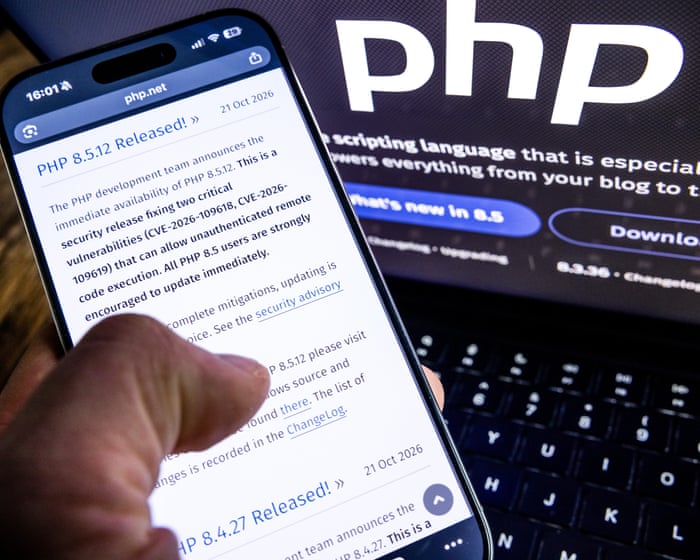
A programming language called PHP, used by about 70% of the world’s websites, was found to have serious security flaws. Artificial intelligence (AI) helped discover these flaws, leading many websites to go offline while they update their systems to prevent hacking.
Key Facts
PHP is a programming language created in the early 1990s and supports many websites globally.
Security firms used AI tools from companies like OpenAI and Google to find hidden security weaknesses in PHP.
The flaws could allow hackers to break into websites, including online stores and government services.
A security update (patch) was released and experts urged organizations to update their PHP software immediately.
Many websites, including official and popular sites, went offline temporarily to protect themselves.
China's industry ministry advised organizations to inspect and upgrade their systems quickly and change passwords and keys.
No active hacking attacks are confirmed yet, but the risk is serious as AI can find and exploit bugs faster than before.
Smaller websites and users may not know about the flaws or update in time, leaving them vulnerable.
Read the Original
Want the full story? Tap a source to open the original
article.
A serious security problem was found in PHP, a programming language used by many websites worldwide. This flaw allows hackers to take control of websites and steal data. Cyber-security groups and governments are urging website owners to quickly update their systems or temporarily shut them down to stay safe.
Key Facts
PHP is a coding language used since the 2000s to build many websites, including Wikipedia and WordPress.
The flaw lets attackers control servers without needing a password and could expose sensitive information.
Artificial intelligence helped discover these security weaknesses, which are described as very severe.
Many websites and government portals worldwide took parts of their services offline to protect against attacks.
The US National Security Agency and other international cyber groups advised urgent updates or taking systems offline.
Developers released patches to fix the flaws and strongly recommended everyone put these updates in place immediately.
Smaller organizations with less computer security could be at higher risk from this flaw.
Experts expect more hacking attempts related to this weakness since details are now public.
Read the Original
Want the full story? Tap a source to open the original
article.
Researchers at OpenAI found a software bug that could affect about 70% of websites worldwide. This bug poses a risk to many online systems, prompting further investigation and caution.
Key Facts
The bug was discovered by researchers working at OpenAI.
It could impact up to 70% of websites on the internet.
The bug threatens online security and stability.
Details about the bug were first reported by Robert McMillan for the Wall Street Journal.
The issue has gained attention from major news outlets like CBS News.
Experts are analyzing the bug to understand its full impact.
The bug relates to common technology that many websites use.
Read the Original
Want the full story? Tap a source to open the original
article.
A major security problem was found in PHP, a programming language used by nearly 70% of websites worldwide. This flaw caused many websites to shut down temporarily while they fixed the issue to stop hackers from exploiting it to attack online servers.
Key Facts
PHP is used by popular websites and systems like WordPress, Wikipedia, Slack, and Facebook’s older platforms.
The vulnerability was made public on a Tuesday and led to warnings from U.S. and UK national security agencies.
The PHP organization quickly released a patch to fix the flaw, but many websites needed time to update.
The flaw could allow attackers to access important files or databases on affected servers.
Cybersecurity experts warned that hackers, including criminals and state-sponsored groups, might try to exploit the flaw.
Artificial intelligence tools helped find the flaw and could also speed up hackers’ attacks.
Some websites took themselves offline as a precaution while applying fixes.
Amazon's security team detected an attempt to attack a fake system set up to trap hackers shortly after the flaw was announced.
Read the Original
Want the full story? Tap a source to open the original
article.
Security experts have found two serious weaknesses, called PHP2Shell, in the PHP programming language used by many websites worldwide. Governments in Europe and Asia temporarily shut down some websites to fix these flaws after the U.S. National Security Agency warned about the risk of attacks.
Key Facts
PHP is a programming language that many websites use to run their systems.
Two major security flaws in PHP were found with help from artificial intelligence (AI).
The U.S. NSA advised websites to go offline if they could not quickly update to fix the problems.
Countries like Germany, France, Belgium, the Netherlands, Finland, the Czech Republic, and Japan took some government websites offline to protect against attacks.
The flaws allow hackers to run harmful commands on servers without a password or account.
The PHP Foundation said these are some of the most serious bugs in the language’s history.
The weaknesses have been in the code for decades but needed AI help to fully identify the risks.
The PHP Foundation warns that AI will make it easier to find security problems, so tech companies should work together to prevent big internet disruptions.
Read the Original
Want the full story? Tap a source to open the original
article.
Tesla reported better-than-expected earnings for the third quarter but with slightly lower revenue than the previous quarter. CEO Elon Musk suggested a possible merger between Tesla and SpaceX, though no final agreement has been made and shareholders must approve the deal.
Key Facts
Tesla’s third-quarter revenue was $28.05 billion, slightly below last quarter’s $28.23 billion but above analyst predictions.
Tesla’s earnings per share were $0.48, beating the expected $0.43.
Elon Musk mentioned a potential merger between Tesla and SpaceX, with special committees exploring the idea.
The merger would need approval from at least 50% of Tesla shareholders.
Musk recently showed off the Tesla Roadster 2, an electric sports car with SpaceX technology capable of flight maneuvers.
Tesla is shifting focus from just car sales to robotics, self-driving technology, and artificial intelligence.
Production and scaling challenges remain with Tesla’s Optimus robot and Robotaxi self-driving taxi service.
Musk has made ambitious predictions for robot and autonomous vehicle usage, but meeting these targets has been slow.
Read the Original
Want the full story? Tap a source to open the original
article.
Microsoft has introduced a new way for Xbox users to pay for game streaming by buying blocks of streaming time called Cloud Playtime. Users can purchase hours to stream games they already own, with prices ranging from 24 to 40 cents per hour, but they must have bought the game first.
Key Facts
Microsoft now lets people buy streaming time for games they own through Xbox Cloud Playtime.
Pricing options are 10 hours for $4, 25 hours for $8, or 50 hours for $12.
Streaming time does not expire until it is used.
Users must already own the games to use the streaming time, except for some free-to-play games.
This pricing model is different from Xbox Game Pass, which offers a subscription with access to many games for a monthly fee.
Microsoft offers a free ad-supported streaming option with lower quality and more wait times.
Microsoft’s model follows earlier attempts by Google Stadia and Sony PlayStation Now to sell streaming separately or as a subscription.
This service targets gamers who want to stream games without a full subscription or for shorter sessions.
Read the Original
Want the full story? Tap a source to open the original
article.
Large companies spend about 28% of their software budgets on upgrades and changes that their IT leaders think will make things worse. Most IT leaders feel they have little power in these decisions and worry that unwanted upgrades take time and money away from other important projects like security and innovation.
Key Facts
The survey included 2,018 chief information officers and senior IT decision-makers at companies with at least 10,000 employees and $1 billion in revenue.
About half of the respondents were from the United States and half from the United Kingdom.
95% said their organization paid for software upgrades they believed would reduce performance or value in the past three years.
53% reported paying for such unwanted upgrades more than once.
76% said their companies have little leverage in negotiations, and 80% said switching vendors would cause major disruption.
Upgrades often use top technical workers’ time for many months each year, limiting work on other important projects.
91% of respondents support laws giving companies protections similar to those for long-term renters.
Experts suggest negotiating exit terms and costs upfront when buying software to better control budgets.
Read the Original
Want the full story? Tap a source to open the original
article.
Security researchers have found a bug in PHP, a programming language used by about 70% of websites. This bug could make many websites vulnerable to cyberattacks.
Key Facts
PHP is a programming language used by roughly 70% of all websites.
A security bug has been discovered in PHP that puts these websites at risk.
The bug was found with the help of OpenAI, an artificial intelligence company.
Cybersecurity experts, including Juan Andrés Guerrero-Saade from SentinelOne, are studying the problem.
Vulnerabilities in PHP can lead to websites being attacked or hacked.
This discovery highlights the growing role of AI in finding and fixing computer security issues.
Read the Original
Want the full story? Tap a source to open the original
article.
Two serious security problems were found in PHP, a programming language used by almost 70% of websites. AI tools, including an OpenAI model, helped discover these flaws, which could let hackers take control of websites without needing passwords.
Key Facts
PHP is an open-source programming language that runs nearly 70% of all websites.
Two critical vulnerabilities were found in PHP that hackers can exploit easily.
The flaws could allow attackers to control web servers without passwords.
AI, including an OpenAI model, helped find and fix one of these vulnerabilities.
Governments from the U.S. to Japan advised website owners to patch their systems quickly.
Some websites, like parts of Wikipedia and 4chan, temporarily shut down to fix the problems.
These PHP flaws have existed for many years but were very hard to exploit until now.
The discovery shows both the benefits and risks of AI in cybersecurity.
Read the Original
Want the full story? Tap a source to open the original
article.
A New Mexico judge ordered Meta to pay $25 billion after a jury found the company misled users in a case linked to the Cambridge Analytica data scandal. This fine follows an $18 billion settlement Meta made with 48 other states over similar claims of user deception and data misuse.
Key Facts
Meta was fined $25 billion by a New Mexico court for deceiving users related to the Cambridge Analytica scandal.
The ruling comes after Meta settled for $18 billion with 48 other states over similar accusations.
Cambridge Analytica improperly collected data from millions of Facebook users via a personality quiz app installed by about 270,000 people.
The app collected data not only from users but also from their millions of friends, reaching roughly 87 million users worldwide.
Facebook learned of the data misuse in 2015 but only disclosed it publicly in 2018 after a whistleblower revealed the issue.
New Mexico’s Attorney General called the decision historic, emphasizing the importance of holding companies accountable for misleading users about their data.
Meta claims the fine is unfair and plans to appeal the decision, calling it a "tax on speech."
Meta has faced multiple other penalties for related issues, including harms to children and unsafe platform practices.
Read the Original
Want the full story? Tap a source to open the original
article.
A judge in New Mexico ordered Meta to pay $25 billion for misleading Facebook users about privacy violations. The jury found Meta responsible for more than 43 million violations of consumer protection laws, making this the largest fine ever against the company.
Key Facts
A New Mexico judge ordered Meta to pay $25 billion in fines for privacy violations related to Facebook.
A jury decided Meta misled users about who could access their personal information and how harmful content was handled.
The case found Meta broke consumer protection laws over 43 million times.
The money awarded will go into New Mexico’s education system fund.
Meta plans to appeal the ruling and expects to win.
The lawsuit partly stems from the Cambridge Analytica scandal, where data from 87 million Facebook users was used without consent.
This is the second big legal loss for Meta in New Mexico in six months, with previous fines totaling nearly $1 billion for failing to protect young users.
Meta's chief legal officer criticized the ruling, saying it makes it very hard to do business in New Mexico.
Read the Original
Want the full story? Tap a source to open the original
article.
AI technology is advancing quickly, and tech leaders are discussing how to manage its risks. They want to make sure AI is used safely while competing with China in technology development.
Key Facts
Artificial intelligence (AI) is developing fast.
Tech leaders are concerned about potential dangers of AI.
Strategies are being planned to control and monitor AI risks.
There is a global competition, especially with China, to lead AI advancements.
The discussion includes balancing innovation with safety.
The news segment features interviews with well-known technology experts.
Managing AI is seen as important for future technology policies.
Read the Original
Want the full story? Tap a source to open the original
article.
A court ordered Meta to pay New Mexico $25 billion because a jury decided Meta lied to users about their privacy on Facebook. This is the largest fine ever against the company that owns Facebook.
Key Facts
A judge ruled that Meta must pay a $25 billion fine to New Mexico.
The fine is because Meta was found guilty of misleading users about privacy on Facebook.
This is the biggest fine Meta has ever received.
The New Mexico Attorney General said the ruling sends a strong message to tech companies.
The case highlights state efforts to hold big tech firms accountable for user privacy.
Meta has introduced new rules for kids on its platforms, including age checks, but some critics say those rules are not enough.
Read the Original
Want the full story? Tap a source to open the original
article.
Apple revealed a new brand design for Apple Music called Liquid Glass. The design uses real physical elements, like mineral oil, to create unique visuals, showing human effort behind the branding in a time when AI-generated images are common.
Key Facts
Apple introduced a new Apple Music brand identity named Liquid Glass.
The design uses physical materials like mineral oil with sound waves to create visuals.
Apple worked with a design agency and a music producer for the project.
The process was filmed in a behind-the-scenes video showing real people and physical work.
The new design aims to emphasize human creativity and craftsmanship in a world full of AI-made images.
The article’s author values seeing actual human effort rather than computer-generated results.
Generative AI images are becoming very common and can make people doubt what is real or hand-made.
The article encourages showing the process behind creative work to highlight genuine human involvement.
Read the Original
Want the full story? Tap a source to open the original
article.
A judge in New Mexico ordered Meta to pay $25 billion in penalties after a jury found that the company misled Facebook users about their data privacy. This ruling comes years after the Cambridge Analytica scandal, where a political data firm took information from millions of Facebook users.
Key Facts
Meta was ordered to pay $25 billion in penalties by a New Mexico judge.
The decision followed a jury finding that Meta misled users about their privacy.
The case is linked to the Cambridge Analytica scandal from about ten years ago.
Cambridge Analytica took data from over 50 million Facebook users to create political ads in 2016.
New Mexico was the only state in a nationwide legal battle that did not settle with Meta.
Judge Francis Mathew set the penalty amount.
Meta has said it plans to appeal the decision.
This is an ongoing legal issue and more updates are expected.
Read the Original
Want the full story? Tap a source to open the original
article.
BioWare, a video game studio known for hit series like Mass Effect and Dragon Age, is closing after more than 30 years. Its parent company, Electronic Arts (EA), announced job cuts and ended early work on the next Mass Effect game.
Key Facts
BioWare was founded in 1995 in Edmonton, Canada.
EA bought BioWare in 2007.
BioWare created popular games including Mass Effect, Dragon Age, Neverwinter Nights, and Star Wars: Knights of the Old Republic.
EA recently laid off 400 employees, including 50 at BioWare.
Early development on the next Mass Effect game has been stopped.
EA became a private company last year after a $55 billion deal involving Silver Lake and Saudi Arabia’s Public Investment Fund.
BioWare faced struggles with game reception and key staff departures over the years.
The studio thanked fans in a final social media message before closing.
Read the Original
Want the full story? Tap a source to open the original
article.
Two serious security problems in PHP, a common internet technology, could let hackers take control of websites or access private data. The problems affect many versions of PHP, and website owners must update their PHP software quickly to fix the issue.
Key Facts
PHP is a technology used on about 70% of websites worldwide.
Two security flaws, called CVE-2026-109618 and CVE-2026-109619 or “PHP2Shell,” have a high severity rating of 9.2 out of 10.
These flaws allow hackers to run harmful commands on servers or reach sensitive information.
The U.S. National Security Agency recommends updating PHP immediately or taking offline vulnerable systems.
PHP versions from 5.4 up to 8.5.11 are affected; fixes are in PHP 8.5.12 and other recent versions.
AI tools helped researchers find and fix these vulnerabilities.
Popular web platforms like WordPress, Drupal, Joomla, and others are impacted.
Website owners must update PHP to fully protect their systems since the flaws are in PHP itself, not just in website code.
Read the Original
Want the full story? Tap a source to open the original
article.
OpenAI's latest AI models will soon be available through Google Cloud services and Antigravity, a coding tool powered by Google. This partnership adds OpenAI’s GPT 6 and 6.1 models to Google’s "Model Garden," giving businesses and developers more options for AI use.
Key Facts
OpenAI’s newest GPT models (versions 6 and 6.1) will launch on Google Cloud.
These models will be accessible in Google’s Model Garden alongside Google’s own Gemini, Anthropic’s Claude, and other open models.
Google Cloud customers can run OpenAI models fully on Google’s infrastructure, with payment handled via Google Cloud Marketplace.
OpenAI models are available in private preview now for select enterprise clients, with early access requests open.
The GPT models will also appear in Google’s Antigravity coding tool, which currently supports Google’s Gemini and Anthropic’s Claude AI.
Google’s system can switch between different AI models based on speed, performance, and cost efficiency.
Microsoft remains OpenAI’s main cloud partner, but this deal extends OpenAI model availability to Google Cloud users.
These additions offer more AI choices for both large businesses and individual developers using Google’s AI services.
Read the Original
Want the full story? Tap a source to open the original
article.